


 Francais
 Deutsch
 Italiano
Refine Your Search
+"United States USA" +1917 stock footage and images
- Showing 25 to 30 of 236 results more
more Hide
Hide
World War 1 training demonstrations by naval reservists at the Great Lakes training station in Illinois,United States.
Naval reservists at the Naval Station Great Lakes training center in Illinois, United States, circa 1917. The World War 1 U.S. Navy reservists standing on the parade ground and demonstrating their activities. The reservists demonstrating stretcher drill. People gather on the ground and watch the sailor demonstrations. The reservists demonstrate a machine gun. The soldiers firing the machine gun. Smoke rises from the firing of the machine gun.
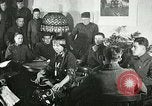
U.S. soldiers watching the performance of Tsianina Redfeather (a.k.a. Tsianina Blackstone), during World War I .
Tsianina Redfeather (also known as Tsianina Blackstone), a famous Creek-Cherokee Native American Indian mezzo-soprano, plays the Hawaiian guitar and sings for U.S. soldiers in YMCA- sponsored entertainment for the troops in a canteen, 1917-1918, during World War 1. (Historic note: While sailing to Europe in 1918 as a member of the American Expeditionary Forces, her vessel, the HMS Carmania, was struck by a torpedo. She continued the journey, entertained thousands of troops, and received a commendation for her service. Her interest in entertaining the troops, according to her autobiography, rested in the fact that so many American Indian soldiers were fighting overseas-- around 17,000. After her return to the U.S. her career continued to escalate. This clip perhaps represents the only surviving footage of this truly remarkable individual.)
Chemists experiment with chlorine gas for influenza immunizations at Chemical Warfare Service in the United States.
Experiments with chlorine gas for influenza immunizations in United States. A World War I tank sprays gas in a field. View of American soldiers during 1917 to 1918 period of World War I, in a trench, wearing gas masks, and firing rifles at enemy positions. Post war tests on use of Chlorine gas to control the flu (emerging from 1918 Spanish Flu epidemic), inspired by low rate of influenza among United States soldiers exposed to chlorine gas during the war. Man enters a chlorine chamber at the Chemical Warfare Service. A chart on the wall showing results on symptoms after exposure in chlorine chamber. A woman in 1920s hat carrying a tissue is treated with chlorine gas. A testing apparatus on a table. Group of patients sit together in a chlorine chamber being exposed to the chlorine gas. A business man in a suit receives a portable chlorine gas treatment in his office as he is too busy to visit the chlorine chamber.
World War 2 film promoting public investment in War Bonds and stamps to aid the war effort and temper inflation
World War 2 era film that also includes some World War 1 scenes. Show girls or chorus girls in follies-like show, costumed as U.S. silver dollars and marching to tune and lyrics alluding to dramatic increase of currency in circulation, over the years. Animation with stacks of coins shows increase in national income from $46 billion,in 1933, to $71 billion, in 1939, and $142 billion in 1943. Back to the "follies dollars," a boy asks why, and then scenes of the Japanese attack on Pearl Harbor,are shown, with U.S. battleships being sunk. Wartime arms plants are shown. An M2A3 Light Tank rolls off a production line. Ships being constructed in a shipyard. B-24 Liberator bombers being built in a factory. Artillery shells being produced. Defense workers receiving their pay. The "follies dollars" group themselves to illustrate the fractions of income devoted to taxes and savings. But other spending is curtailed by wartime shortages. A woman talking with clerk in a drug store. U.S. Army troops crossing a pontoon bridge in open trucks, towing 75mm M1A1 howitzers. Infantry on the march. Animation showing industrial production devoted to war materiel and lots of dollars chasing few civilian goods. A grocery clerk offers to sell a woman customer butter for more than the established price, and she agrees. The "follies" performers then introduce the idea of an "inflationary dollar," and some history of past U.S. inflations. Animated examples of price inflation are shown. Glimpses of World War I scenes are seen, circa 1917 -1918, including: a 12-inch railway gun firing; a huge explosion from shell bursting near the camera; various scenes of United States infantry soldiers and French soldiers in battle action, running to bomb craters for cover and emerging from trenches to go up "over the top" into no-mans land during combat. Meanwhile, singing narration refers to the home front inflation due to competition for limited civilian goods. Map shows Europe and singing narration cites rising prices for food in occupied France and other countries suffering ravages of World War II. Montage of scenes showing needy civilians obtaining food in those countries. Animation shows increases, by 1944, in cost of U.S. civilian goods since the Pearl Harbor attack. "Follies" character called "Double-duty dollar," appears explaining he serves the war and curtails inflation on the home front by being saved through investments in War Bonds and stamps.
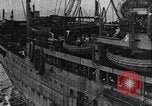
Soldiers march on streets holding rifles during World War I and veterans return to farming and dairying in United States.
A United States troop transport ship at sea during the first World War. U.S. Army troops (aka dough boys) aboard the ship. U.S. Army soldiers march in formation in a large city square area in Europe (likely France) holding rifles during World War 1. United States troop ships being loaded with American soldiers for World War I, and scenes of U.S. troops in WWI marching in the streets of a European city. Scenes from earlier during combat in the war. World War I allied soldiers on battle front in France. Soldiers run to a bomb crater area for shelter when crossing no man's land. Soldiers fire artillery. Artillery shells explode. Allied soldiers running across a battlefield as tanks run beside them toward the German enemy. People wave U.S. flags as First World War war ends with Armistice. Large crowd gathers in New York celebrating WWI armistice. Newspaper held high by a man with headline "Germany Surrenders". Views in the United States of hard times in American towns after World War I ended and war industries were no longer providing money. View of forests. Girl draws water from a well. Man and a boy operate a grindstone sharpening a saw. Farmers plowing fields with horse drawn plows during great depression era. People do agricultural works at fields. White farmer tilling a field. African American farmers working in fields and harvesting hay with help of a horse. African American farmers at cotton office. Cattle in field. Man and a woman milk cows with hands. Man pours milk in vessels. Milk processing before bottling including pouring milk through a cooling device. Men on tractor at fields. A board reads 'For the common defense'. Views of a factory. A man operates a switch on a switchboard for generating electricity. Views of a power generation plant. Narrator describes how America will prevent a slide into hard financial times again after World War 2 ends. From a 1942 production with footage from 1917 through 1942.
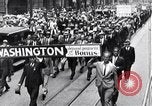
The 1930s Great Depression and the administrations of Presidents Herbert Hoover and Franklin Roosevelt, in the United States
Hard times in the Great Depression led to formation of The Bonus Army. American veterans of World War 1 march on streets of Washington DC, carrying a large poster demanding immediate cash redemption their "bonus" service certificates awarded by Congress in 1924 (but not lawfully payable until 1945). Army Chief of Staff, General Douglas MacArthur, ordered by President Hoover, to clear the Bonus Army encampments, is seen standing in a street surrounded by several U.S. Army troops. People watch from sidewalks as a contingent of U.S. Army cavalry rides down the street. U.S. Army M-1917 tanks roll down Pennsylvania Avenue in July 1932. Bonus marchers and others watch from Lafayette Park in background. Scene shifts to the 1932 Democratic Party Convention in Chicago Stadium, Chicago, where delegates cheer after nominating Franklin D. Roosevelt as their Presidential candidate. Roosevelt seen waving from the podium. Migrant farm workers seen at temporary, dilapidated dwellings in close quarters, and sitting at a campfire, some with sad and desperate faces. Migrant farm workers' cars on the road, piled high with family belongings during westward migration. Migrants riding atop an open railroad freight car. Two men share a copy of the "Epic News" newspaper (published by supporters of Upton Sinclair and the End Poverty Movement in Los Angeles and central California). Narrator describes programs of the Works Progress Administration (WPA) and the Civilian Conservation Corps (CCC). Construction workers ignite demolition charges during construction of Boulder Dam (aka Hoover Dam and officially so-named in 1947). Glimpse of President Roosevelt at the site in an open car, for its dedication on September 30, 1935. Construction workers engaged in building the dam. Another shot of President Roosevelt in his open car. Towers being erected to carry electric power from the dam's hydroelectric generators. President Franklin D. Roosevelt smiling broadly at the formal dedication ceremony, September 30, 1935. Controlled discharges of water through the dam. Views of the Boulder Dam hydroelectric generating station. Oil well rigs or oil derricks at work during construction at night. People at work in fabric mills or textile mills, and in a print shop