


 Francais
 Deutsch
 Italiano
Refine Your Search
+"United States USA" +1917 stock footage and images
- Showing 37 to 42 of 236 results more
more Hide
Hide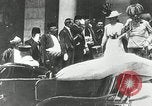
America mobilizes for World War I and confronts demobilization afterwards
Opening scene shows Austrian Archduke Franz Ferdinand and his wife, Sophie, Duchess of Hohenberg. Newspaper swirls into the image, with headline announcing their assassinations. Glimpse of railways guns firing. View of a ship's bow as it sinks beneath the ocean, is covered by newspaper headline announcing the sinking of the RMS Lusitania, by a German submarine. U.S. President Woodrow Wilson at his desk. Newspaper headline reads: "U.S. Declares War !!" U.S. soldiers marching in Washington, DC, with U.S. Capitol building in background. Newspaper announces: "Yanks are Coming!" American General John Pershing on horseback leading a contingent of the American Expeditionary Forces (AEF). American troops going "over the top" (charging out of their trenches) in France during World War 1. Troops firing French 75 artillery pieces at point blank range. A formation of Allied Airco (de Havilland) DH9 aircraft in flight. Bombs bursting near trenches on the front lines. Renault FT-17 tanks accompanying American infantry on the Western Front. Persons playing roles as employees in the Department of Labor when they served as the War Labor Administration in World War 1. Women in the War Labor Administration working with long paper rolls of personnel records. Women in various war effort endeavors including airplane and arms manufacturing. Men working in a wartime steel plant. Marchers and a band demonstrating for the rights of workers to organize. People celebrating the at the end of World War 1, by gathering in the streets, throwing tickertape, dancing in the streets and waving effigies of the Kaiser. Stern view of the U.S. Army Transport Ship, President Grant filled with American soldiers returning from France at the end of the war. Lettering on stern reads, "U.S.A.T. President Grant" (The ship, AP-29, was originally the German ocean liner Konig Wilhelm II, and seized from Germany on 6 April 1917.) Views of United States soldiers returning home, disembarking, and assembling on a wharf home on American soil. Department of Labor persons assisting returning soldiers and prospective employers. Views of workers on farms, and in factories.
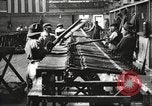
Manufacturing of U.S. Army rifles in an American war plant during World War I
Manufacturing of Army rifles in the United States during World War 1. Workers at a small arms plant in the U.S. examine wooden rifle stocks during World War 1. Men wheeling numerous dollies of rifle stocks to another part of the factory. Fully assembled rifles (appear to be either 1914 or M1917),loaded on a tray are lowered by African American workers using a manual pulley hoist to place them into a bath of hot cosmoline grease (for preservation). Then they are raised and moved to above a draining table, where they are removed and placed on a dolly. Men clean up the drippings. Next scene shows an African American worker placing the new rifles in wooden boxes for shipment. Closeup of an open wooden box of rifles ready for closing and shipping. Workers stacking 10 wooden shipping boxes of rifles in a hand dolly and moving it to shipping dock.

United States Marines Combat Readiness Training Activities
Marines are seen entering dense underbrush in an M274 vehicle with an M40 Recoiless Rifle mounted on it. They rotate the M40 into position and fire it. Marines firing various weapons, including M1 Garand rifle on firing range; Browning M1917 machine gun; grenade launcher; recoiless rifle; hand grenade; M101 105 mm Howitzer; portable flame thrower. Marine communicating with portable field radio. Marine pilot in cockpit of aircraft. Various shots of Marine warplanes in flight,, including F-8 Crusader; A4 Skyhawk; F4 Skyray; and others. A Lockheed Hercules KC-130 serving as Navy refueling aircraft. Marine aircraft making a short field landing assisted by carrier arresting gear installed there. The aircraft making short field takeoffs. Portable bladder fuel tanks laid out to create a combat zone fuel facilities. Aircraft being refueled.
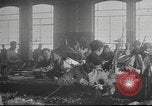
Arms manufacturing in the United States, during World War I
An arms manufacturing plant in the United States during World War 1. War production workers in arms factory woodworking department, manufacture wooden stocks for rifles. Others assemble metal parts of rifles. Still others are seen inserting barrels into wooden rifle stocks. An area staffed almost entirely by women assembling weapon parts. A yard filled with Browning M1917 machine guns.
A captain wears a heavy flying jacket and a helmet before climbing into the cockpit of a Nieuport fighter aircraft in the U.S.
Evolution of United States Air Force uniforms in the United States. A captain in a 1917 uniform wears a heavy flying jacket and a helmet. The captain climbs into the cockpit of a French Nieuport fighter aircraft.

A captain climbs into cockpit of Nieuport aircraft after inspection and aircraft taxis in the United States
Evolution of United States Air Force uniforms in the United States. A captain in the 1917 uniform walks towards a French Nieuport fighter aircraft. He inspects the propellers and the engine of the aircraft. The captain climbs into the cockpit and adjusts his eye gear. The aircraft taxis on a field.