


 Francais
 Deutsch
 Italiano
Refine Your Search
+"United States USA" +1918 stock footage and images
- Showing 43 to 48 of 232 results more
more Hide
Hide
Contribution of African American soldiers during the Spanish American War and World War I.
A film about the role of African American soldiers during various wars in the United States. A dramatization shows a black soldier during the Spanish American War. He also talks about his role in Cuba and the construction of the Panama Canal. Footage of the Panama Canal being constructed and ships underway in the canal. United States Army forces including black soldiers boarding troop transport ships bound for Europe during World War 1. A railroad train carries African American soldiers to France during World War I. African American soldier units under General Pershing march in formation with an Army band in France during World War 1. African American soldiers work and fight against the Germans, including the 813th Pioneer Regiment near Marseilles, the 332nd Labor Battalion, and the 808th Pioneer Regiment near Verdun. African American soldiers racing for front lines including the soldiers with the 8th Illinois and the 372nd regiment and the 371st, and the 369th Infantry Regiment (sometimes called the "Harlem Hellfighters") in the Argonne. View from behind soldier as he fires a machine gun, and United States Army infantry firing artillery. African American soldiers of the 369th regiment "Harlem Hellfighters" being decorated and receiving the French Croix de Guerre for their heroic actions in World War I. The African American soldiers march at a parade in New York City following World War I and are greeted by throngs of enthusiastic African American civilians attending the parade. View of Henry Johnson being congratulated by civilians after he and Needham Roberts performed with exceptional heroism and received the Croix de Guerre. Close up view of the Croix de Guerre medal on a uniform. Graves of African American soldiers who lost their lives during World War I at Arlington National Cemetery in Virginia. View of the All-Wars Memorial to Colored Soldiers and Sailors in Logan Square in Philadelphia (Logan Square, SE corner 20th Street & Benjamin Franklin Parkway, Philadelphia, Pennsylvania). View of a stone memorial erected in the Meuse-Argonne region, north of Sechault, as a tribute to the efforts of the African American soldiers of the 371st Infantry Regiment who fought and died there on April 21, 1918 during World War 1.
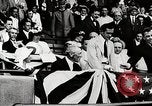
U.S. President Woodrow Wilson throws out first pitch at a major league baseball game
U.S. President Woodrow Wilson is handed a baseball and throws out the ceremonial first pitch from his seat. Seen at left is first lady Edith Wilson; seen at right is Wilson's physician and personal aide Cary T. Grayson. Unidentified baseball player (presumably of Washington Senators team) holds a ball signed by " Woodrow Wilson." Location is Griffith Stadium in Washington, D.C. Date is uncertain, but no later than 1918, which is the last time Wilson is recorded to have attended a baseball game.
Newly recruited American soldiers arriving in U.S. Army training camps; Dutch steamer Amsterdam seized in New York Harbor
World War I Draft and mobilization activities in 1917-1918. American WWI military recruits get down from a railroad train to get to the training camp. U.S. Military officials board the seized Dutch steamer ship in New York Harbor (seized as a neutral vessel during timeframe that Dutch ships under the modus vivendi agreement with the allies were threatened by German U-boats). The ship appears to be the Nieuw Amsterdam. (Lettering behind officials as they board is clearly "Amsterdam" but there is an obstructed word before that may be "Nieuw". Several Dutch ships were seized by U.S. military officials during this same month, including the Nieuw Amsterdam). Crew on the deck of the steamer ship Amsterdam. Dutch flag flying on the ship.
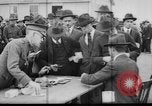
World War I draftees under Selective Service System at a receiving station in New York
Draft and WWI mobilization activities for American men in 1918. Draftees under the Selective Service system get their documents checked by officials. Doctors examine the draftees for military recruitment. Men carry their baggage and move away in a train. Military recruits at a receiving station, lined up. They are seen carrying rifles and marching, beginning their drills, though still dressed in civilian clothing. View of the men marching and Statue of Liberty seen in the distance on the horizon.
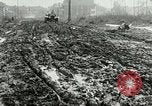
Effects of Ford Model T automobiles on American life; scenes of early road and highway development and sightseeing trips
A man driving a 1917 Ford model T roadster along a severely rutted mud-filled street. A 1917 Ford Model T, one ton truck, trapped in mud. Frustrated driver gets out and kicks a rear tire. Road building crews at work with horse-drawn equipment. Road construction with large steam powered machinery. A 1917 model T roadster driving along a new smooth concrete road. Women making purchases at a sidewalk stand and placing them into their Ford Model T sedan. A doctor arrives at house of a patient, in a Ford Model T roadster. Americans driving Ford Model T cars in the National Parks circa 1920s. Cars driving past a giant redwood tree. Man in a Ford Model T stopped beside woods and feeding a bear in a National Park, as a Park Ranger stands nearby. Ford Model T driving through the tunnel cut in the "Wawona" giant sequoia tree, in the Mariposa Grove of Giant Sequoias at Yosemite National Park. A 1918 Ford Model T touring car parked at a picnic site, with family sitting at picnic table nearby. Families with Ford Model T cars, engaged in outdoor activities, picnicking, and gathering wild flowers. Two men making their Model T into a shelter for overnight camping. Family picnicking at a beach; their Model T parked on road above. A man in a 1920s era swim suit carries a basket for a picnic to others in his family seated near rocks. 1920s or 1930s boy and girl children playing on a beach; picking up seaweed; and wading in the surf, near large rocks.
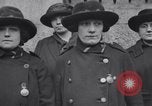
Women join ranks of police reserves in New York City, during World War I.
Closeup of women in the New York City Police reserve, during World War 1. They stand outside the 23rd Police Precinct ("Tenderloin") Station House on West 30th Street, Manhattan, New York City. Their uniforms include round-brimmed hats and overcoats, and they have round badges topped with eagles, pinned to their coats. Next, about 15 are seen, walking two abreast. All wear white gloves and badges, but otherwise, their uniforms are not identical. One supervisor woman walks beside the group, wearing a slightly different badge. Walking casually, a short distance behind the group is a woman (probably Mary Noonan) in the uniform of a captain (with "railroad tracks" insignia on her collar). Scene shifts to a street filled with a traffic mix of horse-drawn and motor vehicles, all staying fairly clear of trolley tracks visible in the center of the road. A police reserve woman stands in the center of the street, directing traffic. Next, a large group of school children is seen standing on a street corner, accompanied by a woman police officer. They begin to cross the street under the watchful eye of another woman reserve police officer, directing traffic in the street. Some adults cross behind the children. (Note: On May 9, 1918, the New York City Police Department announced formation of a new Police Reserve, that would include a women's contingent. This was the idea of Special Deputy Commissioner Rodman Wanamaker, who reasoned, since New York women had received the vote, on November 6th 1917, they should have a role in enforcing the laws. Over 3,000 women were recruited. Their Captain was Mary Noonan. Their duties did not involve direct dealings with criminals. According to the New York Times of May 10, 1918, "If need arose for use of the nightstick or other instrument for curbing crime,the work would be referred to the men members of the force.")