


 Francais
 Deutsch
 Italiano
Refine Your Search
+"United States USA" +1927 stock footage and images
- Showing 19 to 24 of 150 results more
more Hide
Hide
Developed roads link the city to the suburbs and the countryside in the United States.
Growth of suburban areas caused by inter-development of the automobile and the public road system (1897-1927). Development of the American highway. A vintage car and a bus move along developed roads in the suburbs and the countryside. Vehicles on a city street. Developed roads in the city. Cars pass over a covered man hole on the road.
World War I aerial combat portrayal. German aircraft makes a crash landing.
Reenactment of WWI aerial combat action from a 1927 film with Richard Arlen. Aircraft engage in dogfight. Smoking German plane dives and crashes. In another scene, American airplane chases German plane causing it to crash land at German Aerodrome. View through tail as American airplane pulls up and Germans rush to aid of their pilot. Pilot of American airplane (movie actor, Richard Arlen) laughs as he looks over his shoulder from the cockpit of his airplane. Wounded German pilot falls out of his cockpit.
Montage of scenes reflecting life in the United States during the decade of the 1920s, following World War I
Baseball great, Babe Ruth starting to trot around the bases after hitting a home run. An inverted stunt biplane, N57323 with "EM Avery" readable on fuselage while flying inverted. A wing walker is strapped under the airplane (on top wing, now underneath). The airplane rolls over into upright position, trailing white smoke to be more easily seen by spectators on the ground. A 1920s jazz band comprised of African American musicians playing in a night club. A couple and then four women, dancing the Charleston. Point of view (POV) from moving car driving along Broadway in New York City at night, surrounded by neon light signs including some like the Winter Garden Theatre and the Rivoli Theatre. A flagpole sitter atop structure behind an RKO Keith's Advertising sign. Closeup of the man on his perch. A room full of women sewing garments in a factory. Wealthy, formal dressed couples at a city supper club, where an orchestra is playing. Exhausted couples clinging to one another on dance floor during a marathon dance contest. Gangsters firing a machine gun from window of a moving car. Charles A. Lindbergh steps past a policeman, to board his Ryan monoplane, "Spirit of St.Louis,"at Roosevelt field, Long Island, New York, on May 20, 1927. View of takeoff roll. Registration number "NX-211," visible atop the right wing. Manhattan ticker tape parade welcoming Lindbergh back to New York City, following his successful solo transatlantic flight. Charles Lindbergh speaking at a microphone. Traders on floor of the New York Stock Exchange during era of frantic stock market speculation. Money counted out at bank teller window. Labor strife at the gates of a Massey-Harris Company plant, with workers being hit with clubs and fleeing attacks by men hired by the company. Boy workers pose for a photograph While narrator mentions Child labor Act declared unconstitutional (1922). A girl worker. Boys employed as coal miners. Workers installing body panels on cars and working on engines in automobile production and assembly lines. Partially completed vehicles driving out of an automobile factory. Babe Ruth rounding third base and coming to home plate after hitting a home run in a baseball game.
Charles Lindbergh feted in Washington, DC and New York City, upon return to U.S. after his historic transatlantic flight
American aviator Charles A. Lindbergh arrives aboard USS Memphis (CL-13) at the Washington Navy Yard, Washington D.C. upon his return from Europe to the United States following his pioneering trans-Atlantic solo aircraft flight. He comes down the gangplank and is greeted by a phalanx of officials. They drive Lindbergh away in an open car. Two days later, June 13, 1927, the scene shifts to New York harbor, where there is a virtual traffic jam of ships and boats of all sizes and shapes, assembled to greet Lindbergh. Fireboats salute with streams of water as Lindberg arrives (as backseat passenger) in a seaplane from Mitchel Field on Long Island. The seaplane is seen flying over the harbor,and descending to land. The seaplane is seen in the water amongst the flotilla of vessels, as. Lindbergh is picked up by a police launch that takes him to the ship Macom, where he is helped aboard by passengers. (He almost falls into the water while stepping from the launch to the ship.) Lindbergh waves from the deck of the Macom, as they proceed in a parade of vessels toward a Manhattan pier. Upon arriving, Lindbergh is hustled into an open car and driven away surrounded by New york City policemen,including mounted police, who escort the car through mobs of spectators. Police form lines to hold back enthusiastic admirers. The car proceeds along a city street where cheering spectators jam the sidewalks and office workers create a virtual storm of ticker tape and confetti from their windows high above the street.
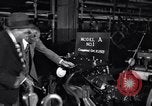
Henry Ford and guest stamp '1' into the first Ford Model- A engine block at a Ford Motor plant in Michigan.
Henry Ford near Ford Model- A automobile engine block. Sign over the engine reads 'No 1 completed October 20, 1927'. Ford and guest stamp '1' into the engine block of this, the first Ford Model A built. Ford poses and converses with officials.
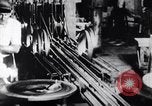
Scenes contrasting the frivolous with more ordinary aspects of the "roaring 20's" in America just before depression
Good times depicted in America during the so-called "Roaring Twenties." Automobile workers on a production line or assembly line. Double-decker buses and taxi cabs fill street in New York City. President Calvin Coolidge, accompanied by his dog, quietly fishing from a canoe. Girls in swim suits dancing around a Tuba player at a beach. Young women dancing happily at a cabaret, nightclub, or club. Behind them on stage is Texas Guinan (actress and speakeasy club manager). President Coolidge casting his fishing line, with another person seen in the rear of the canoe. View of couple's feet as they dance the Charleston in a cabaret. Girls,in bathing suits at a beach, run, like a chorus line, at the camera. Next are shown more mundane aspects of the period and some scenes of poor life, poverty, and unemployment shortly before the onset of the Great Depression. A city back street early in the morning. A man washes his face with water from a horse trough. A Milkman steps from his horse-drawn wagon or carriage to deliver two bottles of milk. People buying slabs of ice from an ice house (for their ice boxes at home). Boy and girl stand on slum or tenement fire escape. Laundry drying on clothes lines stretched across tenement alley. Two children in a family lying in a single bed. Other beds in the same crowded tenement apartment. Union-sponsored housing (founded in 1927) in the lower east side of Manhattan with sign affixed reading: "Amalgamated Cooperative Dwellings, 504-520 Grand Street. 83-91 Broome Street." Views of the Cooperative low rent apartment buildings.