


 Francais
 Deutsch
 Italiano
Refine Your Search
+"United States USA" +1927 stock footage and images
- Showing 25 to 30 of 150 results more
more Hide
Hide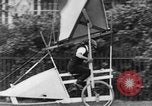
Early and historic flight: Attempts to fly ornithopters, including Gustav Lilienthal's large ornithopter.
Scenes of vintage, historic, early aviation flight attempts: Men at controls of several unsuccessful ornithopter aircraft, intended to fly by flapping wings. One man rides a bicycle equipped with wings that he flaps using sticks by his handle bars. Another sits in a tub-like machine with tricycle wheels, as it "flaps" its wings. In a third scene, men assist as operator moves very large wings on a machine. Although the wings move, the machine doesn't. This large machine might be Gustav Lilienthal's ornithopter. It had a 3 horse-power motor. Location might be Berlin's Tempelhof Airport, around 1927
Peacetime activities and contributions by the U.S. Army in the United States.
Scenes from Army Day on April 6, 1934. Secretary of War George Henry Dern, in broadcast to the nation about importance of the Army, in peacetime. Brief glimpses of the Yellowstone River lower falls and Old Faithful and Beehive geysers erupting in Yellowstone Park, Wyoming. View amongst log buildings in Reproduction of Army Fort Dearborn, at the 1933 Century of Progress Exposition in Chicago, Illinois. A pioneer wagon; Native American Indians in ceremonial regalia; antique locomotives and trains at the Exposition. Army General Leonard Wood being sworn in as the Governor General of the Philippines. Closeup of General of the Armies, John J. Pershing, America's highest ranking Military officer. Headquarters of Walter Reed Army hospital, in Washington, DC, named for U.S. Army Major Walter Reed, who confirmed that yellow fever is transmitted by mosquito. Acting on this, the U.S. was able to complete the Panama Canal. View of French dredging equipment sitting idle in the water after Yellow Fever prevented them from completing the Panama Canal. Closeup of U.S. Army General William C. Gorgas, who, in 1904, headed the Sanitary Department that controlled mosquitoes and eradicated Yellow Fever, so the Panama Canal could be finished. View of alligator in swamp near the Panama Canal. Photograph of George Washington Goethals, Chief Engineer credited with making the canal happen. Explosives employed in Panama Canal construction. Earth and rocks being loaded into open rail cars. A steamship transiting the Panama Canal. The Washington Monument; U.S. Library of Congress; and the Lincoln Memorial, cited as examples of accomplishments by U.S. Army engineers. The Wilson Dam, under construction by Army engineers, in Muscle Shoals, Alabama and system of levees being built to control the Mississippi River. The raging Mississippi River during 1927 flood. Flood victims being assisted by U.S. Army soldiers, at a tent camp, receiving food and clothing. An Army airplane flying over a forest fire. Army personnel supervising men in the Civilian Conservation Corps or CCC. Mail being loaded aboard an Army airplane, as airmail service is being opened between Washington DC and New York City. President Woodrow Wilson talking with Army pilot Major Reuben H. Fleet. Mail being loaded into the nose of an airplane. U.S. Army Douglas World Cruiser airplanes in flight, returning from their trip around the world in 1924. A pilot sitting in front seat of a Douglas O-38 airplane, pulls a fabric hood over his cockpit to practice "blind flying". View of the aircraft in flight, with instructor pilot in the open rear cockpit. Army aviators taking a camera and a rifle aboard their airplane as they prepare to leave on an aerial mapping flight. Aerial view of skyscrapers of Manhattan Island, New York City. Army Signal Corps personnel working on communications devices. A cable laying ship operating at sea, in support of the U.S. Army's Alaskan cable and telegraph system. Men loading chemicals into hoppers on Army crop dusting airplane. Several views of Army airplanes crop dusting. Glimpse of boll weevil, the target of their efforts. Closeup of Karl Connell, who as a major in the AEF, in World War I, invented a superior gas mask known as the “Connell” or “Victory” mask. A group of miners wearing gas masks enter a smoky mine entrance. The Army invented tear gas, which is shown being used to thwart a bank robbery, in a staged demonstration. Brigadier General Hugh Johnson, appointed by President Franklin Roosevelt, as head of the Great Depression era National Recovery Administration, or NRA, is seen about to give a speech. Narrator cites him as an example of U.S. Army officers who also serve the country in civilian life. Scene shifts to cadets on parade at the United States Military Academy, West Point, New York.
Early models of aircraft take off from an aircraft carrier and passengers board a C-30 aircraft in the United States.
Opening slate reads: "First Utility of airplanes was in National Defense." A huge formation of large military bi-planes is seen in formation. The Next slate reads: "In the Navy." Curtiss 28 TS-1 airplanes lined up for takeoff on the deck of the U.S Navy's first aircraft carrier, the USS Langley (CV-1). The first in line takes off. The others wait their turns, with engines running. View from aircraft above, of the Langley cruising with aircraft parked on her deck. Slate refers to Colonel Charles A. Lindbergh's solo flight across the Atlantic Ocean in 1927. Closeup of Charles Lindbergh wearing a flying suit with helmet and goggles. Slate refers to Commercial flying advances. View of passengers boarding a British Inperial Airways Armstrong Whitworth Argosy airplane.
Some U.S. Army soldiers focusing on leisure after World War 2, and some attend Army extension classes in the United States.
A post-war U.S. Army film (after World War 2) in 1945-1946 contrasts dice and pool playing soldiers with the soldiers who take Army extension classes to prepare for jobs in civilian life following demobilization and discharge from the Army. Group of U.S. Army soldiers in a room as they play pool at a billiards table. Soldiers in a barracks room seated on a bed and on the floor throwing dice in a game of craps. The soldiers play cards and smoke. Contrast is shown with U.S. Army students seated in a class. An officer takes lessons. A soldier takes notes. A young teacher or professor explains a concept with the help of a blackboard. View of the Hôtel Miramar in Biarritz, France (built in 1927 and demolished in 1978). Aerial view of a building with interconnected corridors. Street level view of the University of Calcutta Senate Hall in Calcutta (Kolkata), India (hall designed by Walter Granville; one time home to the Asutosh Museum of Indian Art; demolished in 1960). People walking in front of the Senate Hall as a car and a pulled rickshaw go by. In next scene, a sign reads 'Fox-Hole Campus'. An officer holds a mechanical model and explains a concept to students. A soldier works with equipment and an African American soldier stitches clothes at a sewing machine. A sign "Learn today; Earn tomorrow" as soldiers learn skills to help them in the civilian sector after separation from the armed forces. A solder works on a model. Pamphlets on a desk with the names of different subjects written on them that U.S. Army students can study to learn skills and jobs, including Automobile Repair Shop, Retail Bakery, Service Station, Grocery Store, Metal Working Shop, Shoe Repair Business, Small Sawmill Business, Beauty Shop.
Life and times of Henry Ford and the Model T, with events from 1904 through 1936 (not always in chronological order).
Mix of scenes covering Henry Ford and his Model T cars, Model Ts travel through a stream and along rutted roads and through snow. Ford Model Ts equipped with special wheels travel on the rails along a railroad trestle. One drives slowly along a large pipeline. Views inside Ford auto factory of assembly line operations. Car hoods being pressed into shape. Car bodies on assembly line. Engine blocks moving on conveyer. Car bodies being placed on chassis. Henry Ford walking along garden path at his home, Fairlane, in Dearborn Michigan. Glimpse of Henry Ford joking with Scottish comedian, Harry Lauder, in 1914. Henry ford tinkering with an old steam engine, and later, driving one of his tractors. Ford in his office conferring with employees. Family gathering as Edsel Ford is about to embark on a transcontinental trip with Model T Ford cars, on May 5, 1924. The Fords doing country dances together. Henry Ford camping with Thomas Edison, Harvey Firestone, and John Burroughs (later seen driving a 1918 Ford Model T). Views of the men (who called themselves the "Four Vagabonds," as they dine under a tent and use a large Lazy Susan table. Ford speaking directly into Edison's right ear (he was hard of hearing) while Firestone looks on, amused. Edsel Ford with his father outdoors, and in the Ford factory. Father and son sitting by the Quadricycle with a 1936 white Ford sedan behind them. Portrait of Henry Ford. Luxury limousine at a mansion. It has no right side door for the chauffeur, and a right hand steering wheel (British built?) Woman enters and luxurious interior is described. Chauffeur enters at left door and slides across seat to right-side steering wheel. Lincoln chauffeured limousine passes and parks in front of a Model T. May 1927, men assemble the body onto the 15 millionth Model T car, and it drives away with Henry Ford as passenger. Old Ford cars brought into plant where they are seen being crushed and scrapped, and their steel recycled into new cars.
Robert H. Goddard tests rockets in Roswell, New Mexico
American scientist Robert H. Goddard tests a rocket in Roswell, New Mexico during the 1930s. Title card “United States Marine Corps”. Program host, Dennis James, introduces. Early rocket launchpad built in 1927 by American scientist Robert H. Goddard. Robert H. Goddard and his assistants unload a rocket at their test site located in Roswell, New Mexico. Robert H. Goddard demonstrates an early gyroscope used for automatic stabilization. Assistants securing the rocket into the launchpad. Robert H. Goddard and his assistants watch the rocket from the observation shed during ignition. Distant view of rocket as it shoots straight up to 7500 feet in the 1930s. Robert H. Goddard and his assistants examine rocket and parachute after landing.