


 Francais
 Deutsch
 Italiano
Refine Your Search
+"United States USA" +1932 stock footage and images
- Showing 1 to 6 of 122 results more
more Hide
Hide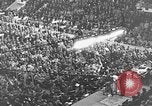
The 1932 Republican National Convention, at Chicago Stadium, in Chicago, Illinois
View of the delegates to the 1932 Republican National Convention at Chicago Stadium, in Chicago, Illinois. The delegates are arranged on the convention floor in groups, by State, each State delegation identified by a sign. Officials coming on stage. President Hoover appears. Former President Calvin Coolidge and Mrs. Coolidge, on stage beside Vice President and Mrs. Charles Curtis. Both ladies hold large bouquets of flowers. War Hero, General of the Armies, John Pershing, is introduced and receives a standing ovation. President Herbert Hoover standing with General Pershing on stage.
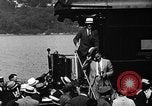
The 1932 Presidential campaign of Franklin D. Roosevelt
Franklin D. Roosevelt in whistle stop campaign for President in 1932. He speaks from rear platform of a rail car, to a crowd of spectators. A bouquet of flowers is handed up from the crowd to Eleanor Roosevelt standing on the train platform. Cheering crowds seen from the moving train, including some sitting on the roof of the train station. FDR and Eleanor Roosevelt each acknowledging recognition from supporters.
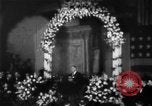
Franklin D Roosevelt campaigning in Atlanta, Georgia, during the 1932 Presidential campaign and relaxing at Warm Springs winter home
Franklin D Roosevelt's Presidential election campaign in Atlanta, Georgia. In the opening scene, New York Governor Roosevelt begins addressing a huge gathering of some 7000 people in the old Atlanta Armory auditorium, on the evening of October 24, 1932. The stage is filled with flowers donated by Atlanta florists, for the occasion, including a tall arch of flowers surrounding the speaker rostrum. Roosevelt begins his comments expressing appreciation for the warm welcome given by people of Georgia. The scene then changes, completely, and He, along with his family, are seen relaxing in his winter home in Warm Springs, Georgia. He sits with a Bun Wright's Fiddle Band and listens as they play country music on guitar, banjo, and fiddle musical instruments. The musicians play "Soldier's Joy" at Roosevelt's request.
U.S. Army aircraft patrol for forest fires, in 1919, in the United States. Bulldozers and forest plows introduced in 1932
World War I scenes of U.S. Army airplanes in action at the front. A picture of U.S. Army Major Henry A. (Hap) Arnold and California Forester Kurt Dubois, who, together, started the fire patrol practice by United States Army aircraft in1919. Army flyers lined up on a field. Army Curtis JN-4 (Jenny) airplanes in flight as smoke rises from the forests below. Weighted messages with ribbons attached, being dropped by pilots while in flight to inform about a forest fire. Later on after the installation of radios a pilot sends a message on a radio set in case of a forest fire. In 1920s, Crawler tractors used to skid logs out of the forest. In 1925, tractor with a blade was developed and used to build forest roads. In 1932, a Bulldozer being used to create firebreaks during a Southern California fire. A fire plow in operation.
Increase in grants for Indian education and decrease in appropriations for military control in the U.S. from 1886 to 1932.
A film surveys federal provisions for federal schools for education of Native American Indian students in the United States during the Great Depression, and cultural integration of Native Americans into white cultures. An Indian woman holds her baby. An Indian man talks to a woman. Two women in traditional dress pose. Exteriors of a church. A picture depicting increase in grants for Indian boarding school education and decrease in appropriations for military control in the United States from 1886 to 1932.
Highlights of game 2, 1932 World Series between New York Yankees and Chicago Cubs
Baseball newsreel slate says "Yankees' Submerge Cubs' Pennant Hopes" but footage is of game 2 of the 1932 World Series at Yankee Stadium. Wide shots of 50,000 spectators in crowd. Shot of Cubs' Billy Herman leading off game with double. Shot of Yankee pitcher Lefty Gomez throwing. Shots of Cubs Kiki Cuyler reaching first on error and Riggs Stephenson hitting fly ball to score Herman from third base. Shots of Cubs' pitcher Lon Warneke walking Earle Combs in bottom of 1st inning. Closeup of Yankees' Babe Ruth in dugout. Warneke walks Joe Sewell, strikes out Ruth, gives up run-scoring single to Lou Gehrig. Shots of Cubs' Riggs Stephenson hitting double in top of 3rd, scoring on single by Frank Demaree. Shots from Yankees in bottom of third: Babe Ruth walks, goes to second on single by Gehrig; minutes later, Babe Ruth runs home on base hit, followed by Lou Gehrig, who slides into home plate. Shots of Yankee stadium from outfield stands. Fans in stands, mostly men wearing hats, stand up for various plays. At end of game, won by Yankees 5-2, happy, celebrating fans spill onto field and many paper game programs are seen floating in the wind and on the field.