


 Francais
 Deutsch
 Italiano
Refine Your Search
+"United States USA" +1933 stock footage and images
- Showing 13 to 18 of 180 results more
more Hide
Hide
United States President Franklin Roosevelt (FDR) signs one law after another on his desk, American farmers harvest produce such as onions
Calendar shows March 1933, some days are encircled. United States President Franklin Roosevelt at his desk after signing a law during the Great Depression. Narrator notes that with regard to Prohibition, "the end of the long drought was in sight." Farmers harvest vegetables. Turnips in crates after being harvested. Farmers pour turnips from crates. Farm workers sort out white onions. Farm workers arrange sacks of onions.
Scenes of sheep and cattle herding in the American West, United States President Franklin Roosevelt at his desk
View of sheep grazing in hills of Western United States. Flock of sheep being herded. Wide landscape views of cattle grazing in American frontier. Cowboys herd the cattle. Cattle herd in long line. Calendar shows March 1933, some days are encircled marking actions the President was taking for relief for American citizens during the Great Depression. United States President Franklin Roosevelt at his desk, pondering.
Franklin Roosevelt signs the Cullen-Harrison Act (or the Beer Permit Act) into law, beer brewed as Prohibition ends in the United States
Calendar shows March 1933, some days are encircled. United States President Franklin Roosevelt on his desk in the White House, signing the national law legalizing beer after a decade of Prohibition in the United States. View of the Cullen-Harrison Act (or the Beer Permit Act) signed by President Franklin Roosevelt. Workers clean up thick cobwebs in a brewery left untouched for 13 years. Men polish machinery used for brewing beer. Men shovel hops into tank. Worker operates brewery. Beer bottles cleaned and filled with beer through assembly line machine. Workers in beer bottling plant.
World War 2 film promoting public investment in War Bonds and stamps to aid the war effort and temper inflation
World War 2 era film that also includes some World War 1 scenes. Show girls or chorus girls in follies-like show, costumed as U.S. silver dollars and marching to tune and lyrics alluding to dramatic increase of currency in circulation, over the years. Animation with stacks of coins shows increase in national income from $46 billion,in 1933, to $71 billion, in 1939, and $142 billion in 1943. Back to the "follies dollars," a boy asks why, and then scenes of the Japanese attack on Pearl Harbor,are shown, with U.S. battleships being sunk. Wartime arms plants are shown. An M2A3 Light Tank rolls off a production line. Ships being constructed in a shipyard. B-24 Liberator bombers being built in a factory. Artillery shells being produced. Defense workers receiving their pay. The "follies dollars" group themselves to illustrate the fractions of income devoted to taxes and savings. But other spending is curtailed by wartime shortages. A woman talking with clerk in a drug store. U.S. Army troops crossing a pontoon bridge in open trucks, towing 75mm M1A1 howitzers. Infantry on the march. Animation showing industrial production devoted to war materiel and lots of dollars chasing few civilian goods. A grocery clerk offers to sell a woman customer butter for more than the established price, and she agrees. The "follies" performers then introduce the idea of an "inflationary dollar," and some history of past U.S. inflations. Animated examples of price inflation are shown. Glimpses of World War I scenes are seen, circa 1917 -1918, including: a 12-inch railway gun firing; a huge explosion from shell bursting near the camera; various scenes of United States infantry soldiers and French soldiers in battle action, running to bomb craters for cover and emerging from trenches to go up "over the top" into no-mans land during combat. Meanwhile, singing narration refers to the home front inflation due to competition for limited civilian goods. Map shows Europe and singing narration cites rising prices for food in occupied France and other countries suffering ravages of World War II. Montage of scenes showing needy civilians obtaining food in those countries. Animation shows increases, by 1944, in cost of U.S. civilian goods since the Pearl Harbor attack. "Follies" character called "Double-duty dollar," appears explaining he serves the war and curtails inflation on the home front by being saved through investments in War Bonds and stamps.

Animation shows the various tributaries of Mississippi river and the Tennessee Valley Authority projects in the United States
The effects of flood in the Mississippi river in the United States. Animation shows the various tributaries of the Mississippi river. The reduced fertile soil and plantation over the years due to the flood. The role Tennessee Valley Authority (TVA) a federally owned corporation created by congressional charter in May 1933 to provide navigation ,flood control,electricity and economic development in the Tennessee valley.
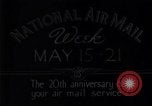
Men load mail bags on a plane.
Opening slate advertises "National Air Mail Week. May 15-21. The 20th Anniversary of your air mail service!" Men load a DC-3 airplane with mail bags at an airport in the United States. Transport truck brings more mail and men load the bags. 1918 Map of United States showing Air Mail connection between New York and Washington. 1923, 1928, 1933 and 1938 maps show further connections to cities such as Chicago, Salt Lake, San Francisco and other destinations. Brief view of International routes between Asia and the United States, and from the United States to South America. Men load mail bags on a plane. The DC-3 plane takes off. Dirigible in background. Closing slate, "Don't Forget. National Air Mail Week."