


 Francais
 Deutsch
 Italiano
Refine Your Search
+"United States USA" +1933 stock footage and images
- Showing 19 to 24 of 180 results more
more Hide
Hide
Newsreel restrospective produced following the death of President Franklin D. Roosevelt (WW2)
Opening scene shows the White House in Washington, DC. Scene shifts to President Roosevelt seated, ready to address the Nation by radio. View of the statue of Abraham Lincoln in the Lincoln Memorial in Washington, DC. FDR with his entire family posing, in front of the family home "Springwood" at Hyde Park, New York. Roosevelt, when Governor of New York, seen in a sail boat, in 1929. FDR in his car at his Institute for Rehabilitation in Warm Springs, Georgia. He is speaking with a man associated with the Institute, who then greets several polio victims in wheel chairs there. Crowds celebrating Roosevelt's election, in Times Square, Manhattan, New York City, in 1932. Roosevelt, at the Democratic Headquarters at the Biltmore Hotel on November 8, 1932. He is standing, supported by his son James, as he remarks: "It looks my friends like a real landslide this time." Aerial view of the U.S. Capitol. FDR taking the oath of office on March 4, 1933. Brief view of New York Stock Exchange trading floor. A man looking at stock market ticker tape. A group of people raising a National Recovery Administration member flag. Glimpse of "Springwood" and then view of President Roosevelt sitting next to his mother, Sara Ann Delano Roosevelt. Next, as Franklin and Eleanor Roosevelt sit in the garden, their grandchildren, Anna Eleanor Dall ("Sistie") and Curtis Roosevelt Dall ("Buzzie") come past riding horses, with granddaughter Sara, behind them on a pony. FDR pets the pony and talks with Sara. FDR being nominated for a second term as President, in the 1936 Democratic National Convention in Philadelphia, Pennsylvania. President Roosevelt, riding in an inaugural motorcade as he begins an unprecedented 4th term as President in 1941. Glimpse of President and Mrs. Roosevelt in an open car. West point cadets marching in the inaugural parade. Military trucks towing artillery pieces in the parade. President Roosevelt speaking at the dinner of the White House Correspondents' Association at the Willard hotel in Washington, DC, March 15, 1941. He extols the virtues of Winston Churchill and the British people. And he promises that America will supply them with the war materiel they need in World War II (This is known as the Lend Lease Speech.)
Peacetime activities and contributions by the U.S. Army in the United States.
Scenes from Army Day on April 6, 1934. Secretary of War George Henry Dern, in broadcast to the nation about importance of the Army, in peacetime. Brief glimpses of the Yellowstone River lower falls and Old Faithful and Beehive geysers erupting in Yellowstone Park, Wyoming. View amongst log buildings in Reproduction of Army Fort Dearborn, at the 1933 Century of Progress Exposition in Chicago, Illinois. A pioneer wagon; Native American Indians in ceremonial regalia; antique locomotives and trains at the Exposition. Army General Leonard Wood being sworn in as the Governor General of the Philippines. Closeup of General of the Armies, John J. Pershing, America's highest ranking Military officer. Headquarters of Walter Reed Army hospital, in Washington, DC, named for U.S. Army Major Walter Reed, who confirmed that yellow fever is transmitted by mosquito. Acting on this, the U.S. was able to complete the Panama Canal. View of French dredging equipment sitting idle in the water after Yellow Fever prevented them from completing the Panama Canal. Closeup of U.S. Army General William C. Gorgas, who, in 1904, headed the Sanitary Department that controlled mosquitoes and eradicated Yellow Fever, so the Panama Canal could be finished. View of alligator in swamp near the Panama Canal. Photograph of George Washington Goethals, Chief Engineer credited with making the canal happen. Explosives employed in Panama Canal construction. Earth and rocks being loaded into open rail cars. A steamship transiting the Panama Canal. The Washington Monument; U.S. Library of Congress; and the Lincoln Memorial, cited as examples of accomplishments by U.S. Army engineers. The Wilson Dam, under construction by Army engineers, in Muscle Shoals, Alabama and system of levees being built to control the Mississippi River. The raging Mississippi River during 1927 flood. Flood victims being assisted by U.S. Army soldiers, at a tent camp, receiving food and clothing. An Army airplane flying over a forest fire. Army personnel supervising men in the Civilian Conservation Corps or CCC. Mail being loaded aboard an Army airplane, as airmail service is being opened between Washington DC and New York City. President Woodrow Wilson talking with Army pilot Major Reuben H. Fleet. Mail being loaded into the nose of an airplane. U.S. Army Douglas World Cruiser airplanes in flight, returning from their trip around the world in 1924. A pilot sitting in front seat of a Douglas O-38 airplane, pulls a fabric hood over his cockpit to practice "blind flying". View of the aircraft in flight, with instructor pilot in the open rear cockpit. Army aviators taking a camera and a rifle aboard their airplane as they prepare to leave on an aerial mapping flight. Aerial view of skyscrapers of Manhattan Island, New York City. Army Signal Corps personnel working on communications devices. A cable laying ship operating at sea, in support of the U.S. Army's Alaskan cable and telegraph system. Men loading chemicals into hoppers on Army crop dusting airplane. Several views of Army airplanes crop dusting. Glimpse of boll weevil, the target of their efforts. Closeup of Karl Connell, who as a major in the AEF, in World War I, invented a superior gas mask known as the “Connell” or “Victory” mask. A group of miners wearing gas masks enter a smoky mine entrance. The Army invented tear gas, which is shown being used to thwart a bank robbery, in a staged demonstration. Brigadier General Hugh Johnson, appointed by President Franklin Roosevelt, as head of the Great Depression era National Recovery Administration, or NRA, is seen about to give a speech. Narrator cites him as an example of U.S. Army officers who also serve the country in civilian life. Scene shifts to cadets on parade at the United States Military Academy, West Point, New York.
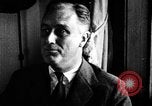
Scenes of Franklin D. and Eleanor Roosevelt in 1920s and 1930s.
New York Governor, Al Smith, candidate for President, seen with Franklin D. Roosevelt (FDR), encouraging him to run for Governor. FDR and Eleanor Roosevelt in an open car following his successful election as Governor. On July 14, 1933, now President Roosevelt, is seen in an open car, with Eleanor, on the grounds of the Catholic University of America. He is dressed in top hat, and Eleanor holds large bouquet of flowers. FDR is later seen,wearing mortar board and gown, as he and Eleanor converse with University Rector James H. Ryan, after receiving an honorary degree as part of the day’s commencement exercises. Montage of scenes showing Eleanor Roosevelt in various political and charitable activities during the 1920s and 1930s.
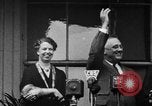
Some activities of U.S. First Lady, Eleanor Roosevelt, during the 1930s and 1940s.
Scenes from the beginning of the Roosevelt Administration in 1933 through 1942, in World War II. First Lady Eleanor Roosevelt waving with President Franklin D. Roosevelt, from a balcony. In a different sequence, she models different clothing fashions for photographers, and sitting with another woman, as she prepares her daily newspaper column, entitled: "My Day." She is seen horseback riding, with companions, in a wooded park. Crowd fills the area around the Lincoln Memorial and reflecting pool, as African American contralto, Marian Anderson, descends steps of the memorial and begins her famous Easter Sunday concert, on April 9, 1939. This concert and venue was made possible by the intervention of Eleanor Roosevelt, after Marian Anderson was denied the opportunity to sing at Constitution Hall because she was an African American. Narration mentions Eleanor Roosevelt's active support for civil rights for all people. First Lady, Eleanor Roosevelt, is seen sitting with Secretary of the Interior, Harold L. Ickes, in the audience. Mrs. Roosevelt speaking as she testifies before a congressional committee regarding care for the elderly. Eleanor and Franklin Roosevelt sitting in a garden where she knits while he works over some papers. Grandchildren run to them. Eleanor Roosevelt with King George VI and Queen Elizabeth Bowes-Lyon, in London, 23 October 1942, viewing destruction wrought by the Nazi German Blitz in World War 2. Eleanor Roosevelt in her Red Cross uniform, visiting soldiers at a U.S. Army hospital, during the war.
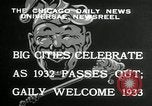
New Year's celebrations in New York, Chicago and other cities of United States.
New Year's celebrations in New York City, Chicago, and other cities of United States. Thousands of merrymakers gather on the streets and celebrate. Crowds gathered in Times Square in New York to ring in the New Year of 1933. Couples drink and dance in night clubs and restaurants.
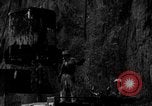
Concrete buckets suspended by cables are dropped on ground at Boulder Dam (Hoover Dam) construction site, Nevada.
Construction of Hoover Dam in June 1933. A bucket of concrete is lowered on ground from mountain top. Base of structure is prepared. Vehicles move on road on Canyon (Black Canyon) wall. Buckets of concrete suspended by cables are dumped on ground. Material is offloaded from truck and transferred through cable ways. Concrete buckets transferred from cliffs. Bucket descends and received by men on ground. Men shovel concrete and operate equipment. Workers from Canyon rim are transferred on ground. Concrete bucket lowered on to construction site. Construction in progress. Two intake towers on each side of the Canyon wall. Other structures constructed for dam.