


 Francais
 Deutsch
 Italiano
Refine Your Search
+"United States USA" +1934 stock footage and images
- Showing 1 to 6 of 120 results more
more Hide
Hide
The U.S. Army Air Corps processes photo-mapping films covering 21,000 square miles, brought back by the 1934 Alaska Flight
Followup to the U.S. Army Air Corps 1934 Alaska Flight. The U.S. Army Air Corps Photographic department processes and assembles the 60 rolls of film shot by the USAAC 1934 Alaska Flight during its aerial photo-mapping mission over 21 thousand square miles of Alaska territory. Photographic workers mount film onto large rolls and place them into developing solutions. Long strips of film are seen drying on rotating slatted drums.Oblique negatives placed in rectifying printer are transformed into vertical photographs. Workers develop the negatives. Developed single wing photographs. Composite five lens photographs ready for mapping.
Scenes from 1934 film about westward expansion of United States in last quarter of 19th Century.
Scenes from a 1934 film documentary on the westward expansion of the United States in the 19th Century. The Marias River flows through the mountains in Montana. Goats and bears in the forest area of Camp Disappointment, the northernmost campsite of the Lewis and Clark Expedition. View of the Camp Disappointment monument erected by the Great Northern Railroad to commemorate Lewis and Clark. Engraved stone reads 'Farthest Point West on Captain Lewis trip up Marias River'. Car drives into portico of the Peace Arch situated near the westernmost point of the Canada–United States border between the communities of Blaine, Washington and Surrey, British Columbia. 'Children of a Common Mother' written on top of a monument. Engraved picture shows Lewis and Clark pointing towards land with boats next to them. View of the Columbia River flowing between mountains and a bridge. Aerial view of city of Portland. Steamer leaves harbor of Portland.

Strikes across the United States in 1934
Teachers in Chicago protest pay injustice during the Great Depression, as they had not been paid for 11 months. 5,000 instructors joined by students and parents in a march and protest as they also complained about cuts in school services. Scenes from other labor strikes across United States in 1934 including shipyard and auto industry strikes. Striking workers marching. President Roosevelt intervenes in an automobile strike. President Roosevelt on Vincent Astor's yacht for a brief fishing holiday. Men in a factory or manufacturing facility punching timecards in time clocks. New automobile cars seen in production and rolling off assembly lines. Working men eat lunch beside their posts in an assembly line factory, during a break.

Ford promotional film about progress made by Ford in 1934 and prospects for 1935 during Great Depression
Ford promotional film. Man talks about the progress made by Ford in 1934. Views of Ford's Administration Building in United States. Henry Ford in conference with two other men. Reporter talks over prospects for 1935. Henry Ford says, "As far as we're concerned, the Depression is over....we'll build a million cars next year." Interviewer says, "Well that will do a lot to pull the country out of the Depression." Ford answers, "Well maybe we'll do better." Newspaper plant with newspaper printing presses rolling new edition. Views of several processes in printing newspaper. Headlines reads, 'Ford Will Build Million Cars in 1935', 'End of Depression seen in Ford Plant'.
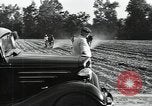
Farmer stands by new 1934 Chevrolet automobile as African American workers plow field with horse-drawn plows
A farmer stands by his new 1934 Chevrolet automobile, watching.as several African American men plow his field using horse-drawn plows. The farmer talks with one of the workers, while others continue plowing.
U.S. Army Air Corps airplanes and crews preparing for Alaskan Flight in 1934
Slate lists planned flight legs of U.S. Army Air Corps aircraft as: Washington DC to Edmonton, Alberta; Fairbanks Alaska to Seattle Washington; and Washington DC to San Diego California. Another slate explains that under command of Lieutenant Colonel H.H. Arnold,ten B-12 bombers demonstrate their capabilities in an 18,000 mile flight. Lt. Col Henry H. Arnold, U.S. Army Air Corps, stands in front of a large map on which planned flights are charted. Sign behind him identifies "Engineering Office," at Patterson Field. Arnold uses pointer to show the routings to another officer who has joined him. The next sequence shows Arnold describing the flight plans to more participants, using more charts. Camera pans across ten assembled Army personnel. Lt. Col. Arnold poses with 15 aviators in front of a YB-12 bomber (displaying air intake on port side of engine). Camera pans over eighteen mechanics and ground crewmen posed in front of the bomber. Symbol of eagle superimposed over map of alaska, is painted on side of forward fuselage. Arnold discussing the mission with Army officers and civilian officials, as they walk past a YB-10 (with air intakes atop the cowlings). Camera pans across Patterson field ramp, where officials, automobiles, YB-10 aircraft, and local civilian workers, including several women, are seen. Crew chief seen refueling a YB-10 with long hose from an underground fuel tank installed at edge of the ramp.