


 Francais
 Deutsch
 Italiano
Refine Your Search
+"United States USA" +1934 stock footage and images
- Showing 7 to 12 of 120 results more
more Hide
Hide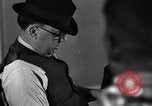
John A Lomax and Huddie William Ledbetter (Lead Belly) reenact events from 1934, in their relationship.
Musicologist John A. Lomax and LeadBelly also known as Huddie William Ledbetter, an American folk and blues musician, reenact events in their relationship in the United States. Lomax works on a typewriter as Lead Belly comes in and says he has been pardoned from prison and asks to work for Lomax for life. Lomax asks if he has a pistol.Leadbelly says no, only a knife. Lomax asks him to give it to him, which Leadbelly does. LeadBelly promises to sing for him and Lomax agrees to provide him a job.
Babe Ruth honored before his final baseball game with New York Yankees, 1934
Brief newsreel clip covering Babe Ruth's final game with the New York Yankees at the Griffith Stadium (Present day Howard University Hospital, 2041 Georgia Ave NW, Washington, DC 20060, United States) in Washington DC, USA. Players, photographers, and dignitaries honor Ruth before the game with ceremony around home plate. Man presents Ruth, wearing the New York Yankees road uniform, with an award. Ruth accepts it and talks briefly, standing next to his wife Claire, seen at right. Brief shot of Washington Senators pitcher Orville Armbrust throwing. (Armbrust would get the only win of his major league career in this game.) Ruth, pictured in a different game and in home uniform, steps into batter's box. Scene of Ruth hitting a home run from earlier in his career.
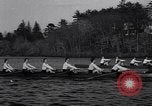
Wellesley College girls team in training for crew races in an eight-oar shell.
Wellesley College girls boat, an eight-oar shell, is seen running on the water as the Wellesley women's team practices for competitive crew racing in 1934.
Japan denounces Washington Naval Treaty of 1922; Also: Helen Richey becomes the first woman to fly mail in the U.S.
Japanese Ambassador to the United States Hiroshi Saito calls on U.S. Secretary of State Cordell Hull In December 1934 to inform that Japan will denounce the Washington Naval Treaty on 1922 which limited the size of the Japanese fleet. A close up of the ambassador Saito. He exits the State, War, and Navy Building (later the Executive Office Building) and gets in a car. Next segment: A female pilot Helen Richey becomes the first woman to fly mail in the United States. Richey stands in front of an aircraft and shakes hand with an official. Richey in the cockpit and the aircraft takes off. From a December 14, 1959 newsreel recounting events 25 years earlier.
Peacetime activities and contributions by the U.S. Army in the United States.
Scenes from Army Day on April 6, 1934. Secretary of War George Henry Dern, in broadcast to the nation about importance of the Army, in peacetime. Brief glimpses of the Yellowstone River lower falls and Old Faithful and Beehive geysers erupting in Yellowstone Park, Wyoming. View amongst log buildings in Reproduction of Army Fort Dearborn, at the 1933 Century of Progress Exposition in Chicago, Illinois. A pioneer wagon; Native American Indians in ceremonial regalia; antique locomotives and trains at the Exposition. Army General Leonard Wood being sworn in as the Governor General of the Philippines. Closeup of General of the Armies, John J. Pershing, America's highest ranking Military officer. Headquarters of Walter Reed Army hospital, in Washington, DC, named for U.S. Army Major Walter Reed, who confirmed that yellow fever is transmitted by mosquito. Acting on this, the U.S. was able to complete the Panama Canal. View of French dredging equipment sitting idle in the water after Yellow Fever prevented them from completing the Panama Canal. Closeup of U.S. Army General William C. Gorgas, who, in 1904, headed the Sanitary Department that controlled mosquitoes and eradicated Yellow Fever, so the Panama Canal could be finished. View of alligator in swamp near the Panama Canal. Photograph of George Washington Goethals, Chief Engineer credited with making the canal happen. Explosives employed in Panama Canal construction. Earth and rocks being loaded into open rail cars. A steamship transiting the Panama Canal. The Washington Monument; U.S. Library of Congress; and the Lincoln Memorial, cited as examples of accomplishments by U.S. Army engineers. The Wilson Dam, under construction by Army engineers, in Muscle Shoals, Alabama and system of levees being built to control the Mississippi River. The raging Mississippi River during 1927 flood. Flood victims being assisted by U.S. Army soldiers, at a tent camp, receiving food and clothing. An Army airplane flying over a forest fire. Army personnel supervising men in the Civilian Conservation Corps or CCC. Mail being loaded aboard an Army airplane, as airmail service is being opened between Washington DC and New York City. President Woodrow Wilson talking with Army pilot Major Reuben H. Fleet. Mail being loaded into the nose of an airplane. U.S. Army Douglas World Cruiser airplanes in flight, returning from their trip around the world in 1924. A pilot sitting in front seat of a Douglas O-38 airplane, pulls a fabric hood over his cockpit to practice "blind flying". View of the aircraft in flight, with instructor pilot in the open rear cockpit. Army aviators taking a camera and a rifle aboard their airplane as they prepare to leave on an aerial mapping flight. Aerial view of skyscrapers of Manhattan Island, New York City. Army Signal Corps personnel working on communications devices. A cable laying ship operating at sea, in support of the U.S. Army's Alaskan cable and telegraph system. Men loading chemicals into hoppers on Army crop dusting airplane. Several views of Army airplanes crop dusting. Glimpse of boll weevil, the target of their efforts. Closeup of Karl Connell, who as a major in the AEF, in World War I, invented a superior gas mask known as the “Connell” or “Victory” mask. A group of miners wearing gas masks enter a smoky mine entrance. The Army invented tear gas, which is shown being used to thwart a bank robbery, in a staged demonstration. Brigadier General Hugh Johnson, appointed by President Franklin Roosevelt, as head of the Great Depression era National Recovery Administration, or NRA, is seen about to give a speech. Narrator cites him as an example of U.S. Army officers who also serve the country in civilian life. Scene shifts to cadets on parade at the United States Military Academy, West Point, New York.
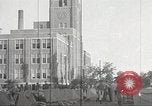
United States guards patrol against striking workers at Kohler Company (Wisconsin) and during truck men's strike in Minnesota
United States troops guard labor strike areas in the United States in 1934. Kohler Company building exterior (RPPC General Offices building). State troopers and National Guard on grounds in Kohler, Wisconsin, near Sheboygan, Wisconsin. Broken windows of various Kohler Company buildings and its showroom. Walter J. Kohler Sr., President of Kohler Company, and former Governor of Wisconsin, walks out of a building. Closeup view of Walter Kohler Sr. who tips his hat to unseen persons and says a few words. Scene changes to Minneapolis, Minnesota, where National Guards patrol the streets to prevent rioting during the Truck men's strike in Minneapolis. National Guard among citizens in shopping and retail areas of Minneapolis.