


 Francais
 Deutsch
 Italiano
Refine Your Search
+"United States USA" +1937 stock footage and images
- Showing 7 to 12 of 260 results more
more Hide
Hide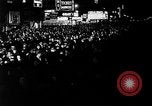
Illuminations viewed from center of Times Square, during New Year's celebration, January 1, 1937. Brief views of crowds.
Large crowd gathered to celebrate New Year (1937) in Times Square, New York City. Neon signs on buildings advertising many places including: "Parlors", "Leblang", and "Theater Ticket", The Rialto and Criterion theaters are seen, as is the Camel sign. Illuminated advertising messages move around the face of the Times Building. The crowds are seen from time to time, as they become illuminated for the camera.
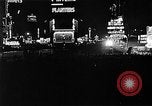
Large crowd celebrates New Year (1937) in Times Square, New York City, United States. Numerous illuminated signs are seen.
Large crowd gathers to celebrate the New Year (1937) in Times Square, New York City, United States. Numerous neon signs are seen. Examples include a "Planters Peanuts" sign that shows peanuts pouring from a package, and signs advertising product names such as: "Camels"and"Coca-Cola." A blinking "Vaudeville" sign is seen. The Criterion movie theater advertises a James Cagney film. Loews theater marquee announces Joan Crawford and Clark Gable appearing in the film "Love on the Run."
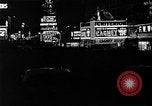
Times Square, New York City, New Years, 1937. Crowds celebrating. Numerous lights and neon signs.
Large crowd gathers to celebrate the New Year, 1937, in Times Square, New York City, United States. People shouting and blowing horns. Neon signs advertise products such as "Coca-Cola." The Criterion movie theater (cinema) advertises a movie called "Great Guy" starring James Cagney. Loews State movie theater marquee announces the film "Love on the Run" starring Joan Crawford and Clark Gable.
Crowd celebrating the New Year, 1937, Times Square, New York City. People seen at brief intervals as light sweeps across crowd
The lights of Times Square as seen in the first few minutes of 1937. Neon signs advertise places and products, such as "Coca Cola" and "Planters Peanuts." A klieg light sweeps across the crowd, sporadically illuminating the revelers.
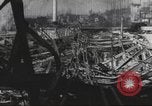
1937 Ohio Valley flood scenes, with major loss of property and life in the United States.
Damage caused by 1937 flood in the Ohio Valley area of the United States. A heavy loss of property due to a flood. Supplies being unloaded from trucks for the people. People being rescued from the areas affected by flood. Men aboard boats moving through buildings on the edge of the Ohio River that are submerged in water. Men moving a wooden casket. Destroyed houses and buildings in the areas. Flooded streets. A weather vane blowing briskly in wind. Narrator details how the weather bureau forecasts the weather and offers the information to help prevent losses from such disasters. Automatic typing machine records weather instrument readings. View of newspapers being printed at a printing press. A radio tower. People gather near injured flood victims. People lined up on the street to get supplies. Scenes of floodwaters below Memphis where flooding was effectively contained. Water rushing under the then new Bonnet Carre spillway of Lake Pontchartrain near New Orleans. Man opens a book published in Lisbon in 1605, now in the Library of Congress, written by Gabriel Lobo Lasso de la Vega, reporting on the exploration team of De Soto on leaf 300 of the book. De Soto's group, in 1543, reported on the flood they saw below current day Memphis, extending over 20 leagues of land, covering the tops of trees, but not overrunning the homes of the Native Americans who build shelter atop high poles. A view of submerged homes in the 1937 flood are shown as the narrator laments that more modern people did worse than the Native American Indians.
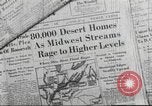
Flooding and rescue work in 1937 as Ohio River Valley floods
Damage caused due to flood in Ohio Valley , United States. Newspaper headlines read: '80000 desert homes as Midwest streams rage to higher levels'. People engaged in the rescue and relief work. Men aboard small boats as they carry on rescue work in the steets of downtown Louisville Kentucky. Buildings along the flooded area. Flooded buildings in Evansville Indiana and Paducah Kentucky. Flooded farms and fields washed away. Marooned livestock atop a levy. A dog atop a car. A cat perched in a 2nd story window just atop flood waters. Aerial views of the flooded Ohio Valley heading toward the Mississippi River. View of the blasting of the so called "fuse plug" in the levy below Cairo Illinois (on the Missouri Side at the junction of the Ohio River and Mississippi River) to prevent the flood waters from destroying Cairo. An army of workmen building extensions on top of the levees near Cairo Illinois to protect it from the flood. Water lapping at the wall built by the workers.