


 Francais
 Deutsch
 Italiano
Refine Your Search
+"United States USA" +1938 stock footage and images
- Showing 13 to 18 of 205 results more
more Hide
Hide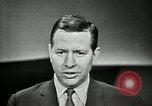
Major events of the 1930s include Wall Street crash, kidnapping of Lindbergh child, Hindenburg disaster, Spanish Civil War, etc.
'Retrospect' about the events that led to the present pattern of life in the United States. Host Douglas Edwards, an American television anchor speaks about the past events in America. Crowd of unemployed men gathering in bread lines after the 1929 crash and subsequent Great Depression. A man near a box of apples. The U.S. President Franklin Delano Roosevelt addresses a gathering. The kidnapping of Charles Augustus Lindbergh, Jr., the son of the aviator Charles Lindbergh in 1932. Bruno Richard Hauptmann, a German carpenter who abducted the child during the trial. The congressmen at the formation of the Lindbergh Law. Newspapers describe the apprehension or death of notorious mafia gangster criminals, such as Dutch Schultz and Baby Face Nelson. Huey Pierce Long, Jr. a American politician addresses people. Emperor Haile Selassie of Ethiopia appeals to the League of Nations, after his country is attacked by Italy under Mussolini. Adolf Hitler stands. Troops of the German army parade. Scenes from the Spanish Civil War in 1936-1937 as Spanish national forces battle against fascist rebel forces. Spanish Troops fire 75mm field artillery pieces. Bombs being dropped on the buildings. Spanish soldiers marching during the civil war. The Hindenburg disaster takes place on May 6th 1937: The German airship LZ 129 Hindenburg catches fire over the Lakehurst Naval Air Station in Manchester, New Jersey. Amelia Earhart the first woman aviator to fly solo holds flowers and is surrounded by people. She went missing in 1937. Cowboy philosopher Will Rogers, alone and with U.S. Vice President John Nance Garner and with aviator Wiley Post (who had patch over one eye). King Edward VIII of Great Britain, abdicating the throne for "the woman I love." People at the German-American Bund Nazi sympathizing gathering including the subduing of objectors on stage, in Madison Square Garden, New York. British Prime Minister Neville Chamberlain, returning from meeting with Adolf Hitler in Munich in 1938. View of Adolf Hitler. German tanks on parade in World War II. an array of artillery guns on display. Railway guns being fired in WW2.
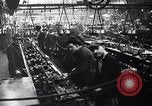
Labor Union movement grows significantly, but labor strife also continues during 1930s in the U.S.A.
Men work assembling transmissions on an automobile production line. John L. Lewis, President of the United Mine Workers Union, giving a speech supporting formation of the Congress of Industrial organizations (CIO). Group of workers gather to listen to a union speaker. Many wear miners hats. Cheering Union workers march in street carrying posters reading: "Long-Live the C.I.O." and "Forward with C.I.O." Leaders of the early C.I.O., Sidney Hillman, President of the Amalgamated Clothing Workers of America (ACWA); Philip Murray, Vice President of the C.I.O.; and John L. Lewis, C.I.O. President, circa 1938. David Dubinsky, President of the International Ladies' Garment Workers' Union (ILGWU); along with Sidney Hillman, and John L. Lewis, are seen mingling with clothing workers. View of a steel mill from workers' residential street on a snowy day. Steel worker in a mill. Deckhand and an engine man aboard a merchant ship. Roustabouts and riggers at an oil well. Nonferris metal miner in rail car. Worker in tire factory. Electrical worker. Union leader speaking to group of workers carrying banner reading: "Shirt workers, Local 128 Allentown, Pennsylvania Joint Board." Labor organizers passing out leaflets to workers leaving a factory. Labor discussions with workers at lunch tables. Draftsman preparing labor organization protest signs calling for "Sanitary Conditions" and "Fair Play." Working women singing a union song. Union workers marching and carrying signs for various causes. Man riding a bicycle displaying sign:"Don't Scab." Car overloaded with people with sign: "Come To Lafollette Labor Rally Monday, July 5, 1937." ACWA workers of Local 95, Atlas Plant. UMWA members of Lafollette, Tennessee. Miners playing cards and playing musical instruments. Miners on strike below in mine for 5 days, cheer leader. Poster encouraging Americans to travel and visit in the USA. Police with batons or billy clubs and military units repel, combat, beat, and arrest striking and protesting workers during labor disputes. Scenes of military uniformed men throwing tear gas grenades into crowds of workers as workers disperse. People assisting injured protesters. Police firing various weapons at protesting workers during labor protests and strikes in San Francisco. U.S. Army soldiers arresting a civilian and throwing tear gas grenades.
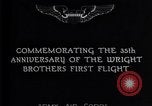
Documentary tilted 'History of Aviation' depicts benefits to mankind brought by development of means of travel, United States.
Documentary tilted 'History of Aviation' depicts benefits to mankind brought by discovery of aviation. A group of travelers on horses and bullock carts, in hot and dusty deserts travels from California to New York. A railroad train runs on railroad between California and New York. Howard Hughes' Lockheed 14 Super Electra Special, Model 14-N2 ( NX18973) seen in aerial views over Manhattan Island, New York City, with New York City skyline and skyscrapers visible. (scene filmed on July 14, 1938). Animated map shows ship sail towards Europe. Brief, distant view of a tall mast traditional sailing ship at sea with full sails deployed. A more modern passenger cruise ship or ocean liner with four large stacks underway in the ocean towards Europe. Howard Hughes airplane takes off in New York, bound for Paris, France.
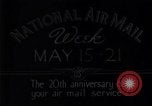
Men load mail bags on a plane.
Opening slate advertises "National Air Mail Week. May 15-21. The 20th Anniversary of your air mail service!" Men load a DC-3 airplane with mail bags at an airport in the United States. Transport truck brings more mail and men load the bags. 1918 Map of United States showing Air Mail connection between New York and Washington. 1923, 1928, 1933 and 1938 maps show further connections to cities such as Chicago, Salt Lake, San Francisco and other destinations. Brief view of International routes between Asia and the United States, and from the United States to South America. Men load mail bags on a plane. The DC-3 plane takes off. Dirigible in background. Closing slate, "Don't Forget. National Air Mail Week."
Career of U.S. Air Force General Henry (Hap) Arnold. Advent of World War Two.
Year 1938. Adolf Hitler gives speech. U.S. Army Major General Henry (Hap) Arnold is appointed Chief of the U.S. Army Air Corps. President Franklin D. Roosevelt with General Arnold in an open car, inspecting a new bomber. Sketches of various airplanes proposed to modernize the U.S. Army Air Corps, including Northrup A-17-A; Bell P-39; and Douglas B-23. Views of U. S. Army pursuit airplanes and North American BC-1 training aircraft. Paratroopers jump from C-47 aircraft. A P-38 lightning airplane maneuvers in flight.

United States citizens give isolationist views regarding potential war in Europe; New Deal programs in America in 1930s
The background of World War II. United States citizens state isolationist and anti-war views. They give their views regarding the beginning of war in Europe, and their desire for the United States to stay out of the war. Board reads 'No foreign Entanglements'. View of idle and closed factories during the Great Depression. Ground level, track level view of a railroad train approaching. Elevated view of homeless and unemployed hobo men riding on top of a train car. President Franklin Roosevelt signs Fair Labor Standards Act of 1938 assuring a minimum wage and maximum work week. View of factory workers arriving at a large factory or production plant for a work shift. Newspaper headlines read 'Social Security Laws Go into Effect'. Civilian Conservation Corps (CCC) workers seen hanging telephone lines, digging ditches, and building roads. Aerial view of new highways and clover leaf overpasses.