


 Francais
 Deutsch
 Italiano
Refine Your Search
+"United States USA" +1938 stock footage and images
- Showing 19 to 24 of 205 results more
more Hide
Hide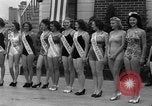
Miss Ohio Marilyn Meseke wins Miss America contest and poses wearing a sash in the United States.
Marilyn Meseke wins 1938 Miss America. The contestants wearing costumes lined up during the pageant at the Steel Pier (1000 Boardwalk, Atlantic City, New Jersey, U.S.) in Atlantic City, New Jersey. Miss Ohio Marilyn Meseke wins. Marilyn with Miss America crown. The winner poses with a sash.
General Motors guidelines for maintaining private cars during World War II, when none were manufactured in the U.S.A.
General Motors film entitled: "It's up to US," explains how to maintain private cars during World War 2, when all manufacturers switched to production of war materiel. Bugler, in U.S. Army uniform, blows reveille. Montage of American scenes, including homes and gardens; mountains; forests and lumberjacks felling a tree; an oil well gusher spewing crude oil; open pit mining operations; Niagara falls; flock of sheep grazing; workers picking cotton and it being delivered to a processing plant by horse-drawn wagon; a large timber log being cut into boards in a lumber mill; steel being manufactured for the war effort; a woman housewife or homemaker saving foods in a refrigerator in a vintage 1940s kitchen; a man cutting his lawn; a woman vacuuming her carpet; a woman taking clothes from a washing machine; a farmer plowing with a tractor; automobiles on American road and in parking lot of a defense plant. A driver with worn and dented 1938 Chevrolet Coupe car parked in front of a home is assisted by another who drives up behind him in a 1941 Oldsmobile and gives him a push. Sign at a Chevrolet service garage reading: "Official O.P.A. Tire Inspection Station." A 1942 Chevrolet 2-door fastback car drives into the garage. Mechanic greets driver and begins routine service, including: adding distilled water to battery; draining oil from car up on hydraulic lift. Scene shifts to a mechanic lubricates fittings on a 1937 Chevy on a lift at a gas station. Scene reverts to the earlier garage where mechanic drains cooling system, and refills it. The mechanic removes the carburetor and services it on a bench. He checks distributor rotor and makes compression checks. He cleans and re-gaps spark plugs, and checks tires and brakes. Cars driving on a town street. Mechanic aligning wheels on 1941 Chevrolet. Animated illustrations of tire wear from alignment problems. Servicing air in tire of 1942 2-door Chevy. More animated illustrations of tire problems. Illustrated explanation of rotation for bias tires.
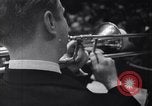
America plunged into World War 2. Montage of various World War II scenes over the span of the war years
American Jitterbug dancers seen at a contest in 1938. View of feet in shoes, as wearers tap their feet and beat time to music. View of drummer using wire brush on drum. Stadium of people cheer for a dancing cinematographer who is using a motion picture camera to film the event. In contrast, Nazi troops seen parading by torchlight. Nazi flags everywhere and Nazi party ceremonies, overseen by Adolf Hitler, in Germany. Nazis burning books. "Attention Jews" with skull and crossbones painted on stores and business establishments. Nazi Storm Troopers intimidating Jewish businesses and advocating boycott. Glimpse of Heinrich Himmler, in foreground, and Hermann Goering, in center of group of Nazi officials. Junkers Ju-87 Stuka dive bombers attacking Poland in 1939. German artillerymen firing heavy guns. A German railroad gun firing. German paratroopers jumping from Ju-52 trimotor transport aircraft. In contrast, patrons are seen descending in parachutes on the Parachute Jump ride at Coney Island Steeplechase Park, in Brooklyn, New York. Life Savers company sponsorship sign seen atop the parachute jump tower. People eating hot dogs, and firing guns at the shooting gallery on Coney Island's boardwalk. Germans march Polish prisoners of war. German troops invading Denmark and Norway. German troops passing a road sign for Chemin des Dames in Picardy, Northern France. Bomb exploding at Pearl Harbor, Hawaii, on December 7, 1941. American forces engaged in war against japan in the Pacific and against the Axis powers in Europe. U.S. soldiers throwing hand grenades. American wounded being carried on litters. People cheering liberating Allied forces in a European town. British soldiers on a vehicle displaying cartoon of Prime Minister Winston Churchill. Soviet forces advancing in snow. U.S. steel and war plants in operation. Men and women war production workers in American defense plants and war materiel factories, using drills, lathes, and power tools in the spirit of "Rosie the riveter." C.I.O. Poster to promote voting, during the war. Closeup of Sidney Hillman, President of Amalgamated Clothing Workers of America. Spectators line sidewalks to get glimpse of President Franklin D.Roosevelt (FDR) in a motorcade. Silhouette of two soldiers helping wounded comrade. FDR's funeral cortege. U.S. troops taking a break, in a war zone. American school children run into a field. An atomic bomb explosion.
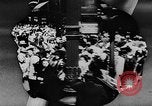
Montage of images reflecting life in 20th century America up to World War II
Streets of Manhattan New York City crowded with pedestrians prior to World War II. Views of Americans at work: miners; farmers; factory workers; office workers. A drafting room. Montage of inventions in America: lightning rod atop roof; cotton gin in operation; telegrapher using a key; anesthetists in operating theater; rotary newspaper printing press; a telephone; an arc welder; early incandescent lamp; early submarines; steam turbine; 4-engine high wing airliner; early X-ray tube; gyroscope compass; singer sewing machine; early television; farmer hooks cows to mechanical milking machine, cat expresses dismay at not getting milk; architectural draftsmen at work; rows of apartment buildings; automobiles crowding roads; sanitation street sweeper truck at work; eggs and dairy products in refrigerated case; Surgical team in an operating theater; Scenes in a modern U.S. hospital; children being cared for, and in schools and colleges; Soldiers marching during World War I; U.S. soldiers marching in World War II; people relaxing on crowded beach; recreational hunting and fishing activity; A football game in progress; a baseball game; horseracing; track & field events; a rodeo; a basketball game; golfing; Ten pin bowling; boys play marbles; frog jumping contest; skiing; springboard diving; motorboat racing; water skiing;ice skaters with sails; Joe Louis boxing with Max Schmeling in 1938; auto racing with cars crashing; Railroad timetables in a rack; Henry Dreyfuss Commodore Vanderbilt New York Central locomotive and interior of dining car; 1935 Chevrolet sedan pulling a trailer; Road sign "Arizona welcomes you"; Motorcycle policeman pulls driver over; roadside motor hotel; girl serving at drive-in diner; signs for hot dogs, beer, cheesburgers; workers preparing sandwiches, pancakes,bacon and eggs, coffee and coca cola, using some machinery; Customers eating at a lunch counter; Welcome sign at Van Nuys California with symbols for Kiwanis, American Legion, Rotary; a Delta Sigma Phi fraternity building. Scene of a person's hand signing a membership certificate document for the Calibou Lake Mountain Club.
Dr. Ad Hoi Tailor works at a radar and an animation shows the operation and the use of the radar in the United States.
Operation and the uses of the radar. A radar with 'XAF installed 1938' written on it. Allied civilian scientist Dr. Ad Hoi Tailor, Chief of Electronic Science Development and his assistant Mr. Lio Se Young at work. A diagram shows the operation of the radar. A dot of voltage barrier at a florescent screen. An animation shows how a radar traces an enemy plane. Radar equipped planes detect enemy fleet. A light mover in the radar. (World War II period).
U.S. Navy Dr. Walt Miner gives historical background of LSD (Lysergic acid diethylamide) drug in the United States.
The film gives an introduction and briefs the history of illegal drug LSD (Lysergic acid diethylamide). U.S. Navy Doctor Walt Miner speaks about revealing the facts about LSD which can be documented. He speaks about the historical background of LSD. He says that LSD is synthesized from lysergic acid derived from ergot, a grain fungus that typically grows on rye. He says that ergot is a fungus that grows on grains and other cereals. He speaks about Swiss chemists Albert Hofmann and Stahl who tried to make modifications in LSD molecule in 1938. He mentions the event of 1943 when Dr. Hofmann intentionally ingested 250 micrograms of LSD in his laboratory and how he felt uncomfortable. Dr. Walt Miner further explains how unique and powerful LSD drug is and says that the most unique thing about LSD is effective dose of the material. Miner states that effective dose for LSD can range from 0.5 micrcograms to 1.5 micrograms per kilogram of body weight.To explain the effective dosage of LSD, he displays a piece of wax paper where a mark is made with a pen. A penny is placed beside that mark to compare the two sizes. Dr. Miner informs that the ink mark weighs some micrograms. Dr. Miner takes one drop of human blood from a tube and says that this one drop contains 330 million cells and in comparison to that the weight of LSD to produce its effect is equal to the weight of two blood cells.