


 Francais
 Deutsch
 Italiano
Refine Your Search
+"United States USA" +1942 stock footage and images
- Showing 13 to 18 of 520 results more
more Hide
Hide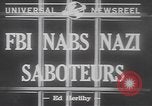
The FBI arrests eight Nazi German spies after they landed off the coast of the United States (WW2)
Nazi German spies attempting sabotage are caught in the United States during World War II. A sign on a building reads 'Federal Bureau of Investigation'. An official at a desk inside an office. A submarine underway at sea as a crew member looks through a periscope. Pictures of Nazi German would-be saboteurs caught by Coast Guard personnel and apprehended by the FBI after they landed near the coasts of Amagansett, Long Island and Ponte Vedra Beach, Florida. (This was Operation Pastorius which disrupted a Nazi German sabotage plot on U.S. soil in 1942.)
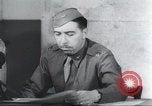
U.S. B-17 crews of 8th Air Force are debriefed by intelligence officer upon return from a mission, during World War II.
U.S. 8th Air Force B-17 crew is debriefed by an intelligence officer immediately after returning from a bombing mission during World War 2. In response to his questions, the crew members describe being hit by enemy fire, damage to their aircraft, and attacks by German Fw-190 and Me-109 fighter aircraft. A gunner tells of shooting down a German plane that flew underneath their B-17. Narrator Richard Cordon seated at a desk speaks to camera in a public service announcement, and appeals to capable American mechanics and men under 50 who are handy with tools to volunteer for service with the Army Air Forces. He reads a notice of the U.S. Army Air Forces dated October 1, 1942, inviting civilian mechanics to service with the Army Air Force. Views of mechanics performing various maintenance duties on parked B-17 bomber aircraft. Mechanics work on a B-17 aircraft with name "Baby Doll" on it. A mechanic works on a propeller of B-17 aircraft with nose art and name "Birmingham Blitzkrieg." A mechanic evaluates a machine gun in side door of a B-17 aircraft named "Shoot, You're Faded." Close-up view of notice from the U.S. Army on its letterhead, appealing for mechanics up to 50 years of age.
Scenes of Japanese attack on Pearl Harbor in World War II; launching of cargo ships and ships at sea
The legislative and maritime history of the U.S. Merchant Marine. Japanese air raid on Pearl Harbor in Hawaii on 7th December 1941. Dramatized view of Japanese airplanes in flight over Pearl Harbor. They drop bombs over the target area. Actual footage of Japanese attack on Pearl Harbor with heavy columns of smoke rising as ships explode. U.S. sailors on the deck of a ship. The activities at a U.S. shipyard. Launching in July 1942 of the SS Ocean Viceroy, built by Permanente Metals Corp in Richmond California for the British Ministry of War Transport. People gather at the shipyard as the SS Ocean Viceroy is launched. A ship convoy underway at sea of various cargo ships and Liberty Ships in World War 2. The U.S. flag flying from a flag pole on a ship. The sailors march on the deck.
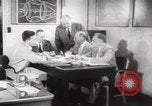
General Electric producing the first American jet airplane engine. Bell Aircraft building first U.S. jet powered airplane.
General Electric Company engineers work on designs for America's first jet aircraft engine during World War 2. In the company's plant, at Lynn, Massachusetts, machinists make parts for the engine and others assemble it. Company executives conversing about the enterprise. On April 18, 1942, the first engine produced is rolled into a test cell for operational testing. Engineers pull down the door to the test cell displaying the words: "Fort Knox." Engineers at control panel of the test cell. View into the test cell. GE Project manager, Donald F. Warner, actuates toggle switch to "on" position, and the engine ignites. Flame seen in rear of the engine. Complete change of location. View of Bell Aircraft company buildings. Bell engineers working on design of an airplane designated, XP-59A (Airacomet) to be powered by the new General Electric jet engine (later designated J-31 by the military). Views of the Bell engineering and production activities at secret facilities in Buffalo, New York. Two Bell workers expressing reservations about airplanes without propellers. A main intersection street scene in Schenectady, New York. Pedestrians walking and shopping. An F.W. Woolworth store on the corner. Copy of the Schenectady Gazette Newspaper, with headline about 500 planes raiding Berlin. A man buying a copy of the paper.
First flight of Bell YP-59A aircraft. GE develops J-33 jet engine. First flight of Lockheed P-80 jet fighter.
Official films of the flight of Bell YP-59A Airacomet jet-powered airplane, October 1, 1942. Workers at the General Electric plant in Lynn, Massachusetts, producing versions of increasingly more powerful jet engines: the I-16 with 1600 pounds of thrust and the J-33, with 4000 pounds of thrust. First flight, January 8, 1944, of a Lockheed P-80 shooting star fighter jet powered by the J-33 engine. Formation of P-80 fighter planes in flight. (World War 2 period.)
U.S. aircraft carriers USS Belleau Wood and USS Bunker Hill, and battleship USS New Jersey are launched in the United States.
Launch of two aircraft carriers and a battleship in the United States during World War II. People gathered at shipyards of New York Shipbuilding Corporation for the launch of the USS Belleau Wood (CVL-24). Sponsor Mrs. Thomas Holcomb seen with U.S. Marine Corps General Thomas Holcomb. Mrs. Holcomb christens the ship as it launches. Scene shifts to Fore River Shipyard in Massachusetts and launching of the USS Bunker Hill (CV-17). The aircraft carrier slides down skids into the water. Scene shifts to Philadelphia Naval Shipyard on the same day, December 7, 1942, as the launching ceremony for the Battleship USS New Jersey (BB-62). Carolyn Edison, wife of New Jersey Governor Charles Edison is seen christening the ship and it then slides into the water. Two boats underway in the background assist with positioning the Battleship.