


 Francais
 Deutsch
 Italiano
Refine Your Search
+"United States USA" +1942 stock footage and images
- Showing 31 to 36 of 520 results more
more Hide
Hide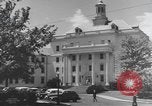
Setting up of hospitals to treat veterans suffering from neuropsychiatric disorders in the United States.
Medical facilities related to neuropsychiatric disorders being provided by the Veterans Administration in the United States. Exteriors of a V.A. hospital building. Animation shows the increase in number of neuropsychiatric patients from 1942 to 1950 and forecasts growing through the 1980s. Narrator describes high prevalence of such problems among veterans. (Also known as "shell shock" or, more recently, Post Traumatic Stress Disorder, or PTSD.) Exteriors of hospitals and training schools where neuropsychiatric specialists train. A doctor talks to a patient in a bed. Neuropsychiatric research being conducted in a laboratory. A technician works on an instrument. A neuropsychiatric specialist being trained. A technician works on an instrument. Psychiatrists discuss. They give various therapies to patients like the shock therapy, the socializing therapy in which a patient plays golf.

A hospital under the Veterans Administration that treats patients suffering from various diseases in the United States.
Medical facilities related to medicine and surgery being provided by the Veterans Administration in the United States. A graph depicts the increase in number of patients suffering from medicine and surgical diseases up to 269% from 1942 to 1950. Two war veterans at a hospital as they recover after an ailment. A surgery being performed. A pathological conference being conducted. Specialists give on the spot directions as they look after the patients. Doctors examine patients as they take X rays. A doctor looks after veterans suffering from various diseases. Patients at a hospital suffering from tuberculosis. Patients in wheel chairs. Women lying down in a garden. A doctor takes a patient's X ray. He looks at the X ray film.
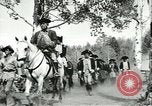
American forces prepare for war; ASF Lieutenant General Brehon B. Somervell addresses officials (WW2)
Continental Army cavalry riding horses and soldiers marching in an American Revolutionary War reenactment. Continental Army soldiers carrying the wounded on their backs under heavy rain. United States Army soldiers marching in New York City during World War II. Views of enormous numbers of U.S. Army soldiers marching in formation. Large columns of U.S. Army soldiers seen approaching camera position and from above. A soldier with an Army Service Forces (ASF) patch marching. Close up of the Army Service Forces (ASF) patch. Commanding General of the ASF Lieutenant General Brehon B. Somervell smiling. A notice detailing the War Department Reorganization effective March 9, 1942. Army Ground Forces commander Lieutenant General Lesley J. McNair. Army Air Forces Commander General Henry H. Arnold. General Somervell and Army Chief of Staff George C. Marshall. Soldiers advance towards a battlefront. Wounded are evacuated from the area. The soldiers stand in formation. Officials seated at a desk. General Somervell addresses them and speaks on the value of war material. A dead German soldier in tank. Dead bodies of Japanese soldiers scattered on the beach in the Pacific. Tires and scraps for use by the army. A newspaper advertisement reads “Your scrap will save some brave boy’s life!”. Ceiling prices listed in grocery store during wartime. Japanese planes bombing Malaya and Singapore. Burned houses after Japanese bombardment in Asia. A burning house in China. An oil tanker explodes and burns after being bombed at sea. Tanks advance towards the front. Generalissimo Chiang Kai-Shek and wife Soong Mei-Ling (Madame Chiang). An airplane in flight, bombarding a target area. Prisoners of war standing. Dead bodies lying on the ground. Destroyed area after an enemy attack. The soldiers and the tanks advance towards the battlefront. Barrage balloons in flight overhead. Allied flags on display such as the Soviet Union and England.
The U.S. Army Quartermaster Corps store procured supplies and enlisted men are trained in quartermaster operations (WW2)
The United States Army Quartermaster Corps in the United States during World War II. A diagrammatic comparison of army manpower of 8,000,000 in December 1943 as against 1,750,000 in December 1941. A diagrammatic representation of huge increase in volume of obligated procurement in 1942 as against 1941. Men wheeling carts of supplies at a store. Men carrying supplies coming down a gangway from a ship onto a dock. Soldiers with guns standing on the dock. Soldiers moving through a wooded area. Men carrying the procured materials for storing. Officers watching the men. Two soldiers wearing their uniforms. People and vehicles moving on a city street. A signboard on a building reads 'Office of the Quartermaster General War Department'. The headquarters building in view. A map of the U.S. showing locations of different procuring offices across the nation. Men and women working in an office at the headquarters. Petroleum, Subsistence and Textile sections at the headquarters. Officers working in the headquarters. Men getting into a truck. Enlisted men being trained in various quartermaster operations at a training center.
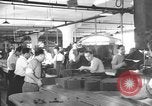
Small war plants' participation in U.S. Army Quartermaster Corps supply program in the United States (WW2)
United States Army Quartermaster Corps supply program in the United States. Workers at small war plants during production of different materials and military uniform parts in World War II. Two officers looking at a sample fur cap. U.S. military personnel with Quartermaster Corps officers seated around a table discuss procurement of materials in association with small war plants. A diagrammatic representation of the increase in the number of purchase transactions and the volume of dollar purchases as a result of the small war plant participation in the Quartermaster Corps supply program for the period of November 1942-43. War produciton workers at the war plants.
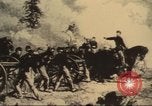
Union soldiers print the first issue of Stars and Stripes newspaper during the Civil War in the United States.
The history of the Stars and Stripes newspaper. Union soldiers print the first issue of Star and Stripes newspaper in a captured press in the U.S. on 9th November,1861 during the Civil War. World War I scenes show soldiers disembarking from a ship and advancing on a battlefield. Commanding Chief of the American Expeditionary Force John J. Pershing writes for the newspaper. Soldiers greet the Chief and wish him luck. After the end of World War I newspaper publication is ceased. During World War II the newspaper publication starts in London, England in 1942. Publication of the Pacific Stars and Stripes newspaper after the end of hostilities in Europe. Headlines in various editions of the Stars and Stripes.