


 Francais
 Deutsch
 Italiano

Refine Your Search
+"United States USA" +1942 stock footage and images
- Showing 367 to 372 of 520 results more
 Hide

Seven brothers and their father (all navy men) pose on a cruiser in the United States.
Seven brothers and their father in the U.S. Navy in the United States. A bus halts. A father (US Navy personnel) welcomes and greets his seven sons (all navy men) as they get off from the bus. The brothers and their father seated on a desk. The eighth brother swears to join the U.S. Navy. The brothers with their father pose near a big gun of a cruiser.
U.S. Army Air Force gunners reassemble and disassemble weapons during a training in the United States.
Training of U.S. Army Air Force gunners in the United States. United States aerial gunners do physical exercise. The gunners are blind folded. They disassemble and reassemble weapons. A gunner boards an airplane with a gun. The gun is equipped with a camera. Airplanes in flight showing aerial combat.
Tanks roll off an assembly line in the United States and advance in a battle field.
Assembly and transportation of tanks in the United States during World War II. A tank manufacturing plant. Tanks drives down a hilly terrain. Tanks roll off an assembly line. The tanks are assembled as parts are carried via an overhead crane. Equipment of steel, rubber, tin and aluminum to be used in assembly of the tanks. Men work on the tanks. The tanks are transported via trains and ships. Ships at sea. The tanks advance in a battle field.

Women training and working at war materiel factories in the United States (WW2)
Soldiers on tanks fire artillery mounted on the tanks. Aircraft in flight. Views of explosions in the battlefield. Soldiers walk in lines. The soldiers in front of tents. Anti-aircraft artillery crew fire at enemy aircraft during World War II. New recruits in civilian clothes arriving for training in military armed forces in the United States. Men are trained for the army. Workers in an American factory make war equipment and war materiel. Men work on airplanes. They carry tire tubes for aircraft. People move inside an aircraft production building. Women stand in a line. Women workers report at a war production plant. A woman is being interviewed. Female war materiel workers are seated on benches and an official briefs them about the job. The women receive uniforms including a one-piece coverall uniform, wiping cloth, a cap, hairnet, and safety glasses or safety goggles, and a towel. A woman takes out uniforms from shelves in a closet. A woman wears a pair of glasses and a cap. Women move inside the production factory on the factory floor. A female worker teaches another woman how to operate a lathe. A liquid comes out of a pipe of the machine in operation. Two women work on the lathe. A truck in front of the receiving department. Women at a table make a note of the incoming material. Women work with hammer on a sheet. Women check for flaws in the raw materials. American flag seen on the wall above the women workers.
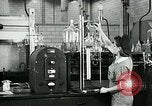
Women work on equipment in a laboratory and on various machines in the United States (WW2)
Female war production workers working in a laboratory during World War II. The women work with chemicals and on specific equipment. A woman takes out a material from a flask containing a liquid with the tongs. Bottles of chemicals kept on a table in the laboratory. Women weigh chemicals on a weighing machine. Narrator mentions their work making turbo superchargers and other parts for military aircraft. Women war production workers operate milling machines, lathes, grinders, tapping machines, punch presses, Natco multiple drill press, hydraulic presses for war materiel manufacture.
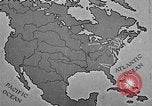
British film intended to acquaint British people with United States landscape, rail transportation, and farming history.
British World War 2 era film showing scenes in the United States from earlier in the 1900s. Film opens showing 19th Century animated map of the United States. It traces the development of the railroads in the U.S. It shows rail lines reaching the Missouri River by the year 1860. (Narrator states this took 250 years to happen.) But in another 10 years, the map shows the Union Pacific and other rail lines extending two the West Coast, and U.S. commerce shifting, from North-South movement, to East-West (with an animated steam locomotive moving across the map). Chicago is highlighted as the greatest railway junction in the world (the "Piccadilly Circus" as the British narrator describes it). View of a late 1800s model steam locomotive train pulling freight railroad cars on railroad tracks in a desert area of the Western United States. Point of view from camera on moving railroad train pointing straight down at railroad tracks moving by at high speed. Landscape and wide views of the arid Western parts of the U.S. Group of Native American Indians watching a railroad train pass. Construction supplies being offloaded from a train. A wind-driven water pump. Buffalo herds affected by the railroads. Wire fencing installed to control cattle on large Western ranches. Large team of horses pulling late 1800s wheat harvesting farm equipment as it harvests wheat in fields. Views of wheat grains being poured at high volume. Cattle roaming in the high country. Views of Chicago stock yards. A man marking in chalk on a Board of Trade chalk board, indicating the prices of farm commodities including wheat, corn, oats, and rye. Various views of steam locomotives pulling trains throughout the rail network, including some 20th century trains near the end of the film, and some close-up views of wheels turning fast on moving railroad trains.