


 Francais
 Deutsch
 Italiano

Refine Your Search
+"United States USA" +1942 stock footage and images
- Showing 373 to 378 of 520 results more
 Hide
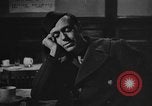
Model community, growth in cities, and town meetings in the United States.
A U.S. Army soldier seated on a chair takes a nap. A cup kept in front of him on the table. Children walking on sidewalk in small town America. Downtown view of small Indiana town. View of an American family of a small town seated in dining room for a dinner meal. Children exit a one room school house. Both a well-kept high school building and a rural simple school are shown, with boys and girls in bare feet exiting the poor rural school down a wooden ramp. Men lined up for work. Children playing in slum and tenement areas in poverty stricken areas. Quick views of skyscrapers, new schools, buildings, colleges (including view of Rice University in Houston Texas) and art galleries in the United States, including the National Gallery of Art entrance. A Texan in a cowboy hat delivers a John Randolph famed "Texas Brag" saying, "If all the hogs in Texas were one big hog, he could dig the Panama Canal with three roots and a grunt.” The National Gallery of Art in Washington, D.C. Labor organizer John L. Lewis, president of the United Mine Workers of America (UMW) states, "The American Federation of Labor can help if it will, it can uphold anything, but we shall carry on." An American town hall meeting in progress. (World War II period).

"Fight Syphilis" describes the effects of syphilis and the areas at risk in the United States.
Treatment and effects of the venereal disease syphilis in United States. A veteran crippled due to syphilis stands as United States veteran troops of World War I march on the street. The World War 1 veteran sits on a high-back wheel chair as a boy pushes him along a sidewalk past community homes. Scientists and chemists work in the laboratory for the detection and cure of syphilis. Technicians works with pipettes and vials. Research for new treatment of syphilis. A microscope kept near a chemist. Patients stand as their tests come negative or positive. A patient takes injections for treatment. A view of colleges (male students playing chess), schools, U.S. Navy ships, and other institutions where infected people come in intimate contact and the disease spreads fast. Animated diagram explains the spread of the disease. A man reads the advertisements of a medical quack. The syphilis cripples men. A patient sits on a chair. Patients sit outside a doctor's room. Houses on animated map without shadow of the disease.

United States President Franklin Roosevelt checks facts and figures about aid sent to Allied countries.
United States provides aid to Allies. United States President Franklin Roosevelt seated in his office. Lend Lease Administrator Edward R. Stettinius reports to President Roosevelt about the aid provided to her allies. Lend-Lease shipments prepared and shipped. Merchandise, tanks, planes sent to Soviet Union and Britain. Rail cars carry crates of machine tools made by Bullard Company in Bridgeport, Connecticut. These crates are seen being loaded in a ship destined for the Soviet Union. A ship at sea. Smoke rises up from smokestack. (World War II period).
U.S. High Command Leaders hold war planning parley in United States (WW2)
United States High Command holds World War II war planning parley. The U.S. High Command leaders stand and talk. General Henry (Hap) Arnold, General George Marshall, Admiral Ernst King, Admiral Land, Admiral William Leahy, Presidential advisor, Harry Hopkins, Paul V. McNutt, Civilian Head of Manpower, and Elmer Davis, Head, Office of War Information, in the conference. The personages are seated on a table. Food served on the table.
Flat-bottom tank carrrier ships launched.Henry J Kaiser with model of victory ship.Launch of the "Robert E. Peary" Liberty ship
United States shipyards launch ships flat-bottom tank carriers. A large number of vessels are produced in order to meet the requirement of World War. Henry J Kaiser assembles model of a victory ship. A ship named 'Robert E Peary' is built in record time. Huge crowd gathered during the launch of the ship.
American home front life during World War II. Reminders of American historic involvement in earlier conflicts since the Revolution.
American revolutionary soldiers march in reenactment of post-revolutionary past. They are led by two drummers and a fife player. American soldiers charge from their trenches in France during World War I. A man removes an antique musket from a wall. Two men converse in a rural agricultural area, in America during World War 2. The men look up in the sky as some U.S. Army Air Forces fighter planes fly overhead. An exploding bomb is artificially superimposed upon a typical residential street in an American neighborhood. The exploding bombs are next seen in Europe during World War II. Buildings are destroyed. Fires rage and heavy smoke fills the air. Views of destroyed cities.