


 Francais
 Deutsch
 Italiano
Refine Your Search
+"United States USA" +1943 stock footage and images
- Showing 133 to 138 of 523 results more
more Hide
Hide
General Motors guidelines for maintaining private cars during World War II, when none were manufactured in the U.S.A.
General Motors film entitled: "It's up to US," explains how to maintain private cars during World War 2, when all manufacturers switched to production of war materiel. Bugler, in U.S. Army uniform, blows reveille. Montage of American scenes, including homes and gardens; mountains; forests and lumberjacks felling a tree; an oil well gusher spewing crude oil; open pit mining operations; Niagara falls; flock of sheep grazing; workers picking cotton and it being delivered to a processing plant by horse-drawn wagon; a large timber log being cut into boards in a lumber mill; steel being manufactured for the war effort; a woman housewife or homemaker saving foods in a refrigerator in a vintage 1940s kitchen; a man cutting his lawn; a woman vacuuming her carpet; a woman taking clothes from a washing machine; a farmer plowing with a tractor; automobiles on American road and in parking lot of a defense plant. A driver with worn and dented 1938 Chevrolet Coupe car parked in front of a home is assisted by another who drives up behind him in a 1941 Oldsmobile and gives him a push. Sign at a Chevrolet service garage reading: "Official O.P.A. Tire Inspection Station." A 1942 Chevrolet 2-door fastback car drives into the garage. Mechanic greets driver and begins routine service, including: adding distilled water to battery; draining oil from car up on hydraulic lift. Scene shifts to a mechanic lubricates fittings on a 1937 Chevy on a lift at a gas station. Scene reverts to the earlier garage where mechanic drains cooling system, and refills it. The mechanic removes the carburetor and services it on a bench. He checks distributor rotor and makes compression checks. He cleans and re-gaps spark plugs, and checks tires and brakes. Cars driving on a town street. Mechanic aligning wheels on 1941 Chevrolet. Animated illustrations of tire wear from alignment problems. Servicing air in tire of 1942 2-door Chevy. More animated illustrations of tire problems. Illustrated explanation of rotation for bias tires.
Documentary titled 'Why We Fight, The Battle of Russia' depicts history of battles fought by Russia defeating invading armies.
A documentary titled 'Why We Fight, The Battle of Russia' depicts battles fought by Russians, fighting military raids from other nations. Dramatized scenes of invasion of German knights in 1242. Town Pskov destroyed and civilians roped. In the battle of Novgorad, the Russians under emperor Alexender Nevesky defeat the Germans in a fierce battle. The Swedish attack Russia and get defeated by Russian army in battle of Poltava in 1704. French troops retreat in a frozen desert after getting defeated by Russians in 1812. German Kaiser Wilhelm II inspects World War 1 troops on Eastern front in 1917. Russian army of cavaliers and infantrymen march for battle. Map shows a part of Russia, Ukraine occupied during the battle. (World War II period).
Japanese American doctors, nurses and dentists work at relocation centers in the United States during World War 2
Japanese- American surgeons at an operating theater at a relocation center (internment camp) in the United States during WW2. A dentist and his assistant take care of a patient. A Japanese American woman lab technician examines a specimen using a microscope. New born babies taken care by Japanese-American nurses. Student nurses learn lessons at the hospitals.
Children of Japanese Americans go to school inside a relocation center during WW2.
Japanese American children at school in a relocation center (internment camp) during World War 2. The U.S. flag on a relocation center. Young children in Kindergarten class. Teachers teach small students in a primary class. Girl student in the class solves problems. Students learn to play basketball at a court. Slate notes, "How do they react to the rising tide of racial prejudice? Well, here's one answer -- a growing feeling among the older Japanese that they will be permanently segregated and become wards of the United States, like the American Indian. Thus willing hands erect more permanent school buidlings." View of Japanese-American worker-residents in the camp building school buildings. Nisei students and American teacher at a high school. A girl solves trigonometry problems, standing at the black board in a class room. A student arranges drawers in a rack. Older Japanese-born men and women (Issei) learning in a school classroom. A student writes answers on the blackboard.
Japanese American children and infants at an orphanage play, dine and sleep together at relocation center during World War II.
Nisei, the Japanese Americans of second generation, at relocation centers (internment camps) during World War II. Infants and children at a Japanese orphanage play in a garden. Girls play on a see saw, swings and slides. Orphans dine at a mess and talk. A nurse assists infants sleep on their beds at a dormitory.
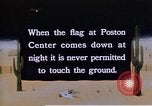
Japanese Americans lower the U.S. flag, soldiers drive in armored vehicles, and Nisei soldiers train for combat operations (WW2)
Japanese Americans lower the United States flag at Poston War Relocation Center (internment camp) in Arizona, during World War II. They fold the flag carefully. Elevated view looking down on armored vehicles and tanks during a military parade in the United States. Nisei (second generation Japanese-American) U.S. Army soldiers of the 442nd Regimental Combat Team seen in training for combat operations, at a military base in the United States. Slate notes that their slogan is "Go For Broke" and quotes a soldier as saying, "We have more to fight for than you do. Of course, we fight for our country, America, but we are also out to redeem the name of our race." Japanese- American soldiers navigate an obstacle course in Army training.