


 Francais
 Deutsch
 Italiano
Refine Your Search
+"United States USA" +1943 stock footage and images
- Showing 13 to 18 of 523 results more
more Hide
Hide
Army Signal Corps receive and send messages via various methods in World War II; Pentagon signal center operations.
The role and contribution of the U.S. Army Signal Corps in combat during World War 2. Submarine cables laid down by the Signal Corps. Soldiers operate field army communication equipment for communication within and between units. Soldiers talk over the radio in a military jeep. American soldiers employ communication equipment seated at a table in a camp. A U.S. Army Signal Officer goes through documents. An officer receives a message in Washington DC. The message is relayed from the State Department to the Signal Center in the Pentagon building. Exterior views of the Pentagon building circa 1943 or 1944. Inside the Army Communications Signal Center in the Pentagon, technicians work using various communication equipment. They receive messages punched on tape as the tapes emerge from machines. Workers encoding and decoding secret and confidential messages that run the war. Workers at the 'Traffic Control, Army Command and Administrative System'. Paper messages seen gliding across a track near the ceiling above a signboard. A man inserts and removes cables from switchboard slots. The plans are then passed on in code through a maze of antennas all over the world. An animated map depicts the sending of these messages by radio multi-channels, radio teletypes, and manual radios to the front lines. A vast network of Army communication system from Washington DC to the rest of the world to carry a message around the world in three and a half minutes.

Destroyer Escort USS Frament, DE 677, is built and launched. Destroyer Escorts fitted out, readied for shakedown cruise
U.S. Destroyer Escort USS Brennan, DE-13,underway. U.S. navy crew aboard the ship. View at shipbuilding area of Bethlehem Steel in Quincy, Massachusetts. Keel is laid and shipbuilders busy on day 60 of construction of DE-677, the USS Frament. Scenes of construction. Welding steel plate. DE-677 is christened USS Frament and launched on June 28, 1943. Destroyer Escorts at pier, being fitted out. New ship's crew assembled on pier and boards for shakedown cruise. Supplies and munitions loaded on board the ship, including ammunition, depth charges, and torpedoes ("tin fish").

World War 2 film promoting public investment in War Bonds and stamps to aid the war effort and temper inflation
World War 2 era film that also includes some World War 1 scenes. Show girls or chorus girls in follies-like show, costumed as U.S. silver dollars and marching to tune and lyrics alluding to dramatic increase of currency in circulation, over the years. Animation with stacks of coins shows increase in national income from $46 billion,in 1933, to $71 billion, in 1939, and $142 billion in 1943. Back to the "follies dollars," a boy asks why, and then scenes of the Japanese attack on Pearl Harbor,are shown, with U.S. battleships being sunk. Wartime arms plants are shown. An M2A3 Light Tank rolls off a production line. Ships being constructed in a shipyard. B-24 Liberator bombers being built in a factory. Artillery shells being produced. Defense workers receiving their pay. The "follies dollars" group themselves to illustrate the fractions of income devoted to taxes and savings. But other spending is curtailed by wartime shortages. A woman talking with clerk in a drug store. U.S. Army troops crossing a pontoon bridge in open trucks, towing 75mm M1A1 howitzers. Infantry on the march. Animation showing industrial production devoted to war materiel and lots of dollars chasing few civilian goods. A grocery clerk offers to sell a woman customer butter for more than the established price, and she agrees. The "follies" performers then introduce the idea of an "inflationary dollar," and some history of past U.S. inflations. Animated examples of price inflation are shown. Glimpses of World War I scenes are seen, circa 1917 -1918, including: a 12-inch railway gun firing; a huge explosion from shell bursting near the camera; various scenes of United States infantry soldiers and French soldiers in battle action, running to bomb craters for cover and emerging from trenches to go up "over the top" into no-mans land during combat. Meanwhile, singing narration refers to the home front inflation due to competition for limited civilian goods. Map shows Europe and singing narration cites rising prices for food in occupied France and other countries suffering ravages of World War II. Montage of scenes showing needy civilians obtaining food in those countries. Animation shows increases, by 1944, in cost of U.S. civilian goods since the Pearl Harbor attack. "Follies" character called "Double-duty dollar," appears explaining he serves the war and curtails inflation on the home front by being saved through investments in War Bonds and stamps.
Senator McKellar congratulates Senator Barkley on his reelection as Majority Leader after he resigned in protest over FDR veto
Senator Kenneth McKellar of Tennessee praises Senator Alben Barkley, following his reinstatement by a Democratic Conference as Majority Leader, after his resignation in protest over President Franklin D. Roosevelt's veto of the Revenue Act of 1943. Senator Barkley's secretary brings him a handful of congratulatory telegrams. She also tells him that the House voted 298- 95 to override the President's veto.
Launches of several U.S. Warships during World War II
Preparations for launch of the USS Hancock (CV-19) at Fore River Shipyard, Quincy, Massachusetts, on January 24, 1944. . Shipyard riggers removing supports from under the ship's hull. Platform at bow is decorated with bunting. Scene shifts to Brooklyn Navy Yard, New York, and the launching of the USS Missouri (BB-63), on January 29, 1944. Crowd gathered around the bow as the Missouri goes down the ways. Another change of scene to the Newport News Shipbuilding and Dry Dock Company of Newport News, Virginia. Here the ways are emptied following the launch of the Light Cruiser, USS Hancock (CL-81) on June 19, 1943. The Hancock can be seen in the water. Tugs attend to the newly launched Cruiser.
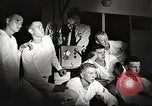
United States Navy sailors watch a movie about naval warfare in the United States; some scenes from World War 2 Pacific battles
A dramatized film about the training of U.S. Navy recruits at various naval training centers in the United States. The training and life of United States Navy recruits at U.S. Navy training center in Bainbridge, Naval Station Great Lakes in Illinois and Naval Base San Diego in California. The sailors watch a movie which depicts historic navy sailors on old masted sailing ships as they fire naval guns at another ship. The reenactment is of a 18th century or 19th century naval battle. The ship being hit by the enemy begins to sink. Sailors from the two ships in combat aboard a ship. Men jump into the sea and try their best not to give up the ship. A tall masted ship sinking. The naval gun canons aboard a ship being fired on another ship. Scene shifts to a mix of both authentic footage and several dramatized World War 2 combat footage scenes in the Pacific, circa 1943, 1944, or 1945, with U.S. Navy sailors on board ships firing at incoming Japanese aircraft. The enemy aircraft being shot down and they fall into the sea. A sailor clicks a picture of Japanese girls against a statue of Buddha. Narrator speaks about Navy recruitment. Sailors lined up on an open field during a ceremony at the U.S. Naval Academy.