


 Francais
 Deutsch
 Italiano
Refine Your Search
+"United States USA" +1943 stock footage and images
- Showing 307 to 312 of 523 results more
more Hide
Hide
People listen to the song 'God Bless America' sung by singer Kate Smith in the United States.
An American feature film 'This is The Army' depicts a performance by singer Kate Smith at the 21st anniversary of the armistice of World War I. Animated map shows Europe with fire in Poland. A man in the radio studio announces the name of Kate Smith on the stage, and noting the 21 anniversary of Armistice Day. A studio audience is present and applauds. Kate Smith introduces "God Bless America" as a new song, and then sings the song "God Bless America" with in-studio orchestra accompaniment. People watch the performance. An old man listens to the song, standing in front of his shop 'The Bugle Call.' He dusts a console radio with a feather duster and then goes inside and removes a bugle from a case labeled, ' Yip! Yip! Yaphank! 1918 ' At the Twardofsky business across the street, a man puts a small American flag into a basket as his father listens to the song on a small radio on the counter. People listen to the song in their houses and buildings. In a family living room: A couple seated in their living room listen to their console radio. A man, likely their son, seated at his desk listens to the song while studying. A woman looks at the photograph of a soldier, named Blake. Blake is then depicted listening to the same Kate Smith performance over a radio while stationed at Hickam Field in Hawaii. Characters Jerry Jones and Johnny Jones, played by actors George Murphy and Ronald Reagan are seen at the Jones and Jones production office. They listen to the radio. The character played by Ronald Reagan reads Variety Magazine.
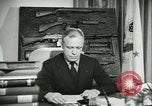
United States Undersecretary of War Robert P. Patterson speaks on the value of war materiel production in the United States (WW2)
United States Undersecretary of War Robert P. Patterson seated at a desk in his office. He addresses the nation and speaks on the value of war material. Patterson talks about production of ammunitions and supplies in the industries of the war department. “The demands of war is insatiable. We will never be satisfied as long as the war lasts,” Patterson said. Railroad train in snow. POV train engineer looking out snowy landscape. Production of war materiel in the United States during World War II. Steel mill operations with ingots being formed from hot metal. A sheet of hot metal emerges from a machine. Women war production workers sort and inspect aluminum sheet metal. Ships carrying supplies sailing an ocean. Crowds of factory workers walking outside war production factory in the United States. Trucks driving on mountain road.
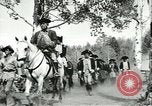
American forces prepare for war; ASF Lieutenant General Brehon B. Somervell addresses officials (WW2)
Continental Army cavalry riding horses and soldiers marching in an American Revolutionary War reenactment. Continental Army soldiers carrying the wounded on their backs under heavy rain. United States Army soldiers marching in New York City during World War II. Views of enormous numbers of U.S. Army soldiers marching in formation. Large columns of U.S. Army soldiers seen approaching camera position and from above. A soldier with an Army Service Forces (ASF) patch marching. Close up of the Army Service Forces (ASF) patch. Commanding General of the ASF Lieutenant General Brehon B. Somervell smiling. A notice detailing the War Department Reorganization effective March 9, 1942. Army Ground Forces commander Lieutenant General Lesley J. McNair. Army Air Forces Commander General Henry H. Arnold. General Somervell and Army Chief of Staff George C. Marshall. Soldiers advance towards a battlefront. Wounded are evacuated from the area. The soldiers stand in formation. Officials seated at a desk. General Somervell addresses them and speaks on the value of war material. A dead German soldier in tank. Dead bodies of Japanese soldiers scattered on the beach in the Pacific. Tires and scraps for use by the army. A newspaper advertisement reads “Your scrap will save some brave boy’s life!”. Ceiling prices listed in grocery store during wartime. Japanese planes bombing Malaya and Singapore. Burned houses after Japanese bombardment in Asia. A burning house in China. An oil tanker explodes and burns after being bombed at sea. Tanks advance towards the front. Generalissimo Chiang Kai-Shek and wife Soong Mei-Ling (Madame Chiang). An airplane in flight, bombarding a target area. Prisoners of war standing. Dead bodies lying on the ground. Destroyed area after an enemy attack. The soldiers and the tanks advance towards the battlefront. Barrage balloons in flight overhead. Allied flags on display such as the Soviet Union and England.

"Movies at War" about Motion picture films being made by and for the U.S. Army during World War II.
Moviemaking and distribution by the U.S. Army during World War 2. Scenes of New York City skyline at night and street scenes in daytime. U.S. Servicemen in South Pacific, the arctic, and in Egypt. Soldiers marching and watching training films.Scenes on set of training film being made about care of wounded. Soldiers checking out films and motion picture projection equipment at an Army library. Comments regarding popularity of the "Fighting Men," "Why we fight,"and other series of war time motion pictures. Soldier technicians inspecting and repairing films and equipment. Discussions and sample slates of films translated into various languages. Views of soldier actors, producers, directors, and technicians enter movie studio buildings to produce films.
Centers for distribution of U.S. Army films throughout the world in World War II.
Scenes of U.S. troops training in amphibious assaults and manning and firing antiaircraft guns. Animated map showing U.S. Army film distribution centers in various countries during World War 2.
U.S. Army movies are loaded on and transported by ships, airplanes, dog sleds and camels to remote areas during World War II
Distribution of motion pictures to U.S. Military units during World War II. Men work in an office of overseas motion picture service in New York. Men tying a document related to shipment of films. Men discuss amongst themselves. The films are placed in wooden cases for shipment. Animated map shows various locations. An airplane in flight. Men unload the wooden cases from the airplane. A ship docked in a harbor. Men gather near the ship. A man enters a building in New Delhi, India. A sign outside the building reads: 'India Film Exchange Film Library'. A sign outside other building reads: 'Special Service Section'. Men stand outside the building. A car arrives near the building. The films are transported to remote areas with the help of dog sleds and camels.