


 Francais
 Deutsch
 Italiano
Refine Your Search
+"United States USA" +1943 stock footage and images
- Showing 319 to 324 of 523 results more
more Hide
Hide
Workers making engines and hulls for Patrol Torpedo Boats (PT Boats) in the United States.
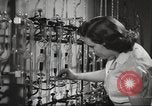
The film 'Devil Boats' shows the construction of Patrol Torpedo Boats in the United States. A young woman stands on a small bridge. A Patrol Torpedo Boat in the background. Two patrol boats underway at sea. Naval officers stand in a line. Workers enter the ELCO Marine Division plant. Assembly of PT boat hull and wiring. A woman worker examines wiring. One of the oldest workers, Frederick Buckley, supervises. Scenes from the Packard factory in Detroit Michigan, where the engines for the PT Boats are made. Engineers and technicians work on building a boat. Ingots thrust into ladels and poured into iron cauldrons. Drop hammer at work on hot pieces. Aluminum crank case moving on assembly line and then anodized by dipping in anodizing solution. Welders weld jackets to cylinder heads on the engine. Engine block lowered into position and joined to completed crank case. Final assembly of engine for PT boat. A woman paints yellow color on a part of the boat. After completion the Patrol Torpedo Boat is lifted by a crane. Shows Bob Palmer who used to be a factory worker and is now in the Navy in the PT service. Naval officer shakes hands with Palmer who had been painting his ID on the engine block.

Crew members undertake repair and maintenance work aboard a submarine in the United States after its return from Japan.
A U.S. submarine at a port in the United States on its return from Japan during World War II. Crew members aboard the submarine. Some of the men hold puppies. A man works on a naval gun aboard the submarine. Crew members paint the submarine at the port. Japanese flags on the conning tower of the submarine. Officers stand against the conning tower.
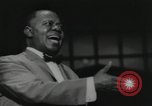
American jazz trumpeter and singer Louis Armstrong performing in a bartender role, singing "I can't give you anything but love."
African American jazz trumpet player and singer Louis Armstrong in the United States. Louis Armstrong, playing the role of a bartender, in the film Jam Session, with several actresses sitting at a bar. He sings "I can't give you anything but love." Louis Armstrong 'Cocktail' written beside the rack on a mirror. Louis Armstrong holds the arm of one of the women and sings. View of Louis Armstrong speaking and reflecting on that time (circa 1960).
Experiments are undertaken by scientists and doctors during the development of nutritious food for soldiers in the U.S.
Scientists determine nutritious food for U.S. Army soldiers during World War 2. Conscripts receive medical examination by an army doctor before going into the U.S. Army. The new recruits holding documents waiting in a queue for their turn to be weighed on a scale. An officer seated at a table. Two military draftees talking. Members of a U.S. Army Combat Service Support Branch, the Quartermaster Corps, cutting meat for preparation. A table set for soldiers with tea cups arranged and fruits in the center. The soldiers seated at tables and having food. Quartermaster Corps serving the soldiers. Scientists in a laboratory studying food that will impart energy, strength, and improved performance to the soldiers. A soldier seated at a table and a member of the Quartermaster Corps measuring out rice into a bowl that a soldier would have to have to provide the same nutrition as in his military rations. Dr. Ansel Keys, a scientist at the University of Minnesota, seated at a table and vitamins kept on the table for the soldiers. Narrator mentions that the German military supposedly has a super man vitamin pill. Doctor dispenses vitamins from a box. Doctor measures the strength of a soldier who has been taking vitamins. Doctor gives a soldier more vitamin pills. Two seated soldiers open tins of vitamin pills. Soldiers sleeping in a room maintained at a certain high temperature during an experiment to determine what foods are best for various climates. Soldiers carrying rifles walking on a treadmill. The amount of perspiration is measured.
Vitamin-enriched food is prepared by Quartermaster Corps for U.S. Army soldiers in World War 2
Nutritious food for U.S. Army soldiers in the United States. Scientists undertake experiments in the University of Minnesota for the development of nutritious food for American soldiers during World War II. A woman monitors tubes in a laboratory experiment. University of Minnesota physiologist Dr. Ancel Keys, who heads the experiments, speaks seated at a table. He says that if a soldier has vitamins and no food he would still starve. He says that it is not vitamins or pills that imparts energy but nutritious food in a wide variety. Few men in a bread factory taking vitamin enriched flour and using it to bake bread for the soldiers. Men kneading dough and arranging it in a tray. A man keeping the tray in an oven. Two men beside the oven. One of the men takes the tray out from the oven with a gloved hand. Quartermaster Corps cooking fresh food for the soldiers. Menu for the soldiers is prepared by a nutritionist. A Quartermaster Corps soldier beside him. Vegetables, fruits, milk and eggs are purchased in vast quantities by army officers and civilian experts. Cattle moving in herds. Quartermaster Corps butchers seen at work butchering and hanging meat. The soldiers debone the meat and other food materials are dehydrated for easier shipping. Eggs are examined for dehydration, yolks are separated from the whites and put through a drier. Pure yolk powder is made. Vegetables go through equipment to maintain their color, taste and vitamin content. Men working at a quartermaster laboratory.
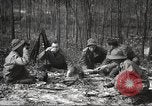
K ration developed under U.S. Army Colonel Roland for U.S. Army soldiers in the United States.
Nutritious food for U.S. Army soldiers in the United States. A group of U.S. soldiers seated among a few trees and having food. The soldiers having pre-cooked meat, which is an emergency ration developed in a laboratory. Nutritionists and army officers tasting food in a laboratory. Different cans with labels 'breakfast', 'dinner' and 'supper'. Three K ration packets developed for the army. 'U. S. Army Field Ration K, Supper Unit' written on one of the packets. A few soldiers seated on an army tank having food. One of the men puts contents of a packet in a mug. Commandos having K ration. Soldiers smoking cigarettes. Colonel Roland, who developed the K ration, speaking. He says that the K ration has been developed to provide soldiers with food under emergency situations and is suitable for all climatic conditions. The items used in K ration are tested. Several recipes are tested for soybean biscuits. Colonel Roland seated with other officers at a table and tasting different soybean biscuits. (World War II period).