


 Francais
 Deutsch
 Italiano
Refine Your Search
+"United States USA" +1943 stock footage and images
- Showing 325 to 330 of 523 results more
more Hide
Hide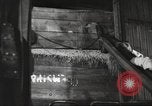
Soybean biscuits are made and K ration packets are put together in a factory in the United States for U.S. Army soldiers.
Nutritious packaged food is formulated and packaged for U.S. Army soldiers during World War 2, in the United States. Workers at soybean processing plants. View of Dr. Percy Lavon Julian, a chemist and soy expert, working in a laboratory (Dr. Julian was one of the first African Americans to receive a doctorate in chemistry). Two workers carry soy flour in sacks and put the flour into processors. Wheat flour and eggs are added. Dough is kneaded in the processor. Soybean biscuits coming out of the processor in strips. Women workers at a chewing gum factory, modified for making K ration packets, stand on the assembly line and pack the K-rations. An army officer beside the workers. The workers, at an assembly line, put a tin of meat, soy biscuits, a concentrated chocolate or a fruit bar, lemon powder, cigarettes and chewing gum in individual containers. The containers are made water and air tight, and a scientist tests some of the kits for quality of packaging. U.S. Army soldiers move in a column on an airfield and get into an aircraft. Views of U.S. Army soldiers in different settings, preparing and eating food: A group of soldiers under a tarp in the jungle preparing food. Two soldiers seated inside a snow igloo eating food. A group of soldiers seated on a tank in the desert, eating food. Group of soldiers having food seated at tables in a dining hall or mess area.
A bottle of champagne is broken at the bow of aircraft carrier USS Wasp at its launching ceremony in the United States.
Aircraft carrier USS Wasp being launched in the United States during World War II. USS Wasp decorated before being launched. Sons of the naval officers who lost their lives in the Battle of Guadalcanal at the launching ceremony. A bottle of champagne being broken at the bow of the carrier as the ship is launched. The ship takes to water.
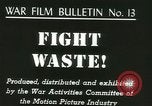
U.S. Government tells citizenry how they can help the war effort by living conservatively and avoiding waste, early in World War II
A public service informational campaign during World War 2 in the United States. A uniformed nurse tends to a U.S. Army Sergeant, Vincent Booth, who lost a leg during the African campaign of World War 2. He is in a wheel chair. The Sergeant speaks about the things that can be done on the home front to ration and help the war effort. As he narrates, a typical American family of three, father, mother, and youth in Boy Scout uniform, are seen sitting down at their dining room table. Missing is their daughter, serving as a WAC overseas (shown briefly in uniform) and their son, in the Navy (also shown briefly, in uniform). Scene shifts to the father at his work place. Narrator says he uses 10 percent of his weekly income to buy war bonds. The mother is seen at home with her Boy Scout son. She is writing letters to her son and daughter in the service. Change of scene shows her in a hospital, volunteering as a Red Cross Nurses aid. Next, the family members are seen in their home, characterized by the narrator as "an arsenal for victory," where they are being careful not to waste resources like electricity, home heating fuel, and cooking oils. They contribute their old metal objects to the war drive collections, and their son in the Boy Scouts participates in the local paper salvage drives. He is seen in Boy Scout uniform tying up a bundle of newspapers (with pictures of Hitler and Tojo on top which he dramatically stands on when tying the papers). They repair and use their old clothes, or contribute them to charities. The propaganda film ends summarizing ways that ordinary civilians can help the war effort, by rationing and avoiding waste at home, with on screen instructions: "Fight Waste! 1. Don't waste anything; 2. Buy only what is necessary; 3. Salvage what you don't need; 4. Share what you have."
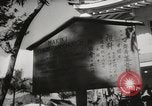
Japanese people practicing their religion and Japanese architecture in the United States.
Japanese people and Japanese American people in the United States before the attack on Pearl Harbor during World War II. Exterior of a Japanese temple. Young Japanese girls enter the temple. The girls remove their footwear and then enter the temple. They are taught religion in the temple. A Shinto priest explains that Hirohito is God. Japanese temples and architecture. A dramatization: two men discuss about the Japanese practicing their religion and argue as to whether they are disloyal.
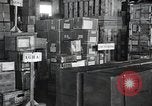
War supplies from different parts of the world, construction of shipyards, and building war ships in the United States.
War equipment and ships built in industries of the United States during World War II. Crates containing war supplies from all over the world stacked. Massive large columns of United States Army Soldiers and huge columns of United States Navy sailors in review, marching and standing in formation. Men work on the construction of shipyards and ships in shipyards. War production workers work on different machines to make and assemble ship parts. A crane lifts a part of a warship to be assembled. Men wearing protective masks do arc welding on parts of ships. A line of ships at dock. Scenes of many different cargo ships, Liberty Ships, battleships, cruisers, submarines, destroyers and aircraft carriers launched. Some of the ship names seen include: SS Zebulon Pike, SS Patrick Henry, SS John C Fremont, SS John Fitch, SS Ethan Allen, SS Mormacwren, SS Irving S Olds, a ship of the Lykes Lines, the U.S. Navy destroyer USS Bristol (DD 453), USS Hancock (CV-19), Men walk down the steps towards the ships. Men load supplies onto ship. Soldiers board transport ships. A Soviet cargo ship with a large flag "USSR" on it. A convoy of ships at sea.
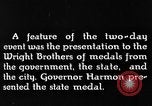
Orville Wright raises a flag and dignitaries including Quincy Gillmore, Edward Andrew Deeds present in the United States.
The 40th Anniversary of the Wright brothers first airplane flight in the United States. A picture of Ohio Governor Judson Harmon presenting a medal to the Wright brothers and people in a stadium arranged to form a flag. A flag being raised. The Wright brothers and other dignitaries surround a flag pole. Aviator Orville Wright raises a flag. A gun salute in front of Air Material building. Aviator Orville Wright, General Quincy Gillmore and U.S. Army Colonel Edward Andrew Deeds present.