


 Francais
 Deutsch
 Italiano

Refine Your Search
+"United States USA" +1943 stock footage and images
- Showing 379 to 384 of 523 results more
 Hide
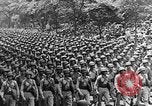
U.S. Army Quartermaster Corps supply program through depots in distribution areas in the United States (WW2)
United States Army Quartermaster Corps supply program in the United States. Soldiers holding guns march in formation. The soldiers on a vessel. Tanks firing during World War II. The soldiers using supplies procured by the Quartermaster Corps. Supplies in a room. Houses on a hillside. A man and a boy moving with a cattle herd on a road. Damaged buildings in a liberated area. Aerial view of debris and damaged buildings and people in the area, where left over supplies procured by the Quartermaster Corps could come into use for rehabilitation of people. The Quartermaster Corps store the procured supplies in boxes. The corps carry the boxes of supplies for distribution to soldiers. Quartermaster depots located in easily accessible areas near railways and highways. The supplies being wheeled in carts at a depot. Trucks with supplies moving on a road. Aerial view of a depot located in the commercial center of distribution. Workers inside a Quartermaster depot which is classified according to the functions they perform including distribution, reserve and manufacture. A map of the United States shows 15 distribution areas, with a depot each, which have the same boundaries as the procurement districts and which supply ports, camps or stations in that particular area.
U.S. Army Quartermaster Corps filler depots, reserve depots, manufacturing depots and remount depots in the United States.
United States Army Quartermaster Corps depots in the United States. A port in the United States. Men at work in the port. The port of embarkation, during World War I, filled with the supplies for the soldiers being sent by the manufacturer due to the lack of sufficient depots for storage of supplies. Cars carry supplies to New York port. A map of the United States shows filler depots at ports of embarkation across the nation. A pictorial representation of New York port, being huge, taking supplies from three nearest filler depots. Another map shows reserve depots in four locations. Manufacturing depots in two locations - Philadelphia where clothing is manufactured and Jeffersonville hardware is manufactured. A manufacturing depot in which women sew different clothing. Workers at equipment in a manufacturing depot. The Philadelphia Quartermaster Depot where items are manufactured and which is also a reserve depot for clothing. Rolled flags in wheel carts hauled by workmen in the depot. Workers during the inscription work of insignias on the flags. View of the insignia. Horses moving in columns on a path. Newly purchased horses and mules trained in areas provided by the Quartermaster Corps. Dogs bred in an area. The corps with the dogs. A map of the United States shows remount depots in three locations.

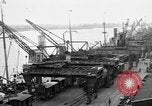
U.S. Army Quartermaster Corps overseas supply involves filler depots, ports of embarkation and overseas bases in the U.S. (WW2)
United States Army Quartermaster Corps overseas supply procedure in the United States during World War II. A pictorial representation of supply for troops overseas shows filler depots, ports of embarkation and overseas bases. Operations at a port of embarkation. Boxes of supplies stacked at the port. The supplies are moved by a crane. A form being filled out. Men hauling carts in a filler depot. Boxes of supplies being loaded into rail carts. Rail cars moving with the supplies. Several ships at the port. Men carrying supplies move onto a ship. Corps at portholes of the ship. The requisition form received from the overseas base at the port of embarkation. The requisition is being approved by officers at the port. Rail cars moving with supplies. Trucks moving on a road. Ships at sea.
U.S. Army Quartermaster Corps overseas supply from port of debarkations to division distributing points in the U.S.
United States Army Quartermaster Corps overseas supply procedure in the United States. A pictorial representation of Quartermaster Corps overseas supplies reaching a port of debarkation. Quartermaster Corps unload supplies from a ship. A crane carrying loads of supplies at the port. A pictorial representation of Quartermaster Corps running the system of supply through communication zone to combat zone. Quartermaster Corps in a combat zone. The corps in a line beside a truck. The U.S. Army soldiers line up to take a shower. A train moving on a track. Trucks moving on a road. Boxes of supplies waiting to be picked up. The corps standing beside the boxes. Representation of a base depot near a port of debarkation where more perishable items are stored. Meat hung in the depot. An open air depot where less perishable items are stored. Stacks of materials in the depot. A truck moving away from the area. A pictorial representation of supplies being taken by rail, truck or boat from base depots to advance depots. Dummy depots to confuse enemy aircraft. Pictorial representation of supplies being taken from advance depots to regulating stations to maintain the regularity of supplies to combat divisions. Rail cars moving on a rail track and people in view. Representation of supplies being moved to a rail head. The supplies are moved from the rail head to the combat zone and by trucks to division distributing points. (World War II period).

An amphibious landing and bombers on a mission and troops battle on a Pacific Island.
Dramatization shows how one defective walkie-talkie can impair battle plans, United States. U.S. transporters including cruisers, destroyers and crew carrying ships underway in South Pacific on a mission to attack on Japanese installation and Island no. 6. A personnel plays whistle from the bridge of cruiser. Interior of manned radio operations room:Task Force officers sitting around table and discuss over battle plans. A personnel talks on radio device. American bombers in formation flight. Pilot and copilot in cockpit. American aircraft drop bombs on Japanese installation. Explosion and large column of smoke rise. Task Force officers look at map of Japanese island no. 6 in the radio room. Animated map shows Japanese Island no. 6 showing an amphibious landing and bombers on a mission. U.S. soldiers on landing crafts with walkie-talkies. Artillery fire on the Pacific island. Troops disembark from the landing craft and heads towards beach area. Soldiers move into action and fire artillery. (World War II period).
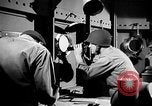
Walkie-talkies are rush-ordered as defective radio fails and American workers work on assembling of walkie-talkie in the U.S. (WW2)
Dramatization shows how one defective walkie-talkie can impair battle plans, United States. Troops battle on a Pacific Island in World War II. Soldiers move into action and fire artillery. Task Force team in manned radio operations room. Soldier talks on radio device from the island to headquarters. Soldiers move into building for counter attacks. Soldiers try to make contacts with headquarters. They fail to make contact as defective radio fails. Soldiers kneeling on island. Explosions and smoke rise. Shows Under-Sec. of War, Robert Porter Patterson; Chief of Services and supplies, Brehon Burke Somervell and Chief of signal officer, Olmstead in their offices. Walkie-talkies are rush-ordered for the invasion. Radios are being made in factory. American workers work on assembling of walkie-talkie instruments. A careless worker produces a defective set. Walkie-talkies are sold.