


 Francais
 Deutsch
 Italiano
Refine Your Search
+"United States USA" +1944 stock footage and images
- Showing 67 to 72 of 489 results more
more Hide
Hide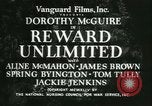
The need for cadet nurses and young girls to volunteer for military nursing service during World War II.
A film titled 'Reward Unlimited' starring Dorothy McGuire dramatizes the need for cadet nurses during World War II. Dramatization depicts why a girl called Peggy decides to become a nurse, and how she is trained. Peggy discusses marriage and future plans with her Lieutenant boyfriend. She decides to get a war job. She meets a woman who was a nurse and who gives her information about the U.S. Cadet Nurse Corps, Congress scholarships for nursing schools and duration of the courses. Peggy discusses her decision to join a nursing school with her parent. After she convinces her parents that nurses are needed, she enters training. She undergoes theoretical and practical training with many other girls in a hospital. Nursing students in classroom setting with teacher or professor at blackboard providing class instruction. Nurses receiving practical clinical instruction. Nurses using microscopes and taking notes, nurses attending patients in a hospital ward. Nurse cadet taking care of an infant baby. Nurse in surgery theater handing instruments to a doctor during operation on a patient. The graduation ceremony from the Army Nursing School. Peggy checks on a little boy called Jimmy. A government message urging young girls to volunteer for military nursing service with information about the U.S. Cadet Nurse Corps.
Dramatization depicts production, black marketing of gas coupons and citizens' responsibilities in supporting World War 2 gas rationing.
'No Alternative' dramatizes citizens' responsibilities in supporting gas rationing in the United States. Dramatization: Group of men seated playing card game. Tom interrupts a poker game to lecture on rationing, after Bob offers an illegal gas coupon to Frank. He talks about the production of automotive gasoline, increasing price and limited production of crude oil. Uses of crude oil: U.S. airmen and soldiers use crude oil to fuel aircraft and tanks. A U.S. aircraft drops bombs made with the use of crude oil. Workers produce synthetic rubber from crude oil at a plant. U.S. Navy ships, merchant fleets, railroads and war industries use crude oil. Tom explains how "black market" coupons cause shortages that affect war industries and military activities. Dramatization depicts safe breakers breaking into a ration board and stealing gas coupons worth 11 million gallons. Gasoline used by farmers in tractors, to take produce to the markets, finished ammunition, guns and tanks to the railroad stations so that they can be sent to the front. Tom points out ways to make rationing work and save gasoline including: formation of car pools, scorning illegal coupons, identifying coupons with the user's license number.
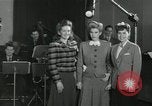
Andrews Sisters Patty,Maxene and Laverne record Boogie Woogie Bugle Boy on a V-Disc during World War II.
Lieutenant Colonel Carl Bronson thanks the Andrew Sisters on behalf of the Music Section of the Special Services Division for making V-Disc recordings that are sent to American soldiers overseas during World War 2. Patricia Marie (Patty), Maxine Angelyn (Maxene), and Laverne Sophie (Laverne) Andrews, perform 'Boogie Woogie Bugle Boy' for a V-Disc recording.
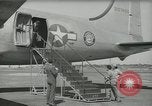
Film rehearsals. Actor playing role of reporter, interviews actor playing role of Soviet diplomat (WW2)
Actors portraying a scene where Soviet diplomat disembarks from a United States Army Air Force aircraft during World War II. Reporter interviews "His Excellency" on Soviet Union's attitude towards division of Germany. Diplomat answers saying the Allies should control Germany's key industries and take away its economic power to wage war.
Destroyer Escort USS Frament, DE 677, is built and launched. Destroyer Escorts fitted out, readied for shakedown cruise
U.S. Destroyer Escort USS Brennan, DE-13,underway. U.S. navy crew aboard the ship. View at shipbuilding area of Bethlehem Steel in Quincy, Massachusetts. Keel is laid and shipbuilders busy on day 60 of construction of DE-677, the USS Frament. Scenes of construction. Welding steel plate. DE-677 is christened USS Frament and launched on June 28, 1943. Destroyer Escorts at pier, being fitted out. New ship's crew assembled on pier and boards for shakedown cruise. Supplies and munitions loaded on board the ship, including ammunition, depth charges, and torpedoes ("tin fish").
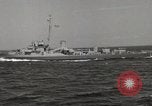
Shakedown cruise of Destroyer Escort USS Frament (DE-677). Practice firing against surface target.
Crew aboard U.S. Destroyer Escort USS Frament (DE-677), load and practice firing at a floating target. Crew fires deck guns, launches torpedoes and depth charges, and fires "hedge hog" bomb clusters. Shells hit water surface and explode. Aerial view of large explosions in water. (World War II period).