


 Francais
 Deutsch
 Italiano
Refine Your Search
+"United States USA" +1944 stock footage and images
- Showing 181 to 186 of 489 results more
more Hide
Hide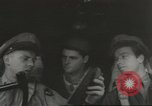
An officer shows safety precautions and control tower communication for flying a B-17 aircraft is carried out in the U.S.
A U.S. Army Air Forces ( USAAF ) training film on instructions to fly USAAF Boeing B-17 Flying Fortress aircraft in the United States. An officer turns on a radio switch. Trainees wear head phones. Men check fuel pressure gauge. Governor control is operated to get desired revolutions per minute ( RPM). The RPM gauge shows readings. A system engineer communicates with men in aircraft. A gauge shows flap position. The flaps are turned down. A dial shows zero flap position. A compass chord, a hydrolic pressure gauge and a suction gauge show readings. A trainee turns a vacuum pump switch. He checks for oxygen cylinder pressure. An officer checks filter warning lights. A trainee turns on an output switch. A pilot communicates with a man in a control tower. A crew man gives hand signals to a man on the ground. The man removes wheel chokes. Switches and handles are operated as the aircraft taxis. The pilot locks the tail wheel. The aircraft taxis past other parked aircraft. Th pilot turns on the automatic control switch. The tail wheel is unlocked.
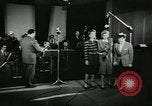
The Andrews Sisters sing for soldiers and recorded V-Discs are packed for transportation in the United States.
The United Service Organizations (USO) in the United States. The Andrews Sisters sing for soldiers. Men record the song. A man takes out a disc from a recorder. People pack discs. Men stack the packed discs. Two men check the packed V-discs. (World War II period).
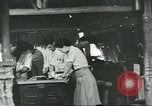
Men learn leather craft, carpentry, painting and sculpting in the United States.
The United Service Organizations (USO) of the United States during World War 2. Recovering soldiers learn arts and crafts at a Port Moresby hospital (New Guinea) with support from the American Red Cross. A man works on a leather craft machine. A man cuts a wooden plank while learning carpentry. Men make paintings and sculptures. Two men read. A man writes a letter. Men play cards.
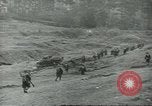
Soldiers fire artillery, advance on a battlefield and take in USO entertainment in World War 2
The United Service Organizations (USO) of the United States during World War 2. Soldiers advance on a battle filed in Europe. Two soldiers fire guns. The soldiers walk on a pier and load supplies in boats. A soldier talks over a field telephone. The soldiers fire field artillery. They walk in a single file. A vehicle moves through a mud pit. The soldiers unload shells from a truck. They carry shells on a snow covered road. Truck moving in deep muddy conditions. The soldiers crawl near a wall. They run on a field. Change of scene to soldiers enjoying USO shows and stage productions. A chrous line group of dancing girls perform. A juggler performs. Three comedians. Soldiers and sailors laugh, applaud, and enjoy the shows.
Supplies are being loaded onto ships in the United States and a U.S. convoy at sea; recruitment film for Merchant Marines
A World War II recruitment film bulletin 'Wanted: Men for Merchant Marine' asking men to join the United States Merchant Marines and go aboard Liberty Ships and other cargo ships supporting the United States war effort during World War 2. A World War II American ship convoy at sea. An official works in Ship Personnel Office aboard a ship. Merchant seamen board a ship. A group of engineers, seamen, radio telegraphers, cooks, bakers and mess men during a training. Supplies are loaded onto a ship. Tanks, bombs and locomotive are hoisted by a crane and loaded onto the ship. Seamen work aboard the ships. Narrator speaks of military materiel delivered by ships and a series of images of American military equipment in action in Europe during World War 2 is shown: Line of camouflage U.S. army tanks fire. U.S. Army Air Force bomber aircraft at an airfield including one with a damaged nose. U.S. Army tractor hauls a long artillery piece on war torn streets of a European city. U.S. Army tank moving by fast on a European paved roadway. A merchant ship at sea. A ship convoy at sea.
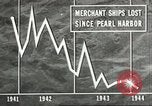
U.S. Coast Guard and maritime authorities assure protection and safety of U.S. ports during World War II
A chart shows the losses of American merchant ships to German submarines diminishing over the course of World War 2. Women walking into the Merchant Marine Council headquarters in Washington DC. Council member officers meeting in their board room. Glimpse of merchant vessels and tugboats. Sign identifies office of the Captain of the Port. Inside, two men discuss movement and anchorage of ships. View of anchor being dropped from a large ship. A small Coast Guard patrol boat moves among anchored ships, checking for possible threats. Closeup of officers aboard the patrol boat with American flag behind them. Sign at office of Port Security Officer. Inside, men update a chart showing ships in port and locations. Coastguardsman patrols cargo area for safety and threats. Cargoes being moved on rail at the port. Explosive cargo and artillery shells are seen in containers. Officer oversees loading of munitions on a ship. Coast Guardsman walking across stacks of military gas cans (Jerrycans) on a barge. Officer and guardsman examine one that appears to be leaking, and remove it.