


 Francais
 Deutsch
 Italiano
Refine Your Search
+"United States USA" +1944 stock footage and images
- Showing 199 to 204 of 489 results more
more Hide
Hide
Material of war being loaded onto vessels and piles of invasion equipment readied in USA and Britain.
War materiel in the United States amassed to serve as D-Day invasion equipment for invasion of France during World War II. At a U.S. port, airplanes are lifted to the decks of ships that are loaded with freight for invasion preparation ports. Materials of war being loaded into vessels. A ship convoy underway at sea. In a British port, piled up material and equipment for invasion armies preparing for war. African American soldiers unload ships. Tires, soap, tobacco, candy and refuse cans. Rolling stock, tanks, gasoline drums, pontoon boats, railroad cars, locomotives, boats, trucks, ambulances, guns and bombs are seen. Rows of gliders, fighter warplanes, and various airplanes are shown parked and ready for shipment. Bomb shells stacked and ready.

Girls join the Women's Army Corps and display newly designed uniforms in the United States.
Girls decide to serve the country by enlisting in the WAC in the United States. In Los Angeles, California girls enlist in the Women's Army Corps (WAC). Their parents greet them as they entrain for Fort Des Moines, Iowa. WAC personnel stand in a pattern to form the word "WAC". The New York skyline. WACs wearing newly designed uniforms. A WAC personnel displays a uniform. The WAC personnel salutes and smiles.
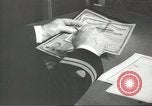
A Coast Guard officer checks identity papers and men being paid in United States.
The U.S. Coast Guard serves the U.S. Merchant Marine in the United States during World War II. A Coast Guard officer checks identity papers. A sign: 'this side to pay off'. The paymaster's table. Merchant marine personnel being paid.
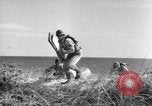
Demonstration about placing of wall and castle charges and the resultant explosion in the United States.
A demonstration shows hand charges being placed and exploded against a wall in the United States. Soldiers place wall charges against a concrete wall. Men place explosive packs on an elevated platform against the concrete wall and explosion occurs. A U shaped gap is created as a result of the explosion. Tanks pass through it. Soldiers place castle charges on an elevated platform about 2 feet above the ground. Men place 66 packs of explosives against the wall. Explosion occurs creating a gap. Tanks pass through the gap. (World War II period).
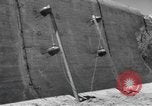
Demonstration about bar charges and the resultant explosion creates a gap in a wall in the United States.
Demonstration shows bar charges being placed and exploded against a wall in the United States. Four 34 pound charges being placed against a concrete wall and being detonated. An explosion occurs. As a result of the explosion four bore holes having a diameter of 5 inches occur. The holes being cooled with water. The holes being filled with 90 pound of C-2 explosives. Charges being detonated and explosion occurs. A gap results and a tank passes through it.
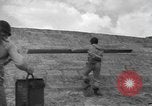
A demonstration about creating a gap in a 45 degree sloping wall with the help of bar charges in the United States.
A demonstration shows bar charges being placed and exploded against a wall in the United States. The face of a 45 degree sloping wall. Bar charges are placed on the wall by soldiers. The soldiers place the bar charges on the face of the wall to demolish it. An explosion occurs and billows of smoke rise. The explosion results in an 18 feet wide gap. A United States Army tank passes through the gap. (World War II period).