


 Francais
 Deutsch
 Italiano
Refine Your Search
+"United States USA" +1944 stock footage and images
- Showing 19 to 24 of 489 results more
more Hide
Hide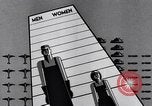
American women at home and work in the context of WW2
Graph compares the number of female factory workers to men during World War II. Factory workers producing war materiel in the United States. Workers using lathe. Welders welding machines. Tanks are loaded onto rail freight cars. Railroad freight yards and shipping. Posters advertising war jobs for women. Women interviewed for war jobs by men. Alarm clock rings as tired woman wakes up in bed. Women in front of Sterner's Department Store and buying fur coats. Women reading newspapers while smoking. Crowd trying to get onto an overcrowded bus. A mother comforts her boy who has skinned his knee. Men and women leaving a factory. Interior of World War 2 airplane factory. Soldier examines broken radio on battlefield. Wounded American soldiers carried on litters. A telegraph is delivered to a woman by a girl. Woman reads the telegraph. Woman crying in bed while reading the telegraph that announces her husband's death, while her son comforts her. Close up photo of deceased husband. Montage of graveyards with gold star of service superimposed on image. Newspaper headline "All Job Deferments Face Drastic Review" View of men inside Selective Service local board 226 office. Some men being drafted then in 1944 are shown, including older men, more fathers, and men who had been doing essential industrial work. Man working with metal lathe. American soldiers climbing mountain in snow in Italian mountains. American soldiers wade through deep water in a jungle region of the Pacific. View of a sinking ship or merchant ship, and two crew members jumping off the sinking ship into the water. View of London England blitz damage and devastation, and people digging through piles of rubble from bombing. Dead bodies of adults and children from war in Europe. Crying women, London Blitz. Woman holding boy in arms. Woman kissing girl. Old woman sewing in factory to help with the war production effort. Women picking crops to help with farming and supply of food for soldiers.
World War 2 film promoting public investment in War Bonds and stamps to aid the war effort and temper inflation
World War 2 era film that also includes some World War 1 scenes. Show girls or chorus girls in follies-like show, costumed as U.S. silver dollars and marching to tune and lyrics alluding to dramatic increase of currency in circulation, over the years. Animation with stacks of coins shows increase in national income from $46 billion,in 1933, to $71 billion, in 1939, and $142 billion in 1943. Back to the "follies dollars," a boy asks why, and then scenes of the Japanese attack on Pearl Harbor,are shown, with U.S. battleships being sunk. Wartime arms plants are shown. An M2A3 Light Tank rolls off a production line. Ships being constructed in a shipyard. B-24 Liberator bombers being built in a factory. Artillery shells being produced. Defense workers receiving their pay. The "follies dollars" group themselves to illustrate the fractions of income devoted to taxes and savings. But other spending is curtailed by wartime shortages. A woman talking with clerk in a drug store. U.S. Army troops crossing a pontoon bridge in open trucks, towing 75mm M1A1 howitzers. Infantry on the march. Animation showing industrial production devoted to war materiel and lots of dollars chasing few civilian goods. A grocery clerk offers to sell a woman customer butter for more than the established price, and she agrees. The "follies" performers then introduce the idea of an "inflationary dollar," and some history of past U.S. inflations. Animated examples of price inflation are shown. Glimpses of World War I scenes are seen, circa 1917 -1918, including: a 12-inch railway gun firing; a huge explosion from shell bursting near the camera; various scenes of United States infantry soldiers and French soldiers in battle action, running to bomb craters for cover and emerging from trenches to go up "over the top" into no-mans land during combat. Meanwhile, singing narration refers to the home front inflation due to competition for limited civilian goods. Map shows Europe and singing narration cites rising prices for food in occupied France and other countries suffering ravages of World War II. Montage of scenes showing needy civilians obtaining food in those countries. Animation shows increases, by 1944, in cost of U.S. civilian goods since the Pearl Harbor attack. "Follies" character called "Double-duty dollar," appears explaining he serves the war and curtails inflation on the home front by being saved through investments in War Bonds and stamps.
U.S. film designed to boost national morale during World War II. Numerous scenes of American forces engaged in combat.
Several American school children, including one in a Boy Scouts of America uniform, recite the pledge of allegiance during World War 2. Scene broadens to encompass a school yard filled with elementary school students reciting the pledge in front of an American flag flying high on a pole. As scene fades images appear of battleships firing guns; an F4F airplane taking off from an aircraft carrier; landing craft approaching a beach; American soldiers fighting with small arms and a flame thrower, in jungles of New Guinea; a U.S. gun crew firing heavy artillery; and a U.S. P-38 aircraft on a rainy runway, spraying water as it takes off, in the Aleutian Islands. U.S. troops firing automatic weapons on a Pacific Island. A B-17 pilot wearing an oxygen mask in his cockpit, flying in a formation creating contrails at high altitude over Germany. Waist gunner firing at an attacking German fighter plane that explodes in air. U.S. troops in jeeps moving over jungle road. U.S. ski troops on snow in Iceland heading downhill toward their tents in the snow. American troops during amphibious landing in the Philippines. U.S. troops aboard army halftracks on desert in Iran. American paratroopers dropping from C-47 aircraft over France. U.S. soldiers marching through two large gates with cadre of Chinese soldiers in China. American troops fighting in Italy and firing a 155mm howitzer. U.S. infantry following a sherman tank over a war-torn landscape with shells bursting nearby. Crowded, busy street scenes of traffic and pedestrians in Manhattan, New York City, and Chicago, Illinois. Army tanks being manufactured by war production workers in a Detroit war production plant or factory. A Los Angeles shipyard filled with workers at shift change. Closeups of individual American soldiers in combat helmets. U.S. troops descending rope nets from transport ships to board landing craft, and approaching the beaches of Normandy, France, under fire, on D-day, June 6, 1944. Views of the Statue of Liberty, including closeups.

A fleet oiler re-fuels destroyer, USS Cooper (DD-695), underway at a sea in the United States.
Fueling of destroyer, USS Cooper (DD-695) underway at sea in the United States. Sailors aboard a destroyer ship. Officers maneuver the destroyer. An engineer involved in the preparations. An animated diagram shows information applicable when a destroyer takes on board fuel oil from a tanker alongside and both ships are underway. The small tanks are filled first. The officers work efficiently and wear life jackets. Men at forward fueling station. An animated diagram shows the course taken by the destroyer and the tanker. The animated diagram shows the collision of both ships. The heaving line and towing line are taken from the tanker to the destroyer ship. The free end of the messenger is returned to the destroyer. Sailors hold the fuel hose and take it to the tanks. A safe distance is maintained between the two ships. The straps are cut after refueling and the destroyer ship increases it's speed. (Note: The USS Cooper was torpedoed by the Japanese Destroyer, Take, during an engagement with Japanese naval forces in the Gulf of Leyte, on December 3, 1944. Reportedly, She exploded, split in two, and sank. Of her crew, only 168 could be rescued. The remaining 191 lost their lives.)
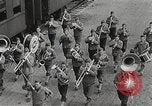
US Army soldiers and heavy equipment transported by railroad trains in the United States, bound for war front in World War 2
Activities of the United States Army in the United States during World War II. A U.S. Army band from the 407th Engineer Battalion playing musical instruments and marching. U.S. Army soldiers board railroad trains at a railroad station for transportation toward the war front. A railway steam locomotive pulling train cars. M4 Sherman tanks are seen on them as well as M2A4 (Mae West) tanks sitting partially turned with their guns out of sight away from the direction of travel.Browning M1919 .30 caliber machine guns are seen in their extra turrets. Army trucks and other military vehicles are also aboard the supply trains. The supply train moves through American countryside. Two women seated under hair dryers converse about the war in a beauty shop or beauty parlor. U.S. troops on troop transport railroad trains at night. Interior of a train car. American soldiers read books, sleep, and some play dice. An African American porter watches the game. A chaplain speaks to the soldiers. Civilians buy newspapers at a news stand. Headline on newspaper reads "London Expects Invasion of Europe at Any Hour" (before the upcoming Normandy Invasion of France in June 1944.)
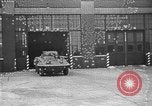
Ford military M8 armored cars are driven out of a Ford motor plant in the United States.
Ford military M8 light armored cars rolling off a Ford production line in the United States. Three armored cars driven out of a Ford motor plant. A man walks to the entrance of the plant as the trucks are driven out. Circa 1944.