


 Francais
 Deutsch
 Italiano
Refine Your Search
+"United States USA" +1944 stock footage and images
- Showing 277 to 282 of 489 results more
more Hide
Hide
Representatives of labor and management observe an aircraft on maneuvers and learn from pilots during navy show in U.S. (WW2)
Executive visit U.S. navy show at Atlantic Coast in the United States during World War II. Representatives of labor and management observe an aircraft on maneuvers. The U.S. aircraft takes off during a navy show. A man signals to the aircraft for take off. Business leaders learn from pilots, crews and executive staff, how industry can best aid war effort. Crew and pilot near and around the aircraft.

Stanley Hiller demonstrates his "Hiller Copter" and Filene's Dept. stores deliver cigarettes with a helicopter in the U.S.
Hiller's coaxial bladed helicopter is demonstrated and helicopter delivers cigarettes to veterans in the U.S. Berkeley, California: "Hiller Copter" on ground. It is coaxial bladed helicopter, a ship which has rigid blades and no tail rotor. Stanley Hiller, 19 year old inventor demonstrates his coaxial bladed helicopter at University of California at Berkeley football stadium. Next scene is Boston, Massachusetts: Filene's Department stores deliver cartons of cigarettes to patients at the Veteran's Hospital with an ultra modern helicopter. The Helicopter takes off and lands at Veteran's Hospital in West Roxbury. Cigarettes are distributed to veterans.

A man secures stabilizer to ring tail,covers with drag ring,adjusts valve before the release of torpedo in United States.
New techniques in aerial torpedo attack, United States. An aircraft in flight over a sea. The aircraft releases torpedo in water. Torpedo moves. Men haul trolley loaded with the torpedo. The shroud ring or ring tail is in conjunction with the drag ring on nose of the torpedo. Using ring tail and drag ring with wooden stabilizer results in successful test drops. A man secures the stabilizer to ring tail with wooden dowels. The man covers the torpedo with a drag ring which helps to stabilize the torpedo during air travel, and seals the ring. The man adjusts the water trip delay valve which prevents the torpedo from burning up during long travels. Depth setting is done. (World War II period).
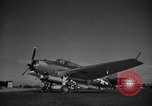
Men load torpedo onto aircraft parked at an airfield in the United States.
New techniques in aerial torpedo attack, United States. A Grumman TBF Avenger aircraft parked at an airfield. Men load torpedo onto the aircraft. The propellers start. A man signals as the aircraft taxis and takes off from the airfield. The aircraft in flight over a sea. The aircraft releases torpedo in water. (World War II period).

A man explains graphical presentation of the proper speed and altitude combination for torpedo release in United States.
New techniques in aerial torpedo attack, United States. A man explains the graphical presentation of the proper speed and altitude combination for torpedo release. An aircraft in flight releases torpedo in water. The torpedo moves in water. The torpedo launching guide. In double entry type graph, the combination of 2 coordinates gives the third coordinate. Dropping speed and dropping altitude data is entered in the chart. It gives the entrance angle. The man explains the concept of point of release to the point of hitting target using the graph. The cross wind effect on torpedo drop is explained. Time column on graph gives time of fall of torpedo. Release of torpedo with proper range is necessary. Radar ranging requires teamwork between the pilot and the radio man. Demerits of long and short range is explained. (World War II period).
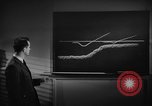
Diagrammatic presentation of full range of entrance angle for shallow and deep water for release of torpedo,in United States.
New Techniques in aerial torpedo attack, United States. A diagrammatic presentation shows the full range of entrance angle. The range for shallow water is18 to 22° and for open sea or deep water is 22 to 32°. Extreme angle to be avoided. A Grumman TBF aircraft in flight. The aircraft releases torpedo in water. Estimation of correct amount of lead depends on speed of target and target angle. Thumb rule explains the aiming allowance for ship vessels. The ship underway at sea takes a turn. (World War II period).