


 Francais
 Deutsch
 Italiano
Refine Your Search
+"United States USA" +1944 stock footage and images
- Showing 37 to 42 of 489 results more
more Hide
Hide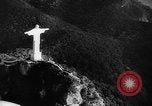
FBI agent William Sebold (posing as Harry Sawyer), and successful filming of members of Duquesne spy ring in the United States.
Aerial view of Christ Redeemer Statue on Mount Corcovado, Brazil. The director of the Federal Bureau of Investigation (FBI), John Edgar Hoover, narrates this 1944 clip and talks about enemy agents in the United States during World War II, before America's entrance into the war. German and Japanese suspects seen in South America. A German fleet carries German agents aboard merchant and cargo ships. German agents in formation on deck of ship, shown debarking the ship after receiving instructions. Japanese and Nazi German colonies being established in South America in large cities and in remote areas of Patagonia. Automobile industries, hotels, shops, and other industries established by Nazi German agents. German signs and Nazi Swastikas and Nazi flags shown on some buildings in South American countries including Brazil. A Nazi flag. A view of German factories in South America. Photographs of Adolf Hitler in a school building where young boys and girls are being instructed by their teacher. German pilot shown operating a passenger airliner; aerial view of from aircraft of Rio de Janeiro Brazil, including port and city areas. A dramatization depicts well planned accidents in the factories and sabotage attempts to slow production of goods bound for the United States. The Federal Bureau of Investigation (FBI) receives reports about planning of German attack on the Panama Canal. A woman watching a teletype machine as a report arrives. A man in a radio room of the Federal Bureau of Investigation receives information and turns to type out a report on his typewriter. Men and women convicted as spies are seen together in a room with U.S. federal agents. The spies are taken in a police van. Man serving as projectionist seen running a film projector. A film of Fritz Duquesne case in the FBI office shows FBI Agents' successful secret filming of members of the Duquesne spy ring. The film is shown being loaded onto a projector and then played. FBI agent William Sebold (posing as spy Harry Sawyer) is seen with Fritz Duquesne and other spy ring members: Pedestrians and vehicular traffic on a New York street corner as Sawyer and Duquesne prepare to meet. German spies sit together in a hotel room in New York City, recorded by hidden camera. Heinrich Clausing, a spy ring member and former cook on the cruise ship SS Argentine is seen. Also seen is Hartwig Richard Kleiss putting on his hat and smoking a cigar. He's shown giving money to Sawyer for purchase of a spy camera, according to narration. J Edgar Hoover notes that German agents communicated through a Long Island radio station that was secretly controlled by the FBI. Hartwig Kleiss is seen showing the blueprint plans of the steamship SS America, including plans for its secret gun emplacements. Fritz Duquesne is shown in the film, removing diagrams of various American arms that he had concealed in his sock Japanese agent Takeo Ezima, of the Imperial Japanese Navy, is also seen meeting in the hotel with Harry Sawyer.
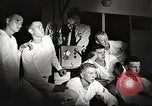
United States Navy sailors watch a movie about naval warfare in the United States; some scenes from World War 2 Pacific battles
A dramatized film about the training of U.S. Navy recruits at various naval training centers in the United States. The training and life of United States Navy recruits at U.S. Navy training center in Bainbridge, Naval Station Great Lakes in Illinois and Naval Base San Diego in California. The sailors watch a movie which depicts historic navy sailors on old masted sailing ships as they fire naval guns at another ship. The reenactment is of a 18th century or 19th century naval battle. The ship being hit by the enemy begins to sink. Sailors from the two ships in combat aboard a ship. Men jump into the sea and try their best not to give up the ship. A tall masted ship sinking. The naval gun canons aboard a ship being fired on another ship. Scene shifts to a mix of both authentic footage and several dramatized World War 2 combat footage scenes in the Pacific, circa 1943, 1944, or 1945, with U.S. Navy sailors on board ships firing at incoming Japanese aircraft. The enemy aircraft being shot down and they fall into the sea. A sailor clicks a picture of Japanese girls against a statue of Buddha. Narrator speaks about Navy recruitment. Sailors lined up on an open field during a ceremony at the U.S. Naval Academy.
First flight of Bell YP-59A aircraft. GE develops J-33 jet engine. First flight of Lockheed P-80 jet fighter.
Official films of the flight of Bell YP-59A Airacomet jet-powered airplane, October 1, 1942. Workers at the General Electric plant in Lynn, Massachusetts, producing versions of increasingly more powerful jet engines: the I-16 with 1600 pounds of thrust and the J-33, with 4000 pounds of thrust. First flight, January 8, 1944, of a Lockheed P-80 shooting star fighter jet powered by the J-33 engine. Formation of P-80 fighter planes in flight. (World War 2 period.)
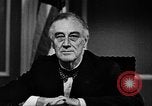
The funeral and interment of President Franklin D. Roosevelt.
President Franklin D. Roosevelt, looking frail, after his election to a 4th term, late in 1944. Newspapers announce his death, on April 12, 1945. View from high above, of funeral procession for Franklin D. Roosevelt. Crowds of mourners line sidewalks in Washington, DC, along the funeral route. Members of the military, in the crowd, salute as the flag-covered coffin of the President passes. Military pallbearers carry the coffin into the White House for a funeral service in the East Room. On April 15, 1945, Pallbearers carry Roosevelt’s coffin to a gravesite at the Roosevelt family home, Springwood, in Hyde Park, New York. Eleanor Roosevelt at President Roosevelt’s gravesite (4097 Albany Post Rd, Hyde Park, NY 12538, United States) with her children, including sons, James and Elliott, both in military uniforms.
USAF Lieutenant General Ira Eaker speaks about his experiences in the U.S. Air Force in the United States.
An interview of United States Air Force Lieutenant General Ira Eaker conducted by Dr. Maurer in the United States. Dr Maurer and General Eaker seated at a desk. Dr Maurer talks about the work and the contribution of General Eaker in the U.S. Air Force. He says that General Eaker was the Commander of the 8th Air Force. In 1944, he became the Commander in Chief of the Mediterranean Allied Air Force. Then from 1945 until his retirement in 1947, he was the deputy commander of the Army Air Forces and chief of the Air Staff. General Eaker talks about his experiences. He talks about the first airplane flight he saw. He further speaks that he was sent to a training camp in 1917. A man came in the camp looking for some fliers. He was already selected for an examination of regular army. He says that in November 1917, he was on a parade grounds. An airplane was in flight overhead. The aircraft landed and he looked at the engine of the aircraft.
A Japanese Mitsubishi A6M3 Type 32 Zero fighter plane being tested at Wright Field, Ohio, during World War II
Army Air Forces records describe this as flight tests conducted at Wright Field on a Japanese Mitsubishi Type 0 MK2-SSF Hamp fighter plane, Army Air Forces (AAF) No. EB-201. (Recognized later, as a variant of the Zero, these Mitsubishi A6M3 Type 32 planes were renamed "Zeke 32.") Flight tests were made from January 9th to March 10th, 1944, to compare this aircraft with AAF fighters and to verify tests made in Australia by the Special Duties and Performance Flight of T.S.-7, Directorate of Technical Services, Melbourne. Test pilot in the cockpit with engine running. Closeup of pilot (possibly Captain Ralph C. Hoewing, who became first Commandant of the AAF Test Pilot School). He takes off from the airfield. and is seen in flight. Various aerial views of the Zero are seen including: flying overhead and from above as it flies over Ohio farmland. The pilot enters a shallow climb; and is seen from above and behind. He performs a slow descending roll. Finally, he buzzes the airfield at low altitude and high speed, and then brings the aircraft in for a smooth landing. (Note: This aircraft was rebuilt by the Allied Technical Air Intelligence Unit in Hangar 7 at Eagle Farm Airfield, Brisbane, Australia, from the wrecks of five Mitsubishi A6M3 Type 32 Zeke's captured at Buna, New Guinea, during the war.) [ Ref. WWW. hangar7.org.au ]