


 Francais
 Deutsch
 Italiano
Refine Your Search
+"United States USA" +1945 stock footage and images
- Showing 7 to 12 of 405 results more
more Hide
Hide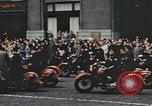
President Truman in New York City for Navy Day and the Christening of the USS Franklin D Roosevelt in 1945
New York City motorcycle policemen gathered on a city street in readiness to escort Harry S. Truman upon his first official visit to the city as President. He is seen riding in an open car, accompanied by Secret Service agents and several U.S. Naval officers. New Yorkers line the sidewalks to catch a glimpse of the President. Workers, of the 32nd Street Western Cafeteria, line the sidewalk in front of their restaurant in the Chelsea neighborhood. The Presidential motorcade crossing the Manhattan Bridge to Brooklyn, and then turning into the gate of the Brooklyn Navy Yard. Sailors lining the Navy Yard roadway presenting arms. Military personnel, yard workers and others fill the Navy yard. The President's flag hoisted on the USS Franklin D Roosevelt. Hundreds of Navy officers and sailors all in white hats, salute in unison. All sit to listen to President Truman's remarks. Scene shifts back to the streets of Manhattan, as policemen control spectators lining the sidewalks. Brief view from a car moving along the path of the motorcade.
Allies demand the unconditional surrender of Japan in World War II. Entry of Soviets and use of atomic bomb ends the war.
Representatives of three nations, seated around table at Potsdam Conference held at Cecilienhof in Potsdam, Germany. British prime minister, Clement Attlee; President of United States, Harry Truman; and representative of Soviet Union, Joseph Stalin at the Potsdam Conference, July 1945. They deliver an ultimatum of unconditional surrender to Japan. Swarms of B-29 bombers and Aircraft Carrier Task Forces destroy Japanese homeland. Planes on carrier decks.Navy Grumman carrier-based TBF aircraft dropping bombs.. Destruction of ships at sea. Mushroom cloud due to atomic bombing. Chart depicts the power of one atomic bomb. Britain's 'grand slam' bomb, most destructive conventional bomb ever produced. Doctor Ernest Orlando Lawrence, inventor of the cyclotron (atom smashing machine). A man works at the Cyclotron at the University of California, Berkeley. General Leslie Groves, head of the project speaks. He is seated with Dr Vannevar Bush, government director of science and research, and Dr Richard Tolman, technical expert. Quantities of uranium shipped from Alberta, Canada are used in bombs. The atomic bomb process (Manhattan Project) is developed in widely separated areas; scenes from Hanford Project plant in Richmond, Washington. Project personnel exit cars and enter into the search area before starting their work day. Lieutenant colonel Franklin T Matthias with the army corps of engineers, appointed to the Hanford Project. Sign of 'Oak Ridge' in Tennessee. Largest of the three atomic bomb plants located near the Tennessee Valley Authority (TVA) dam. Employed personnel in atomic bomb plants are seen going to work. Man and woman employees at the plan read and smile at a Knoxville Journal newspaper in August 1945 with news headline "Power of Oak Ridge Atomic Bomb hits Japs" after the atomic bomb was dropped in Hiroshima. View of dense prefabricated home communities to house large number of Oak Ridge plant workers. View of families setting up their houses in trailer towns after the prefabricated homes were full. People come out from the Henebry's Jewelers and supermarket, among stores setup to meet the needs of the quickly built city. Scenes changes to show view of Soviet leader Joseph Stalin at conference. Russian artillery and troops in a parade at Red Square in Moscow, Russia (these parade scenes are from the May 1, 1945 May Day parade, just days before Germany's surrender). President Harry Truman reports on the latest developments regarding the war with Japan. He states that the United States is prepared to destroy every productive enterprise in Japan and the U.S. shall completely destroy its power to make war. He warns of an attack by the U.S. due to the rejection of the July 26th ultimatum at Potsdam. He warns that Japan "should expect a rain of ruin from the air; the like of which has never been seen on this earth." Truman notes that it will be followed by an unprecedented sea and land invasion of Japan.
Harry S Truman assumes office of President of the United States following death of Franklin D. Roosevelt during World War 2
Harry S Truman appointed President of the United States. The U.S. Capitol building in view. Trees in the foreground. President talks on the phone. Harry Truman attends the 1944 Democratic convention with his daughter, Margaret Truman. People gather holding boards and placards of Truman in hand. A board reads: 'Truman for Vice President'. Franklin Roosevelt seated in a car during his fourth inauguration parade, on January 20, 1945, with motorcade proceeding on Constitution Avenue in Washington DC, and then driving up to the White House. Past events show President Franklin Roosevelt talking to Vice president Truman. Flag at half staff on the U.S. Capitol following death of President Roosevelt. Truman addressing a joint session of the Congress. General Marshall, Admiral King, Secretary of War Stimson all arriving at the White House to meet with President Truman. Also seen are James Byrnes and Truman receiving Lord Halifax, Anthony Eden, Secretary of State Stettinius in the White House. Truman speaks to joint session of congress on April 16, 1945 and expresses desire to continue the efforts and direction set by Franklin Roosevelt, saying, "With great humility I call upon all Americans to help me keep our nation united in defense of those ideals which have been so eloquently proclaimed by Franklin Roosevelt...." He also states, "So that there can be no possible misunderstanding, both Germany and Japan can be certain, beyond any shadow of a doubt, that America will continue to fight for Freedom until no vestige of resistance remains. Our demand has been, and it remains, unconditional surrender. We will face the problems of peace with the same courage that we have faced and mastered the problems of war. In the memory of those who have made the supreme sacrifice; in the memory of our fallen president, we shall not fail."
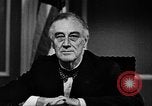
The funeral and interment of President Franklin D. Roosevelt.
President Franklin D. Roosevelt, looking frail, after his election to a 4th term, late in 1944. Newspapers announce his death, on April 12, 1945. View from high above, of funeral procession for Franklin D. Roosevelt. Crowds of mourners line sidewalks in Washington, DC, along the funeral route. Members of the military, in the crowd, salute as the flag-covered coffin of the President passes. Military pallbearers carry the coffin into the White House for a funeral service in the East Room. On April 15, 1945, Pallbearers carry Roosevelt’s coffin to a gravesite at the Roosevelt family home, Springwood, in Hyde Park, New York. Eleanor Roosevelt at President Roosevelt’s gravesite (4097 Albany Post Rd, Hyde Park, NY 12538, United States) with her children, including sons, James and Elliott, both in military uniforms.
U.S. Marine Corps raise American flag on Mount Suribachi in Iwo Jima during World War II; and original statue unveiling at Quantico in 1951.
A film titled 'Uncommon Valor' about the raising of the U.S. flag by U.S. Marines on Iwo Jima, Japan during World War II. United States naval fleet underway off the coast of Iwo Jima. U.S. Army Air Forces aircraft in flight. U.S. 4th and 5th Division Marines disembark from a ship and get onto landing crafts as they head towards the Iwo Jima shoreline. Marines land ashore and advance inland. They raise the American flag on Mount Suribachi. A newspaper boy sells newspapers on a street in the United States. A picture of the raising of the flag on Mount Suribachi. View of sculptor Felix De Weldon as he carves a sculpture of the flag raising event. Scenes from the unveiling and dedication ceremony of the original limestone statue on November 10, 1951, at the Marine Corps base in Quantico, Virginia, for the 176th anniversary of the founding of the Marine Corps. (The version of the statue seen in this footage had been placed in front of the Navy Department Building at the intersection of Constitution Avenue and 19th Street Northwest, Washington, D.C on 10 November 1945. It features 9 foot figures at 1.5 times life size scale. This sculpture was moved to Quantico Marine Base on 17 November 1947. It had been originally constructed by De Weldon of Indiana limestone, cement, and sand due to a lack of bronze during the war. At the time of its move to Quantico in 1947, the statue had deteriorated due to weather. Also, coats of paint to give the look of bronze had hidden much of the detail and had to be removed. Felix de Weldon supervised the repairs at Quantico before the statue was officially dedicated at the main entrance of Quantico on 10 November 1951, as seen in this ceremony). Officers lined up at the ceremony and many guests in the audience. A parking lot seen in the distance behind the assembled crowd. Cover sheets being removed as the war memorial is unveiled at Quantico.
Ground Infantry quiz question on the famous speech by President Harry S Truman in United States
Picture of Benjamin Franklin, Photo of President Franklin D Roosevelt, President Abraham Lincoln, President Harry S Truman, Prime Minister of Britain Winston Churchill and Premiere of Soviet Union Joseph Stalin. GI quiz question on the famous speech by President Harry S Truman. President Harry S Truman addresses United Nations Council on April 25, 1945 at the group's opening conference in San Francisco, California. Truman says, "If we do not want to die together in war, we must learn to live together in peace."