


 Francais
 Deutsch
 Italiano
Refine Your Search
+"United States USA" +1945 stock footage and images
- Showing 13 to 18 of 405 results more
more Hide
Hide
Y-12 atomic production facility; Trinity Shot atomic text explosion in the United States; Truman speaks about atomic secrets.
Atomic bomb production and its use in the United States. Doctor Ernest O. Lawrence experiments with the cyclotron at the University of California, Berkeley. View of the exterior and interior of the cyclotron. An animated diagram shows the results of the splitting of the uranium atom. Diagram shows a nucleus, electrons and protons. Atomic structures of Helium, Lithium and Uranium. A diagram of the creation of barium and krypton, and the release of atomic energy. Aerial and ground views of Y-12 atomic energy testing, uranium enrichment, and manufacturing plant at Oak Ridge, Tennessee created during Manhattan Project. Workers walking on the grounds of the the plant. The Trinity Shot first atomic explosion is shown near Los Alamos, New Mexico on July 16, 1945. Flash of explosion and a cloud of smoke rises as seen from U.S. Army cameras 6 miles away. Two other views of the explosion are seen from other camera positions while narrator explains the effects. U.S. President Harry S. Truman speaks of the need to keep the secrets of the atomic bomb among the U.S., the U.K, and Canada, alone, until they find successful techniques to control the bomb and protect the world from total destruction. He indicates that he will work the the U.S. Congress in the effort and make the power a force for world peace. Truman asks that God guide the U.S. in how to use the technology in His ways and for His purposes. (World War II period).
President Harry S. Truman announces surrender of Germany in World War II. Crowds celebrate in streets of Manhattan
VE Day (Victory in Europe) May 8, 1945. From the White House, in Washington DC, President Truman announces that Germany has surrendered, bringing World War 2 in Europe to an end. Americans are seen celebrating the good news in the streets of downtown, Manhattan, New York City. Crowds on Wall Street and cheering on steps and in front of statue of George Washington at Federal Hall. Ticker tape falls on Wall Street. View of Trinity Church between tall buildings. Cheering crowd fills Times Square. Many in the crowd are soldiers, sailors and other military servicemen in uniform. American flags are seen on buildings and some carried by people in the crowd.
American farmers increase production of agricultural products needed during World War II
Film opens with series of animated maps of the United States, showing the States that are the typical sources of agricultural products, including wheat, corn, dairy products, beef cattle, cotton, flax, lumber, and fruits and vegetables. A woman in overalls places fresh cut corn from a truck on to a conveyor. Farmers pitch hay from trucks. Momentary glimpse of a warehouse on a waterway, with a railroad train running to it, and a large cargo ship docked beside it. A federal official briefs a group of farm state officials and farm families, about the need for increased agricultural production, during World War 2. Closeups of persons in the audience. Scene shifts to window of a modest wooden home with anchor symbol two blue stars displayed for family members in military service. Closeup of the two blue stars in the window. With many men gone in military service, women and youth fill the labor gaps. A women at the wheel of a piece of farm equipment. A boy picking fruit from a tree. View of a large vacant lot in a city being used for numerous "Victory Gardens." A girl digging with a spade in one of the gardens. Other gardeners conversing in the background. A woman storing mason jars of preserved fruits and vegetables on a shelf in her home. Farmers performing maintenance and repairs on farm machinery. Momentary view of farmers loading crates of foods onto an open truck. Women placing vegetables into cans at a factory. Cattle moving into a pen. Men loading bales of cotton onto a river boat. A large freighter being loaded at a port. A farmer treating the soil with something dispensed from a spreader behind his tractor. A farmer harvesting corn by machinery. Three dead pigs, on the ground, (victims of disease.) Cattle foraging close to one another in a pasture. Insects attacking crops as there is a shortage of insecticides during the war. Severe weather causing crop losses is seen. A farmer harvesting with a combine. A document is shown labeled PL 147 77th Congress (the Steagall Bill). (Narrator states it guaranteed prices of 90 percent of parity for war needed crops.) Brochures for alternate crops that farmers might consider because foreign supplies were cut off. A farmer removes an envelope from his mail box. (Narrator alludes to government supplied crop loans and dairy feed payments.) Corn being piled up. Pigs at feeding troughs. Men loading crates of food onto a truck. fresh cut logs rolling into a river. Complete change of scene to Piazzale Loreto, in, Milan, Italy, 1945, where Benito Mussolini and other fascist leaders are seen hanging upside down following their deaths at the hands of crowds. Adolf Hitler and Marshal Hermann Goering at Berteschgaden. Japanese Emperor Hirohito astride a white horse leading some of his senior military officers as they review assembled troops.
United States 9th Army troops and equipment cross the Rhine River in Europe during World War II.
A 1976 training film in the United States details the role of Combat Military Police of the United States Army in supporting river crossing during war. A member of U.S. Military Police looks through binoculars on a hillside while the division advances on a training battlefield. Rest of clip shows actual footage from World War 2: U.S. 9th Army troops cross the Rhine River in Europe in 1945 during World War II. Equipment and U.S. Army soldiers cross the river. Landing crafts and barges across the Rhine River. The troops disembark from landing crafts at the river bank. A pontoon bridge is built by men. An MP directs traffic of vehicles and other equipment along the bridge.
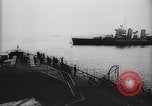
Franklin Delano Roosevelt retrospective - FDR with Winston Churchill, Chiang Kai-shek and Joseph Stalin at different events in different continents.
Life of the President of the United States Franklin Delano Roosevelt in the United States. U.S. President Franklin D Roosevelt is greeted by British Prime Minister Winston Churchill aboard HMS Prince of Wales during the Atlantic Conference for signing of the Atlantic Charter off Newfoundland in 1941. The ship approaches the harbor. Soldiers present arms aboard a ship. Prime Minister Churchill and President Franklin D Roosevelt talk. President Franklin Roosevelt addresses U.S. Congress with declaration of war after the Pearl Harbor attack by Japan in World War 2. The President signs a document. President Roosevelt reviews troops in Casablanca. The troops march. Franklin Roosevelt salutes troops. Vehicles driven in the foreground. Cairo: Franklin D Roosevelt and Winston Churchill with the Chairman of the Nationalist Government of China Chiang Kai-shek. Tehran : Franklin D Roosevelt, Winston Churchill and General Secretary of the Communist Party of the Soviet Union Joseph Stalin pose. United States: The exteriors of the White House. People enter White House. President Franklin Roosevelt with Vice President Harry S. Truman at the 1945 inaugural ceremony. Yalta : President Franklin D Roosevelt, Winston Churchill and Joseph Stalin pose. Franklin D Roosevelt addresses a conference. (World War II period).
Some U.S. Army soldiers focusing on leisure after World War 2, and some attend Army extension classes in the United States.
A post-war U.S. Army film (after World War 2) in 1945-1946 contrasts dice and pool playing soldiers with the soldiers who take Army extension classes to prepare for jobs in civilian life following demobilization and discharge from the Army. Group of U.S. Army soldiers in a room as they play pool at a billiards table. Soldiers in a barracks room seated on a bed and on the floor throwing dice in a game of craps. The soldiers play cards and smoke. Contrast is shown with U.S. Army students seated in a class. An officer takes lessons. A soldier takes notes. A young teacher or professor explains a concept with the help of a blackboard. View of the Hôtel Miramar in Biarritz, France (built in 1927 and demolished in 1978). Aerial view of a building with interconnected corridors. Street level view of the University of Calcutta Senate Hall in Calcutta (Kolkata), India (hall designed by Walter Granville; one time home to the Asutosh Museum of Indian Art; demolished in 1960). People walking in front of the Senate Hall as a car and a pulled rickshaw go by. In next scene, a sign reads 'Fox-Hole Campus'. An officer holds a mechanical model and explains a concept to students. A soldier works with equipment and an African American soldier stitches clothes at a sewing machine. A sign "Learn today; Earn tomorrow" as soldiers learn skills to help them in the civilian sector after separation from the armed forces. A solder works on a model. Pamphlets on a desk with the names of different subjects written on them that U.S. Army students can study to learn skills and jobs, including Automobile Repair Shop, Retail Bakery, Service Station, Grocery Store, Metal Working Shop, Shoe Repair Business, Small Sawmill Business, Beauty Shop.