


 Francais
 Deutsch
 Italiano
Refine Your Search
+"United States USA" +1945 stock footage and images
- Showing 25 to 30 of 405 results more
more Hide
Hide
Profile of job and work of Commissioner of Consumer Affairs as she checks various goods and retail practices in New York City
Views of the crowning ceremony at the Miss America beauty pageant in 1945, and winner Bess Meyerson on stage. Next scene shows Bess Myerson years later as Commissioner of Consumer Affairs for New York City enters a car, car on road on streets of Manhattan, New York City. View of New York City buildings from a moving car. Views of various consumer goods, with price tags on them, people buying. Views of manual cash registers ringing up totals. Views of consumers in markets, stores, and supermarkets. Views of Consumer rights protection office, men and women at work. Women and men on phone. Consumer protection officer at a store, checking different food items. Views of items in butcher or meat department. Interior of a laboratory, food items are tested. Officials working in an office. Commissioner of Consumer Affairs in her office, various items on her desk. View of many different grocery items moving on a checkout belt toward a store cash register. Store worker lifts paper grocery bag and hands it to shopper. Consumer Affairs Commissioner walking on streets of New York City and greeting a woman passing by.
General Douglas MacArthur delivers a farewell address at a Joint meeting of Congress in Washington DC.
The life of U.S. General Douglas MacArthur from 1945 to 1951. General Douglas with other officers in Korea during the Korean War. Soldiers battle with the Chinese on the Korean Front. MacArthur in a jeep studies a map. A motorcade in San Francisco. Large crowds welcome MacArthur. MacArthur in an open car waves at the people. Mrs MacArthur in an open car with other women. MacArthur makes a speech expressing his gratitude towards his wife. The MacArthur family in an open car. Gen. MacArthur delivers a speech at the Joint session of Congress in Washington DC as he completes his 52 years of service, including famous line, "Old soldiers never die, they just fade away." The audience applauds. Sergeant Stuart Quinn of the U.S. Army talks about General MacArthur.

Early pictures of General Eisenhower showing his childhood home and his welcome ceremony when he returned home.
'The Big Picture' depicts the life of U.S. General Dwight D Eisenhower. Sergeant Stuart Queen of the U.S. Army stands in front of a map. He gives an introduction of Eisenhower. In 1945 Eisenhower returns to his homeland in Denison, Texas. A banner reads 'Welcome IKE'. People gather on the sides of the streets to welcome him. He waves from an open car at the cheering crowds. People at parade carry the U.S. flags during a ceremony. Eisenhower salutes. D Day, June 6, 1944- Barges carrying American troops land on the shore of Normandy. Eisenhower with another military officer. Eisenhower salutes. Streets of the city Abilene. Exterior of the Eisenhower Museum. Two boys enter the museum. Pictures of Eisenhower in his childhood - during infancy, house in which he was born, Eisenhower with a group of children, Eisenhower with his family, with his baseball and football team. View of Eisenhower's bedroom- scripture readings on the walls and books in the shelves. A truck passes the creamery where Eisenhower worked in his spare time. Pictures of Eisenhower leaving home to join the Military Academy at West Point. Cadets marching at the grounds of the military academy. Graduation Certificate of Eisenhower. Eisenhower with his wife Mamie Geneva Doud. Fight in Western Europe during the World War I. Picture of Eisenhower with other cadets. The certificate of the Distinguished Service Medal presented to Eisenhower for his services for training tank crews in Pennsylvania.
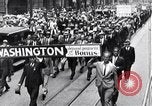
The 1930s Great Depression and the administrations of Presidents Herbert Hoover and Franklin Roosevelt, in the United States
Hard times in the Great Depression led to formation of The Bonus Army. American veterans of World War 1 march on streets of Washington DC, carrying a large poster demanding immediate cash redemption their "bonus" service certificates awarded by Congress in 1924 (but not lawfully payable until 1945). Army Chief of Staff, General Douglas MacArthur, ordered by President Hoover, to clear the Bonus Army encampments, is seen standing in a street surrounded by several U.S. Army troops. People watch from sidewalks as a contingent of U.S. Army cavalry rides down the street. U.S. Army M-1917 tanks roll down Pennsylvania Avenue in July 1932. Bonus marchers and others watch from Lafayette Park in background. Scene shifts to the 1932 Democratic Party Convention in Chicago Stadium, Chicago, where delegates cheer after nominating Franklin D. Roosevelt as their Presidential candidate. Roosevelt seen waving from the podium. Migrant farm workers seen at temporary, dilapidated dwellings in close quarters, and sitting at a campfire, some with sad and desperate faces. Migrant farm workers' cars on the road, piled high with family belongings during westward migration. Migrants riding atop an open railroad freight car. Two men share a copy of the "Epic News" newspaper (published by supporters of Upton Sinclair and the End Poverty Movement in Los Angeles and central California). Narrator describes programs of the Works Progress Administration (WPA) and the Civilian Conservation Corps (CCC). Construction workers ignite demolition charges during construction of Boulder Dam (aka Hoover Dam and officially so-named in 1947). Glimpse of President Roosevelt at the site in an open car, for its dedication on September 30, 1935. Construction workers engaged in building the dam. Another shot of President Roosevelt in his open car. Towers being erected to carry electric power from the dam's hydroelectric generators. President Franklin D. Roosevelt smiling broadly at the formal dedication ceremony, September 30, 1935. Controlled discharges of water through the dam. Views of the Boulder Dam hydroelectric generating station. Oil well rigs or oil derricks at work during construction at night. People at work in fabric mills or textile mills, and in a print shop

Views of the United States. Farms, cities, highways, and beaches. Destruction in Japan by atomic bomb. U.S. infantry in combat
Farmers harvesting grain and corn with machinery on American farms with a narrow tractor harvester. Steel mills and heavy industry and cargo railroads in the United States. Industrial views with smokestacks releasing much smoke and smog (also pollution scenes). Scenes of New York City with busy streets filled with cars, buses, and truck traffic, together with pedestrians. Many varied 1940s and 1950s cars on the roads. Elevated and also aerial views of U.S. highway networks busy with 1940s and 1950s cars. Views of Jones Beach, on Long Island, New York. Scenes of destruction in Japan from the atomic bomb, with sweeping views of destroyed city in Hiroshima or Nagasaki circa 1945 or 1946. U.S. Army infantrymen engaged in house-to-house fighting in Europe during World War II, firing rifles and moving between points of cover in a city filled with rubble.

The United States demobilizes following World War II
Opening illustrated slate shows reduction of Amercan Armed forces personnel from more than 12 million in 1945 to only a little over 1 and a half million in 1947. U.S. Navy submarines are seen docked in storage. Men work spraying protective coatings over guns on Navy ships as they are placed in storage in the "Mothball Fleet." A lone sailor is seen on the deck of a ship with vast number of mothballed Navy destroyers in the background. A B-24 Liberator bomber being dismantled and a B-17 parked with engines removed, seen through stack of propellers in foreground. Airman sets a demolition charge. Views of several bomber aircraft being blown up as junk. Stacks of junked and scrapped American war materiel rusting. View inside a mill where molten metal is being processed (ostensibly recycled from junked war materiel). Narrator speaks of beating guns into plow shares. Several views of molten metal being poured into and from ladles. Views inside post-war factories returning to peace-time production, where industrial heavy equipment, railroad wheels, kitchen appliances, home appliances, rubber tires, and new 1946 Ford automobiles are assembled (looking exactly like the 1942 models).