


 Francais
 Deutsch
 Italiano
Refine Your Search
+"United States USA" +1947 stock footage and images
- Showing 1 to 6 of 161 results more
more Hide
Hide
Plan for Peace, 1947. Public information film about U.S. Army Universal Military Training Project
Firing of a V-2 rocket from White Sands, New Mexico. An XP-84 jet aircraft on a test flight in California. Scenes of devastation in Hiroshima and Nagasaki. An atomic bomb test conducted in Bikini Atoll, Marshall Islands. Large smoke cloud rises. Americans expressing disgust with war and confidence in ability to protect against it in future. Newspaper headline about Armistice ending World War I on November 11, 1918. Victory parade in New York City. Close up view of Adolf Hitler as he speaks forcefully to a German audience. V2 rocket being launched in Germany. German Messerschmitt Me 163 Komet rocket plane in flight. Map depicting uranium deposits world wide. An XB-36 bomber in flight with landing gear extended. A huge formation of various warplanes in flight, high overhead. A wartime tank assembly plant. American army troops on parade. A United Nations meeting in session. Peaceful scenes of American soldiers in Hawaii before World War II in the Pacific. Hawaiian Hula dancers. Japanese carrier-based Aichi D3A1 dive bomber in flight during attack on Pearl Harbor, December 7, 1941. Bombed U.S. warships and facilities in Pearl Harbor. American Army officer and civilian discussing wisdom of maintaing large standing army. Army recruits are seen in the U.S. Army Universal Military Training Experimental Unit at Fort Knox, in 1947. They are seen in quarters, studying; taking part in sports (baseball); and attending religious services in a base chapel. Several trainees in a field tent, working with numerous tape decks in some kind of military communications activity.
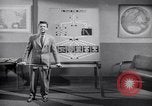
U.S. Army Public affairs film to explain idea of Universal Military Training (UMT) as a Plan for Peace, in 1947
The Universal Military Training Plan for Peace, 1947. A civilian spokesperson stands before a briefing chart entitled "Plan for Peace." He explains the concepts for the program, involving military training for young men immediately after they complete high school.He explains how young men would register and be screened, assigned, and trained under the program. Two college students discuss a requirement to join the Reserve Officer Training Corps (ROTC) under the program. Scene shifts to a U.S. Army officer talking with a civilian about the cost of World War 2. As scens of wartime military production are shown, Narrator interjects that "a full year of Universal Military Training will cost less than three days of war." Scene shifts to Separation Center, Fort Douglas, Utah. U.S. soldiers are seen mustering out. One holds his Honorable discharge certificate. View of marching German soldiers is inserted at this point. Contents of the U.S. Constitution are displayed in plain print, higlighting the part: "...provide for the common defense..." View of college students on a campus. Closeup of Dexter Gate at Harvard College, and three men walking through it into Harvard Yard. ROTC cadet talking with acquaintances about studying rockets. ROTC cadet talking with two middle aged men about unique sounds of airplanes. A B-17 bomber in flight. A C-119 (flying boxcar) aircraft in flight. A formation of B-17s viewed from above with clouds beneath. The XP-84 jet in flight. A V2 rocket being test fired at White Sands, New Mexico.
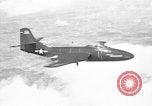
McDonnell prototype of Banshee Navy jet fighter, XF2D-1, in flight over Missouri, January, 1947
Prototype (XF2D-1) of the U.S. Navy F2H McDonnell Banshee jet fighter plane during an introductory flight over Missouri in January, 1947. The aircraft carries the name Banshee on its forward fuselage, and identification number, etc. on its empennage.
X-15 on ground. Bell X-1 mach 1, October 14, 1947. The X-1D, nose wheel collapse, July 24, 1951
The high frontier of X-15 in United States. Rocket powered aircraft X-15 is towed and taken out from a hangar. Various symbols on X-15. A sign reads 'North American Aviation Inc'. Models of aircraft from earliest to most recent are shown. B-29 launching Bell X-1 rocket plane on October 14, 1947. View inside cabin of B-29. Airspeed indicator in the X-1 shows Mach 1 plus. View of X-1D rocket plane landing in Mojave desert, July 24, 1951, as nose wheel collapses and the plane sends up plumes of sand as it spins around before coming to rest, facing backwards. Test pilot Jean Ziegler is seen afterwards in the cockpit, breathing a sigh of relief. Jet fighter seen exceeding mach 2 airspeed. Animation of B-52B Stratofortress launching X-15. and its landing on desert.
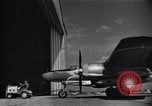
Use of artificial lightning equipment in Project Thunderstorm, and radar operations supporting project and its aircraft
Tug tows Northrop F-15 Reporter into hangar in Minneapolis, Minnesota to be instrumented for Project Thunderstorm. Various scenes of electrical equipment used in making man-made lightning, including a generator made up of hundreds of transformers, and a connected massive generator for producing high voltage. A large oscillograph is shown along with a smaller oscillograph designed for airborne use. A scientist is seen inside the giant generator. Artificial lightning tests are made on canopy of the F-15 occupied by a scientist, and the canopy remains intact following lightning strike. Lightning rods are attached to lightning-vulnerable nose, tail fin, and wing tip locations of the Project Thunderstorm aircraft. Pilot climbs into canopy of F-15. Airborne F-15 project aircraft seen in flight headed toward area of dark clouds. In Ohio at Clinton County Army Air Field, a project officer (AAF Captain) describes how search procedures of the pilot, weather observer, and radar observer are coordinated and key locations of radar and cooperating facilities at Jamestown and the Clinton County Army Airfield. Large radar antenna revolving on top of large tower, scanning for signs of thunderstorms. Radar antenna scanning vertically, near Quonset huts. Command center inside a quonset hut with project personnel at radar scopes and thunderstorm and aircraft positions plotted on large plexiglass screens. Technician adjust motion picture camera that photographs radar scopes every four seconds. Operator at vertical measuring instrument, showing reflected returns from targets, on July 18, 1947. View of operator at plan position indicator radar scope showing weather returns on June 6, 1947. Ground Control Approach (GCA) truck located near end of airfield to guide landings of Thunderstorm aircraft. Radio operators sitting at radar scopes inside the GCA unit. P-61 makes GCA approach and landing in good weather, to maintain skills needed when weather is bad. Briefing officer at blackboard cites radio channels to be used for various purposes. View of AAF aircrews in audience.
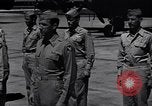
Aircraft pilots running out of door at operations during Project Thunderstorm in Ohio.
Group of officers standing at attention on ramp. Ground crew working on engines of F-61. Large radar antenna revolving on top of tall tower. E M operating radar set. Officer drawing weather maps. E M working on F-61 in hangar. E M talking over telephone. EM climb aboard tug, and ride off cross runway. Pilots running out of door at operations. Pilots run out to their F-61s. Pilots climb into the cockpit of F-61. F-61s warm up before take off. F-61s taxiing on runway. Thunderstorm clouds. E M operating radar instruments in Quonset hut. 18 July 1947 on a plate. 2 June 1947 on a plate. A formation of F-61s. P-61 in flight. Pilot at controls of F-61 while in flight. A formation of F-61s. F-61s break formation. Pilot at controls of F-61 while in flight. F-61s break formation. E M operating radar set. F-61 in flight.