


 Francais
 Deutsch
 Italiano

Refine Your Search
+"United States USA" +1947 stock footage and images
- Showing 7 to 12 of 161 results more
 Hide
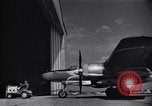
Use of artificial lightning equipment in Project Thunderstorm, and radar operations supporting project and its aircraft
Tug tows Northrop F-15 Reporter into hangar in Minneapolis, Minnesota to be instrumented for Project Thunderstorm. Various scenes of electrical equipment used in making man-made lightning, including a generator made up of hundreds of transformers, and a connected massive generator for producing high voltage. A large oscillograph is shown along with a smaller oscillograph designed for airborne use. A scientist is seen inside the giant generator. Artificial lightning tests are made on canopy of the F-15 occupied by a scientist, and the canopy remains intact following lightning strike. Lightning rods are attached to lightning-vulnerable nose, tail fin, and wing tip locations of the Project Thunderstorm aircraft. Pilot climbs into canopy of F-15. Airborne F-15 project aircraft seen in flight headed toward area of dark clouds. In Ohio at Clinton County Army Air Field, a project officer (AAF Captain) describes how search procedures of the pilot, weather observer, and radar observer are coordinated and key locations of radar and cooperating facilities at Jamestown and the Clinton County Army Airfield. Large radar antenna revolving on top of large tower, scanning for signs of thunderstorms. Radar antenna scanning vertically, near Quonset huts. Command center inside a quonset hut with project personnel at radar scopes and thunderstorm and aircraft positions plotted on large plexiglass screens. Technician adjust motion picture camera that photographs radar scopes every four seconds. Operator at vertical measuring instrument, showing reflected returns from targets, on July 18, 1947. View of operator at plan position indicator radar scope showing weather returns on June 6, 1947. Ground Control Approach (GCA) truck located near end of airfield to guide landings of Thunderstorm aircraft. Radio operators sitting at radar scopes inside the GCA unit. P-61 makes GCA approach and landing in good weather, to maintain skills needed when weather is bad. Briefing officer at blackboard cites radio channels to be used for various purposes. View of AAF aircrews in audience.
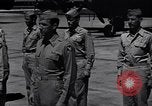
Aircraft pilots running out of door at operations during Project Thunderstorm in Ohio.
Group of officers standing at attention on ramp. Ground crew working on engines of F-61. Large radar antenna revolving on top of tall tower. E M operating radar set. Officer drawing weather maps. E M working on F-61 in hangar. E M talking over telephone. EM climb aboard tug, and ride off cross runway. Pilots running out of door at operations. Pilots run out to their F-61s. Pilots climb into the cockpit of F-61. F-61s warm up before take off. F-61s taxiing on runway. Thunderstorm clouds. E M operating radar instruments in Quonset hut. 18 July 1947 on a plate. 2 June 1947 on a plate. A formation of F-61s. P-61 in flight. Pilot at controls of F-61 while in flight. A formation of F-61s. F-61s break formation. Pilot at controls of F-61 while in flight. F-61s break formation. E M operating radar set. F-61 in flight.
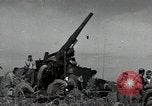
U.S. 24th Infantry Soldiers firing from tank.
Soldiers of U.S. 24th infantry regiment. Soldiers on and around a tank. Soldiers fire the tank. A tank marked with USA 9132569 can be seen in water. Soldiers sitting on the tank. 1947.

President of the UMWA John L.Lewis speaks about Centralia mines disaster, in the Congress of Industrial Organizations (CIO).
President of the United Mine Workers of America(UMWA) John L. Lewis addresses the Congress of Industrial Organizations. He presents a report about a mining accident that occurred in the Centralia coal mines of Illinois. The accident which occurred on 25 March 1947, claimed the lives of 111 mine workers. Mr. Lewis presents statistics about the families of the dead. Press and members of the congress listen to him. Photographs taken.
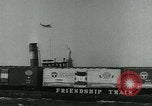
The Marshall Plan being launched to assist recovery of Europe after World War II
Rail cars on the November, 1947 "Friendship Train," at a sea port in the U.S.A. Behind it is seen the funnel of the SS Exiria, of the American Export Lines. The camera moves around to show the Exiria, displaying a large American flag and words,"Friendship Food Ship," on her hull. A steam locomotive on train in France, delivering relief supplies, displays crossed American and French flags on it. Trucks on road in France, displaying French and American flags and pictures of the Freedom Train on their sides, with words:"Ravitaillement, offert spontanment au peuple de France à partir de peuple Americain." (Refueling, spontaneously offered to the people of France from American people.) The SS Exiria docked in an Italian port. A catholic priest and several nuns with a group of boys, standing on the pier, wave American flags. Another group of American girls enthusiastically wave American flags. A large crowd waves several large Italian flags. President Harry S. Truman, at his desk on the White House, Washington, DC, signs the Economic Recovery Act of 1948 (AKA Marshall Plan). Secretary of State Marshall speaking in support of the legislation before Congress. Senator Arthur H. Vandenberg, of Michigan, speaking in support of the bill.
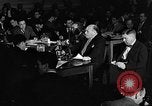
HUAC testimony of "Hollywood Ten" member Samuel Ornitz during investigations into Communist affiliations in Hollywood
Meeting of the House Un-American Activities Committee, or HUAC, in October 1947, under J. Parnell Thomas (the so-called "Thomas Hearings."). Hollywood screenwriter Samuel Ornitz is questioned and asked if he is a member of the Screen Writer's Guild. Ornitz begins his response and expresses that his response is a matter of conscience. He speaks out against the intimidation tactics of the committee chairman. The Committee members continue to cut-off the response from Ornitz and push for a rapid answer to the question. Ornitz continues to give a longer answer and states his belief that the Committee is asking him to violate the Constitution. Robert Stripling is directed to ask the next question. Ornitz is asked "are you now or have you ever been a member of the Communist Party." Ornitz continues to protest the line of questioning and likens his affiliation with any party to be like his affiliation with any religion and thus protected by the Constitution. The Committee asks if his party affiliations are directed by a foreign government. Ornitz is told to stand away and the next witness is called.