


 Francais
 Deutsch
 Italiano
Refine Your Search
+"United States USA" +1947 stock footage and images
- Showing 73 to 78 of 161 results more
more Hide
Hide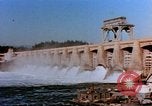
Promotion to buy U.S. Saving Bonds in the United States to contribute towards the development of the country.
A public service announcement (PSA) depicts industrial development in the United States and urges the purchase of savings bonds to preserve American heritage and way of life. Water flows through the Bonneville Dam on the Columbia river between Oregon and Washington for hydroelectric production of electricity. A power house for power transmission. Views of transmission towers and electricity is supplied to houses and industries. A glass tumbler factory. Robot machines using electricity in operation to make drinking glasses. A line of finished articles and items being made in factories using new materials like plastics. A man mixes a color in an industrial mixer. A scene with lightning flashing. A worker moves a large breaker handle in a power transmission facility. Neon lights of Times Square, New York City, at night, with many lit sign boards using electricity. Exterior view of U.S. Capitol on a clear day. View of traffic and pedestrians in front of New York Public Library. View of exterior of Trinity Church Wall Street in New York City. A boy with a dog on a long driveway in front of a nice house. Farmers harvesting crops, a mechanic operating a large wrench, a professor in front of a chalk board in a class room, overhead view of a surgical operation underway by doctors, a business man at work in an office typing a paper. Hands of a banker spinning large wheel to open a bank vault. Scenes of busy traffic on streets of New York City. View of Empire State building skyscraper panning from ground to top of building. Welders working at a job site. Women shoppers or office workers in 1940s fashions walking on sidewalks of a city with a double decker bus in background. View of streets of a small town. A line of people to buy U.S. Saving Bonds. View of United States Savings bonds of various denominations being placed on a table. Overhead view of women office workers filing items in a business office. View of a skyscraper in New York City. Wide view of Manhattan New York City skyline from water. A view of Mount Rushmore. Two women serve food and drink to young children seated in chairs. View of Bill of Rights document. Statue of Abraham Lincoln inside Lincoln Memorial in Washington DC. View of a U.S. flag being raised on a flag pole and fluttering in breeze.

Idyllic scenes of American natural resources, lifestyle, and industry in the late 1940s
American teenagers walking in and out of a school or other institution. Movie set view of a immigrant family ostensibly on a ship deck looking outward. A view from the ground of the Empire State Building in New York City. People working on a farm and a red farm barn visible. Wide view of a river with forest on either side. Two people in a canoe paddling on a lake toward log cabin structures. Wide view of High Falls waterfall on Genesee River at Genesee Gorge in Rochester, New York, panning upward to show Williams, Hoyt and Company shoe factory building and buildings of downtown Rochester in more distant background. View looking upward at the Statue of Liberty. Scene with arms of people stretching out across a map of the United States and interlocking hands to represent unity across the nation. People walk towards the horizon.
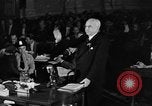
Under Secretary of State George Messersmith gives testimony about the Hans Eisler case and Dorothy Thompson to HUAC commission
Excerpts of testimony by United States Under Secretary of State, George S. Messersmith, to the HUAC (House Un-American Activities Committee) in Washington DC. Ambassador Messersmith raises his hand and is sworn in, and then seated beside his legal counsel, Norman M. Littell. Ambassador Messersmith gives testimony about Hans Eisler and Dorothy Thompson related to his own time in Berlin Germany in the 1930s on behalf of the U.S. State Department. He references his work with U.S. diplomat Sumner Welles. He says that he read the Eisler file to refresh his memory. He says that although they were not involved in the war at the time the responsibility on the State Department had increased. He talks about a case related to columnist Miss Thompson. He looks into his papers He talks about the time when he was posted in Berlin and Austria and she made a number of visits. He laughs. He tells about officers who showed prejudice in examining visa papers.
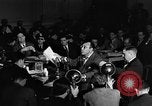
During HUAC hearing in the United States, Herbert Biberman is questioned about his affiliation with the Communist Party
A hearing of the House Un-American Activities Committee (HUAC) in the United States, under Congressman J. Parnell Thomas (the "Thomas Committee") . People seated during the hearing. Hollywood director and screenwriter Herbert Biberman is questioned about his occupation in the Screen Writer's Guild and his affiliation with the Communist Party. Biberman begins his response and does not directly or quickly answer the question, which draws an angry, heated response from J. Parnell Thomas pounding a gavel, shouting from Congressman Thomas and from Robert Stripling, and demanding an answer. Biberman is subsequently asked, "are you or have you ever been a member of the Communist Party" and Biberman begins a response in which he decries the work of the committee and its negative effects on the Hollywood film industry. Biberman, one of the "Hollywood Ten," is dismissed from the stand.

Function of local Veterans Administration offices in answering questions from United States military veterans after World War 2
A public service announcement or PSA after World War 2, targeted at U.S. military veterans. Narrator communicates how to correspond properly by mail when contacting the Veterans Administration. He encourages veterans to visit their local Veterans Administration office to get answers to questions when possible, rather than writing to the United States Veterans Administration. View of the central office of the Veterans Administration with a number of bags of postal mails and letters piled up. Stacks of letters received from veterans, at a rate of four million letters each month. Mails being sorted out by the staff. A veteran visits a local Veterans Administration office. Animation shows issues that the Veterans Administration cannot assist with, including housing, employment or jobs, and surplus property, and encourages that they contact other government agencies for help on those issues. They summarize problems of veterans that the Veterans Administration does look into like housing, jobs and employment, surplus military property, education, insurance and medical care. They encourage veterans to visit local Veterans Administration offices for answers and help.
A film in the United States shows different ordnance like trucks, aircraft, landing crafts being used during a combat.
A film titled 'Trends in Ordnance' about the importance of ordnance and military equipment. Various flashback scenes from the recently ended World War 2: U.S. Army Air Forces aircraft in flight. A bomb bay door opens and bombs drop out. The bombs explode and smoke rises. Trucks with soldiers and tanks advance. Artillery being fired. A technician in a laboratory conducting an experiment with chemicals as various beakers and tubes are nearby. A man works on a drafting table. Ammunition being tested on test grounds. Interiors of an ordnance factory. Battle tanks being built by war production workers on production floor. Bomber aircraft being assembled. Trucks lined up at a factory. A railroad train loaded with military supplies. Aircraft in flight and paratroopers aboard the airborne airplanes. The paratroopers jump and descend. Troops get off a Higgins boat at a beach. A DUKW (amphibious truck), trucks and movers in action.