


 Francais
 Deutsch
 Italiano
Refine Your Search
+"United States USA" +1947 stock footage and images
- Showing 19 to 24 of 161 results more
more Hide
Hide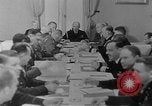
Career of U.S. Air Force General Henry, "Hap", Arnold. The final years.
U.S. Air Force General Hap Arnold meeting with other allied military chiefs at the Potsdam conference, following the end of World War II, in Europe. General Arnold gives a speech during the 38th Anniversary of air power in the United States. Military band plays during the ceremony. General Henry steps from airplane and shakes hands with some of his Air Force Commanders in the Pacific theater. B-29 Super fortresses bombing Japan.Bombardier seen inside B-29 Super fortress. View of General of the Army, Henry (Hap) Arnold. Aircraft of the Air Force demonstration team, The Thunderbirds, in flight. September 18, 1947, formation of the United States Air Force as a separate service. January, 1950, the funeral of General Arnold at Arlington Cemetery, Virginia. Arnold Engineering Development Center building in Tullahoma, Tennessee. President Harry Truman dedicates the Center. B-47 and B-52 bombers taking off. Various Air Force aircraft seen taking off. Views of the United States Air Force Academy, Colorado Springs, Colorado.
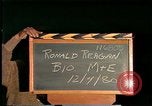
A film sketch about U.S. President Ronald Reagan and tracing his personal history and career leading to the Presidency in the 1980 election.
Opening scene shows U.S. President Ronald Reagan holding a little girl, and then standing with officials and Secret Service agents, as he prepares to enter a car. Closeup of him smiling. Closeup of President Reagan signing his autograph for spectators in a crowd. Next, Reagan and his wife Nancy are seen on November 4, 1980 waving to supporters at the Century Plaza Hotel, celebrating his election victory as the 40th U.S. President. The President elect says a few words of thanks to them. Views of the crowd cheering. Adopted son, Michael Reagan holds his son Cameron as he and his wife, Colleen Reagan, join Ronald and Nancy Reagan on the stage, followed by daughter Patricia Reagan and son Ron Reagan. The crowd cheers the President elect and his family. At this point the film begins showing images about Ronald Regan's life, starting with baby pictures; his parents; Tampico, Illinois, where he was born; Dixon, where he is seen in a school picture and with boyhood friends. A photograph of "Dutch" Reagan President of his High School Class. Reagan in photo with other members of the Eureka College football team, in Eureka, Illinois. The seal of the college. Pictures of Reagan with college classmates and teammates. Reagan posing in bathing suit when he was swimming team coach. Young Reagan, after graduation, as a sports announcer, sitting at a microphone labeled: "WHO" in Davenport, Iowa. The broadcasting tower of that radio station. A Track and field event taking place. Reagan posing with a pipe in his mouth, at the WHO radio station in Des Moines, Iowa. A baseball game in progress before a full stadium of spectators. In 1937, a Chicago baseball team is seen boarding a ship to a Spring training camp in California. (Narrator states Reagan accompanied them.) Aerial view of buildings at the First National Studios (home of Warner Brothers) in Hollywood. Ronald and Nancy Reagan, circa 1952, being applauded at a gathering when he was President of the Screen Actors Guild. Views of Reagan in U.S. Army uniform. A U.S. Army C-47 aircraft taking off from a field under attack, with fires burning and smoke rising (possibly during Japanese December 7, 1941 attack on installations in Pearl Harbor, Hawaii). U.S. Airmen standing on a ramp next to a Douglas C-47B-1-DL transport aircraft (tail number: 43-16145). What appears to be a ViP version of a B-50 aircraft parked on a ramp with an honor guard at the stairway. Ronald Reagan, in uniform, signing up for active duty. Later, Captain Reagan, U.S. Army Air Forces, is seen with other uniformed men at a gathering in Warner Brothers studios. The entrance of Paramount Pictures studios in Hollywood. A large group of studio employees walking between buildings. Reagan speaking, as President, of the Screen Actors Guild, at an outdoor gathering. Actor Robert Young and film industry executives stand nearby. Reagan, as Chairman of the Motion Picture Industry Council, addresses a dinner gathering of that organization. He is also seen testifying before he House Committee on Un-American activities Committee (HUAC) on October 23, 1947.
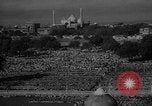
Funeral of Pandit Jawaharlal Nehru, first Prime Minister of India in New Delhi; flashback scenes from prior years.
Pandit Jawahar Lal Nehru, the first Prime Minister of India dies in New Delhi, India. Flashback scene from 1947 as thousands of people assemble and listen to Nehru speak from the Red Fort as India achieves Independence. View of Nehru talking with U.S. President John F Kennedy while walking in a garden in the early 1960s. Indian national flag lowered to mourn for his death. A large crowd gathered to witness his funeral according to Hindu rituals. A woman joins hands towards the dead body of Nehru and weeps.
Unemployed men get jobs in industries and a cooperative farm plan to meet market demand in the United States.
Postwar (after World War II) agriculture activities in the United States. Farming equipment in operation on farms. Canned food in a store. Flashback scenes to the Great Depression during the 1930s: A man carries a banner which reads 'Unemployed Will Take Any Job'. Unemployed men lying on a bench. A sign on a gate : 'No Men Wanted'. Shabby housing tenements and shacks of poverty victims falling apart in a rural farm area. Forward again to the post war 1940s: Smoke comes out off chimneys of a factory. American workers busy at a auto assembly line finishing new cars (appears to be 1946 or 1947 Chevrolet cars). Factory workers line up at a pay window to receive pay checks. An industrialist works in his office. Crowds of American citizens on busy city streets with pedestrians and automobiles, and shoppers looking in store windows, including store windows showing elaborate Christmas displays. A cooperative farm plan to produce what the industrial and consumer markets demand. A man milks a cow with an automatic milking machine. A woman using electricity on a farm to power a new open top clothes washing machine. Farm machines are used.
The United States demobilizes following World War II
Opening illustrated slate shows reduction of Amercan Armed forces personnel from more than 12 million in 1945 to only a little over 1 and a half million in 1947. U.S. Navy submarines are seen docked in storage. Men work spraying protective coatings over guns on Navy ships as they are placed in storage in the "Mothball Fleet." A lone sailor is seen on the deck of a ship with vast number of mothballed Navy destroyers in the background. A B-24 Liberator bomber being dismantled and a B-17 parked with engines removed, seen through stack of propellers in foreground. Airman sets a demolition charge. Views of several bomber aircraft being blown up as junk. Stacks of junked and scrapped American war materiel rusting. View inside a mill where molten metal is being processed (ostensibly recycled from junked war materiel). Narrator speaks of beating guns into plow shares. Several views of molten metal being poured into and from ladles. Views inside post-war factories returning to peace-time production, where industrial heavy equipment, railroad wheels, kitchen appliances, home appliances, rubber tires, and new 1946 Ford automobiles are assembled (looking exactly like the 1942 models).
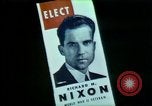
Prior to U.S. Presidential Election of 1968, Richard Nixon recounts his past and tells how he got into politics.
Self-portrait of Richard Nixon aired during his 1968 presidential run against Hubert Humphrey and George Wallace in the United States. An interviewer asks Richard Nixon that how he got into becoming a member of U.S. House of Representatives in 1947. Nixon replies that soon after World War II ended some Whittier Republicans approached him about running for a seat in the United States House of Representatives and he accepted. A picture of Nixon during his campaign in 1946. He says America is a great country because American people are competitive and it does not mean competition in the destructive sense. He considers America a great country in terms of competitive people and says that competitive spirit is a great driving force in any nation. And he says it is the reason why politics appeals to him.