


 Francais
 Deutsch
 Italiano
Refine Your Search
+"United States USA" +1955 stock footage and images
- Showing 13 to 18 of 176 results more
more Hide
Hide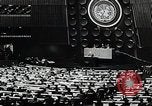
Atoms for Peace. UN approves formation of IAEA. Nuclear scientists gather in Geneva Switzerland
UN General Assembly seen meeting in 1954 as it approves an International Atomic Energy Agency (IAEA). U.S. Ambassador Henry Cabot Lodge II, and French ambassador, Henri Hoppenot, speaking. Finn Moe, of Norway, speaking. View of the city of Kjeller, Norway. Flags of Norway and the Netherlands at joint atomic laboratory. Scientists with various pieces of scientific equipment inside the facility. Indian ambassador, Krishna Menon, speaking at the United Nations. Atomic laboratory and a Government Teachers' Training College, in India. Indian scientists in a laboratory. Indian lecturer speaks to students. Brazil's Professor Ernesto Leme speaks at the UN. The city of Sao Paulo, Brazil. The University of Sao Paulo. Rio de Janeiro, Brazil. The Center for Physical Research. Clock tower of Brazil Central Station in Rio. Sutan Sjahrir,of Indonesia at the United Nations. An animated map shows nations interested in atomic energy. The UN Headquarters building on the East River in New York. A person looking through a microscope. Foreign scientists attending indoctrination courses at the U.S. Argonne National Laboratory. Diplomats sign agreement between the U.S. and Philippines on July 27, 1955, for the Philippines to lease uranium for a research nuclear reactor, and to receive technical assistance. Views of Geneva Switzerland in August 1955, including street views with pedestrians, and tram or streetcar on city streets. Exterior of Palace of Nations, then interior view with atomic science conference in progress. Indian nuclear physicist, Homi Jehangir Bhabha, presiding over conference of scientists and university representatives from 73 nations, including, inter alia, John Cockcroft, of Great Britain; Otto Hahn, of Germany; Willard Libby, of the U.S.A.; Vladimir Vexler of the Soviet Union; and Niels Bohr of Denmark. Views of exhibit hall at the conference, and displayed models of nuclear reactors, uranium ore refining exhibits, and accelerators. U.S. President Dwight Eisenhower views swimming pool reactor, while visiting the exhibit hall. Site work and construction underway in Meyrin, Geneva, Switzerland for a research laboratory for the European Organization for Nuclear Research (CERN - Conseil Européen pour la Recherche Nucléaire). Sitework seen for a facility of Euratom in Europe (European Atomic Energy Community). View of early sitework in Manila for an Asian nuclear center in the Philippines under the Colombo plan, for training personnel in nuclear science and technology.
T-33A aircraft review during a project activity in United States.
Views of T-33A Shooting Star in flight. Three T-33A airplanes parked at an air base in United States. A film on Lockheed activity report covering T-33A improvements during 1955 which included cockpit changes, design and safety features in escape system. Pilot in cockpit demonstrating correct position in the escape system of the aircraft. An instructor demonstrates the system.
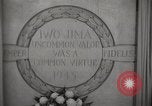
Dedication of Marine Corps War Memorial at Quantico Virginia, and sculptor Felix de Weldon working on sculpture for Arlington location.
The U.S. Marine Corps War Memorial original statue during its unveiling ceremony at the Marine Corps base in Quantico, Virginia on November 10, 1951 (This is after the statue had been moved from its original Constitution Avenue location in Washington DC in 1947, and subsequently renovated under sculptor de Weldon's supervision while it was in Quantico.). A sign on the memorial reads "Uncommon valor was a common virtue, 1945." Next scenes show sculptor Felix de Weldon as he works to build the larger Marine Corps War Memorial in Arlington, Virginia, which was dedicated in November 1954. Felix de Weldon measuring a model of the flag raising on Iwo Jima made by him. de Weldon and others on his team work to carve the large war memorial in plaster before it is cast in bronze. Views of the sculpted faces of the six Marines who raised the flag on Iwo Jima: Faces of John Bradley, Rene Gagnon, Ira Hayes, Franklin Sousley, Harlon Block and Michael Strank. Brief glimpse of the original flag raising scene on Mount Suribachi in February 1945. Next scene, circa 1954 or 1955, shows the completed Marine Corps War Memorial in bronze, in Arlington Virginia, with Washington Monument and Lincoln Memorial landmarks of Washington DC in the background. Close-up views of faces of a young boy, an elderly woman, and a middle aged man who removes his hat. American flag fluttering in the breeze atop the war memorial.
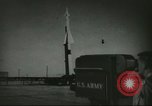
Atomic bomb scenes WWII; atomic testing at U.S. Army atomic experiment station 'Camp Desert Rock' in Nevada, United States
Episode of "The Big Picture", a U.S. Army series of news release programs. U.S. Army cameraman recording Nike missile launch. Atomic cannon fires shell creating atomic explosion and classic mushroom cloud.. Army troops spill out of Sikorsky YH-19 helicopters. U.S. Army infantry soldiers ascend hill firing their rifles. Atomic experiments at Camp Desert Rock in Nevada, United States. U.S. Army Master Sergeant Stuart Queen seated at a desk in his office. He speaks about a series of atomic experiments ("Desert Rock 6") held in barren lands of Nevada at Camp Desert Rock. Celebrating victory in Europe, during World War 2, American troops parade down the Champs Elysees in Paris, France, with the Arc de Triomphe behind them. Happy Parisians watch the parade. War scenes in Japan: footage of explosion and mushroom cloud rising after atomic bomb blast over Nagasaki on August 9, 1945. Barren land on the ground in Hiroshima after the August 6, 1945 atomic blast there . B-29 bombers in flight. Atomic bomb test detonation. Atomic artillery gun M65, also called the Atomic Cannon or Atomic Annie, fires and creates nuclear explosion on distant target.Viking missile launch. U.S. soldiers on parade. Headquarters sign at U.S. Army atomic experiment station at Camp Desert Rock, Nevada, displaying 6-pointed star with "A" in center.. Several atomic test explosions. Soldiers on hillside witness a non-nuclear explosion. Buses carry troops along a road past a sign warning of radiation hazard. Army captain, instructor, briefing troops before the start of atomic maneuvers.. Maps of planned maneuvers. Engineer surveyors lay out ground zero target. View of the ground zero area which is the target area for testing. Signal men lay communication lines to receive and transmit teletype messages. Men operate machinery and dig trenches in which troops will take cover. Other men cover them with sand. [Note: According to the U.S. Department of State, Office of the Historian, from February 18 to May 15, 1955, the United States conducted Operation Teapot, a nuclear test series at Yucca Flat and Frenchman Flat on the Nevada Test Site in the continental United States. During the test period 14 nuclear shots and 1 non-nuclear shot were detonated. Several thousand scientific, military (army, air force, navy, marines), and civilian contract personnel participated in the organization, planning, and execution of the test series. Military exercises undertaken during and following the shots took place under the name Desert Rock 6.]
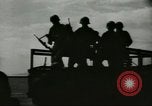
U.S. Army conducts exercise Desert Rock VI, as the "Apple 2" atomic explosive test shot is fired at the Nevada test site
U.S. Army troops silhouetted against sky at dawn as they step from trucks and then proceed to their protected positions in area of ground zero prior to the "Apple II" atomic explosive test shot, "Apple Two," associated with the Army exercise Desert Rock 6. They enter sand-bagged trenches. A briefing officer in a trench issues final instructions that are broadcast over a loudspeaker. View of desert dry lake bed, beyond which is ground zero (detonation site) about 5 miles away. Soldiers are seen foxholes and trenches. An M48 Patton tank, of Task Force Razor is seen, with a tank commander speaking to his group by radio. He instructs them to shut down engines, close all hatches and turn turrets to the rear. Views of tank crew members inside their tanks. The Commander goes down closing his hatch behind him. Other tank crews do likewise. Two Soldiers seen waiting in a trench. One smokes a cigarette. Others standing in their trench. At H-Hour minus two minutes, a siren blows and all begin taking protected positions deep within their trenches and foxholes, as instructed over the loudspeaker. Views of some soldiers in their positions. Glimpse of jeep and of B-45 bomber sitting unprotected on the desert. View of P-47 aircraft in protected positions. Several trees in a line. White flash fills screen as the atomic device is detonated. The explosion seen through camera filming through a porthole. A building flashes into flame and then is blown over by blast wave or shock wave. Interior of house containing mannequins seen, as windows burst in flames and then blast destroys it. Other buildings being swept away. A steel tower bending but remaining upright. Troops out of their trenches moving forward toward ground zero, as the mushroom cloud forms in the distance, and a helicopter flies overhead. Patton tanks of Task Force Razor move toward ground zero, "fighting" their way through obstacles. [Note: According to the U.S. Department of State, Office of the Historian, from February 18 to May 15, 1955, the United States conducted Operation Teapot, a nuclear test series at Yucca Flat and Frenchman Flat on the Nevada Test Site in the continental United States. During the test period 14 nuclear shots and 1 non-nuclear shot were detonated. Several thousand scientific, military (army, air force, navy, marines), and civilian contract personnel participated in the organization, planning, and execution of the test series. Military exercises undertaken during and following the shots took place under the name Desert Rock 6.]
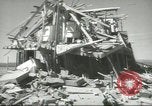
Soldiers assess damage from atomic explosive test shot,"Apple Two," during U.S. Army exercise Desert Rock 6.
Views of various structures and objects after being exposed to atomic explosive test shot "Apple 2" during U.S. Army Exercise Desert Rock VI. A wooden frame house splintered by the blast. A low concrete structure, relatively intact. An overturned Army vehicle. An unsheltered low-wing monoplane, number NG 489851, with skin stripped from its horizontal stabilizer and wing tips. A P-47 aircraft appearing relatively intact. A badly damaged two-wheel trailer. A relatively unscathed auxiliary power unit on a stabilized trailer. Vehicles reduced to rubble. Radar unit and accompanying truck and power unit, seemingly OK, but dish antenna may be damaged. Three soldiers stand around an M2HB heavy machine gun knocked from its stand. A B-29 bomber sits on a ramp with a sign in front of it warning of radiation. A ground crewman sprays the bomber down with a pressure hose to decontaminate it by washing off radioactive particles. A soldier rides a jeep out to check radiation readings on a vehicle that had been exposed. Troops walk back from ground zero and undergo personal cleaning with brooms and checks by geiger counters. A soldier being checked, including his boots. Soldiers sweeping dust from M48 tanks used in the exercise. A soldier being "interviewed" by another, about means of coping with atomic weapons on the battlefield. A formation of soldiers marching, led by one carrying a Corps of Engineers Guidon with the number 14 on it. [Note: According to the U.S. Department of State, Office of the Historian, from February 18 to May 15, 1955, the United States conducted Operation Teapot, a nuclear test series at Yucca Flat and Frenchman Flat on the Nevada Test Site in the continental United States. During the test period 14 nuclear shots and 1 non-nuclear shot were detonated. Several thousand scientific, military (army, air force, navy, marines), and civilian contract personnel participated in the organization, planning, and execution of the test series. Military exercises undertaken during and following the shots took place under the name Desert Rock 6.]