


 Francais
 Deutsch
 Italiano
Refine Your Search
+"United States USA" +1967 stock footage and images
- Showing 19 to 24 of 339 results more
more Hide
Hide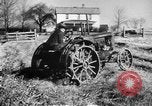
American economy strengthens after the Great Depression; also growth and prosperity and civil rights reform in 1950s and 1960s.
Chronicles recovery in America after the Great Depression in the United States, from roughly 1933-1967, but with emphasis on the earlier years of that period. Pre-war work programs such as the Works Progress Administration (WPA) help with employment. Farmers work in their fields with tractors. Officials in an office discuss and prepare graphs. Workers drill and work at a construction site. The 1933 Homeowners Loan Corporation sparks new home building. View of new homes being built and new suburban neighborhoods. Brief scene of bombing at Pearl Harbor. American warships launching from shipyards during World War II. Women war production workers work in factories in the United States. Post-war Marshall Plan aid being sent to European countries. Crates of supplies marked for European countries. Industrial output booming again, and scenes of industrial factories and plants with smoke pouring from chimneys and pollution from stacks. Large pool typists room filled with female typists and clerical workers busy at work in government agency. Close up views of hands of women operating typewriters. Reforms for housing projects, African American Civil Rights and measures taken to stabilize unemployment, with scenes of successive Presidents signing reform bills, including Truman, Eisenhower, and Kennedy. A ship departs from a harbor with goods. A convoy of vehicles on a road. Various Federal buildings in Washington DC. The White House building. An aerial view of an American town and of a factory with pollution smoke emitting from stacks. Letters being delivered to elderly women. People enter a medical clinic and wait in the clinic waiting room. Racially integrated classroom of older high school students or university students, with white and African American students, and both young men and women. A young white woman worker and a young African American working in a machine shop or possibly an academic shop class. A white and a African American man share a sandwich and views of white and black people together in integrated classrooms and factories as segregation begins to wane. Elementary school children in a classroom drawing pictures.
LSD tests conducted on unwitting victims including prostitutes and drug addicts by the CIA in the United States.
A documentary depicts research and administration of LSD (Lysergic acid diethylamide ) by the CIA (Central Intelligence Agency) in the late 1950s and into the 1960s (part of project MKUltra). A remote mountain area in Southern Mexico. A view of a hand holding a mushroom. View of a part time chemist for the CIA, Dr. James Moore, who narrator says duped amateur mycologist and mushroom science enthusiast R. Gordon Wasson into providing information that led to the development of LSD. Mr. R. Gordon Wasson is asked about a magic mushroom leading to the drug psilocybin. He talks about how they found the mushroom in Mexico and ingested it as administered by a local shaman or magical priestess, Maria Sabina, in a Mazatec mushroom ritual. Wasson describes his own experience of what it was like to be under the influence of psilocybin. He describes visions and his sensory experience. Narrator relates how Dr. Moore was instructed by the CIA to get close to Mr. Wasson and obtain the magic mushrooms on a trip to Mexico, and that internal memos revealed plans to derive a drug from the mushrooms that would remain an agency secret. Dr. Moore discusses his work in helping the CIA to produce a new drug. Anonymous speaker relates information from CIA operative of plans by the CIA to test the drug on unwitting American citizens. People drinking and sitting at a bar. Charles Siragusa, a former narcotics officer, tells about discussions with Mr. George White. Scenes with swirling colors and lights meant to simulate the experience of someone taking LSD drug. CIA operative says that George White helped the CIA locate unwitting persons on which to test the drugs, including prostitutes and illegal drug addicts. Traffic on city streets. Narrator states that Mr. White set up safe houses for CIA in Greenwich Village, New York. Night time views of neon signs for cocktail lounges and night clubs. Exterior neon sign of Plantation Inn Motel in San Francisco, another safe house. View of an apartment building atop Telegraph Hill in San Francisco, with a view of San Francisco Bay from the safe house apartment. Former CIA official relates how they used the safe houses to administer drugs to prostitutes and determine if the drug could be useful in getting people such as prostitution customers to reveal secrets. Cars and prostitutes on a street. Views of a college campus green. Narrator states that millions of dollars were spent on LSD research at universities throughout the United States. Narrator states that word spread on college campuses about the drug, and ushered in the counter-culture movement of the 1960s. Dr. Timothy Leary is interviewed and states that he gives the CIA credit for launching the consciousness movement and counter-culture events of the 1960s. Scenes of Dr. Leary in 1967, depicting him while using the drug. Dr. Leary states that the CIA funded and encouraged use of the drug by hundreds of psychologists to advance research and understanding of it, and that psychologists found it to be an intelligence enhancing and consciousness raising experience.
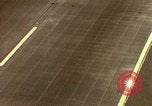
A car hits a breakaway pole along Interstate Highway as seen from a film on safety features of highways in the United States
Cars move on a highway in United States. A red 1967 Ford Country Squire station wagon car drifting. Automobile accident scene where a car hits a breakaway pole along Interstate Highway. Various safety features of modern highway illustrated including grooved pavement; breakaway light poles; Jersey bounce and bridge designs to keep car on the road; wide shoulders; emergency call boxes. An animation shows a car getting on the base of the side wall along the highway and back on the road. A man drives his car on the paved area along the highway and stops by a pole with a sign that reads ' Call Box' he makes a phone call. Image of cars on the highway in the side mirror of a car.

Montage of U.S. scenes covering various parts of the nation
Opening scene shows a wheat field in the United States. White hot molten metal collected in ladles as a furnace is tapped. Sandstone buttes the Navajo Nation's Monument Valley Park. Half Dome in Yosemite National Park. Michigan Avenue in Chicago, Illinois, as seen from a moving vehicle looking North from the Art Institute, with many skyscrapers of glass and steel. A white church in a suburban setting. The Japanese cherry trees in bloom along the Tidal Basin in Washington DC. A major river and an old fashioned stern wheeler River Boat cruising on it. A street scene in New Orleans, Louisiana. A roadway in Florida. A fishing village scene in New England. A formation of oil well pumps operating out West. Cowboys on horseback herding cattle in a wide open prairie view. View of the Statue of Liberty with dramatic sunset behind it. Two U.S. Marines conversing as they look at the Manhattan skyline in New York City. Aerial view of the skyscrapers on Manhattan Island. View of Times Square in Manhattan, with the Astor Hotel visible (It was razed in 1967). Police officer directing traffic at an intersection. Two Marines walking past the United Nations Building in Manhattan, New York City. View of the General Assembly Building and construction site of the The Dag Hammarskjöld Library Building being added in front of it. Camera pans upward showing Independence Hall in Philadelphia, Pennsylvania. Camera pans the U.S. Capitol building, followed by the Lincoln Memorial, the Jefferson Memorial, and the Washington Monument (viewed from steps of the Lincoln Memorial across the reflecting pool, in Washington, DC. A Marine color guard marches across the lawn in front of the United States Marine Corps War Memorial (Iwo Jima Memorial) in Arlington Ridge Park Virginia, as the Marine Band marches and plays. Closeup of the Memorial with American flag flying above it.
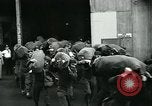
Troop Transport ship Monterey arrives in New York City with Major General Terry Allen and 6500 returning troops (WW2)
Arrival of U.S. Army 104th Infantry Division soldiers home to the United States at the end of their deployment in Europe during World War 2. Happy U.S. Army troops smile as they leave ship pier with transport duffel bags and boarding a waiting railroad train. Close-up views of Timberwolf patches on shoulder of uniforms. Transport ship docking at pier. Large sign on side of transport reads "104th Timberwolves" (the U.S. Army 104th Infantry Division) and troops seen aboard transport ship. Major General Allen (Terry de la Mesa Allen Sr.) comes down gangplank. General is greeted by his wife (Mary Frances Robinson Allen) and teenage son (Terry Allen Jr., who, later, as a Lt. Colonel in the U.S. Army, was killed during the Vietnam War Battle of Ong Thanh in 1967). Troops with bags walk up stairs. (World War II period)
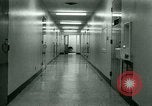
An interview with a young male patient and views of a hospital corridor in the United States.
A hospital in the United States in the 1960s. View from a dolly moving down a hospital hallway or corridor. Patient treatment rooms on either side of the hall. A door at the end of the hall. Another corridor adjoining the hall. A ceiling light in the adjoining corridor. An interview with a young male drug abuse patient who use illegal drug LSD (Lysergic acid diethylamide).