


 Francais
 Deutsch
 Italiano
Refine Your Search
+"United States USA" +1968 stock footage and images
- Showing 25 to 30 of 200 results more
more Hide
Hide
President Johnson delivers a speech and people express grief after the assassination of Martin Luther King Jr. in the U.S.
From production "April Aftermath", showing mourning and grief throughout the United States after the assassination of Martin Luther King, Jr. on April 4, 1968. The flag of the United States is lowered at half mast. People watch on television President Johnson's speech about the assassination of Martin Luther King Jr. (leader in the American Civil Rights Movement). Families are seen at home gathered around the television to watch the speech. Views of several families of husband and wife and children gathered in their living rooms viewing television sets to watch the address. Most are white families. One family is an African American family watching television. President Lyndon B. Johnson delivers a speech. The Seal of the President of the United States on a dais. President Johnson declares April 7 as a national day of mourning for the civil rights leader. Mourning ceremonies are conducted in all churches and pilgrims of the United States. Television broadcast the faces of leaders and the news about the assassination and people expressing grief. A large crowd of civilians gather at a condolence meet. People in a line enter a building to express their grief. They come outside the building. A large crowd of civilians gather and attend the condolence ceremony. They express grief.
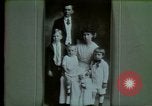
Richard Nixon recounts his past and speaks about his football coach Wallace Newman in the United States.
Self-portrait of Republican nominee Richard Nixon aired during his 1968 presidential run against Hubert Humphrey and George Wallace in the United States. A photo showing Richard Nixon's father and mother, Mr. and Mrs. Francis Nixon and their children, left to right: Harold, who died when he was 23; Donald and Richard, in Yorba Linda, California. Richard Nixon speaks about how devoted and self sacrificing his mother and father were for their children. He calls his family a happy family but also speaks of the difficult times when his brothers Harold and Arthur died from tuberculosis. An old picture of Richard Nixon showing him with his younger and elder brothers. Nixon speaks that a life without any ups and downs can not know the beauty of life in a broader sense. He says that he got his attitude about winning from his football coach Wallace Newman during his college years. A picture of Coach Wallace Newman. A 1934 photograph of Richard Nixon in football gear during his senior year at Whittier College.
A political broadcast shows Richard Nixon shaking hands with people during a campaign prior to U.S. Presidential Election.
A political broadcast promotes Republican nominee Richard Nixon prior to the 1968 Presidential Election in the United States. Still images show Richard Nixon shaking hands with people during an election campaign. A sign reads 'NIXON'S THE ONE'.
Outtake from a Hollywood movie purportedly showing actual UFO in sky behind actor
Actor dressed as a cowboy,on horseback, smoking a cigarette in a movie. Purportedly an unidentified flying object (UFO) appears behind him in the sky. (Note: This is from a U.S. Air force collection and has been identified as an outtake from a movie entitled "A man called Gannon," filmed in 1968.)
U.S. President Lyndon B Johnson presents the Medal of Honor to American servicemen in Virginia, United States.
The Hall of Heroes at the Pentagon in Virginia, United States. Footsteps echo in Pentagon hall as camera moves along corridor toward the Hall of Heroes. John Charles Daly stands next to a giant replica of the U.S. Medal of Honor and speaks about medal recipients. He steps in front of a display listing names of Medal of Honor recipients and explains the medal's significance. Scene shifts back in time , to May, 1968 when President Lyndon Baines Johnson is seen speaking at the dedication of the Hall of Heroes, where he confers the Medal on recipients from each of the four military services. He calls out the names of : Charles C. Hagemeister (Army); James E. Williams (Navy); Gerald O. Young (Air Force) and Richard A. Pittman (Marine Corps). President Johnson says their names will be placed with others in the new Hall of Heroes. The President places the medals around the necks of the respective recipients as citations accompanying their awards are read. Next, Mr. Daly is seen again in front of the list of recipients. He notes that these four new additions brought the total of names to 3,210.
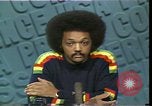
Patrick Borgan questions Jesse Jackson on Civil Rights protests of the 1960s versus 1970s approaches, during a press interview.
Jesse Jackson is interviewed in a press conference. Jesse answers Patrick Borgan of London Times on protesting peacefully with reference to 1968 and its riots and unrest vis-à-vis Civil Rights and racial equality for African Americans. Judith Randal of New York Daily News and Henry McGee of Newsweek Magazine are also present. Bill McCrory of Voice of America is the moderator. Jackson discusses the purposes of the protests of the 1960s, and explains that the vision toward the goal of equality takes time and has curves, rather than being a straight line. He implies that some people because satisfied with the gains from the 1960s, but that there is more to do, and that moral depravity and a lack of good ethics is the current obstacle in the 1970s holding back progress.