


 Francais
 Deutsch
 Italiano
Refine Your Search
+"United States USA" +1969 stock footage and images
- Showing 13 to 18 of 131 results more
more Hide
Hide
Man smoking at night, woman getting on bus, women driving and at gas station, girls at roller rink 1970s.
View of a dark, secluded street at night. A soldier holds a lighted cigarette, with cigarette butts littered on the ground. Close up car headlight turning off. Woman's feet stepping out of car. Young female sergeant walks alone in secluded street at night. Soldier throws cigarette butt on the ground at night. Bus pulling up to bus stop in Alabama. Young woman wearing 1970s fashions, with blue boho head scarf steps onto bus as doors open. Blond woman holding groceries unlocks car door. Young woman sitting in driver’s seat as gas station attendant at Gulf gas station cleans windshield of her sports car. Car drives down street at night while 1969 Mustang GT car pulls away. African American girl and her friend in pigtails approaches the African American girl’s father in a roller skating rink. The African American girl tells her father that her friend needs a ride home. Man looking through binoculars at night. Views of several apartment windows at night with curtains drawn. Man putting down binoculars and closing curtains at night. A soldier greets a young female sergeant. Female sergeant asks the soldier to hold her handbag for her while she plays billiards with them. After the soldier asks if it was an order, the female sergeant hands over her handbag to him, explaining “… it’s called being a good sport.”
Realistic example: U.S. Army 1st Battalion 87th Infantry prepares for a night operation.
Night vision techniques and the use of metascope and starlight scope by the United States Army. Relaistic example of a night operation. Command post of the Alpha Company, 1st Battalion, 87th Infantry. Captain Wald briefs Sergeant King about a night mission to be conducted the same night. Soldier on the radio nearby. The two officers draw and mark the route on a map. Captain Wald salutes the Sergeant and gets on the radio. Animation shows the functioning of a starlight scope, a portable battery operated telescope. Includes the functions of illumination and magnification. A soldier prepares for the night mission. He walks up to a log and sits behind it. He mounts the starlight scope onto the rifle, selects a target, takes a comfortable position with support and then turns the power switch on. After that he takes aim, adjusts the eye piece focus and the range focal ring, and fires.
Realistic example: U.S. Army patrol reaches the Listening Post and scans the area for danger during a night operation.
Night vision techniques and the use of metascope and starlight scope by the United States Army. Relaistic example of a night operation. 2100 hours: 1st Battalion, 87th Infantry patrol clears the parameter. Sergeant King checks if the soldiers' eyes are adapted to darkness. Animation depicts parts and operation of camera, parts and functioning of human eye, comparison between the two, and functioning of rods and cones. Listening Post (LP): Sergeant King confirms the patrol's coordinates, the LP in turn alerts the headquarters that the patrol has passed his position. An illuminated object falls from the sky to the ground. The soldiers cover one eye to retain night vision in the same. They advance through the jungle. A soldier sights danger area and signals the patrol to halt. Soldiers sit on the ground and scan the area. Scanning includes short, abrupt, irregular movement of the eyes over and around the area every 4 to 20 seconds. A stream in the area.
U.S. Army soldiers employ night vision principles and night vision devices for a successful night operation.
Night vision techniques and the use of metascope and starlight scope by the United States Army. Relaistic example of a night operation. Sergeant King obtains a starlight scope to scan the opposite bank.. Point man receives instructions for crossing the danger area. Soldiers advance. Soldiers in prone position takes aim with both eyes open above the barrel, and fire. One soldier signals to the rest. Two soldiers by the road. They take out a starlight scope and look through it. Sergeant King decides to continue and the patrol moves across. A soldier signals with a torch. They move through the jungle. Sergeant King radios the Company Commander about their approach into the parameter. Point man scans the area with a starlight scope to locate the friendly patrol. Recognizing the patrol leader's signal, the guard signals him to move forward. The patrol moves ahead while the guard continues to scan. The patrol returns, mission accomplished. Soldiers employ the night vision principles of scanning and off center vision, as well as night vision devices for successful night operations.
C-5 Aircraft taxis on runway. General description of C-5 with emphasis on its 28 wheel landing gear
C-5 Aircraft taxis to come to the runway. Narrator describes features of the C-5. Pilot and Copilot seated inside cockpit. 'Beware of Blast' written on side of the C-5 Aircraft. Airman explains about the flexibility and 28 wheels of the aircraft with the help of a model. Adapting to crosswind landing. Forward, aft, and level "kneeling" of the aircraft is shown. View of control panels inside the aircraft.
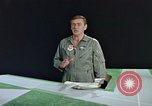
Pilot explains safe taxiing of C-5, emphasizing its extreme size and potential for damage from obstacles and foreign objects
Pilot explains safe taxiiing of the C-5, with the help of a model. He emphasizes the need to care due to the sheer size of the overall aircraft, from nose to very high tail section and wing tip to wing tip, where outboard engines can be operating only 9 feet above areas outside of runway where foreign object damage could occur.