


 Francais
 Deutsch
 Italiano
Refine Your Search
+"Vietnam" +1968 stock footage and images
- Showing 1 to 6 of 614 results more
more Hide
Hide
A political advertisement critical of Democratic nominee Hubert Humphrey during the 1968 presidential campaign
A political advertisement from the Nixon campaign or Republican party during the 1968 Presidential election campaign portrays Democratic party challenger Hubert Humphrey in a negative light. Still images show Democratic presidential nominee Hubert Humphrey at the party's convention in Chicago, Illinois. Riots in the United States following assassinations of prominent leader in the African American civil rights movement, Martin Luther King, Jr., and Senator from New York Robert F. Kennedy, in 1968. U.S. soldiers battling the enemy in Vietnam during the Vietnam War. A picture depicting poverty shows a poor family. Images of Humphrey are interspersed throughout, portraying him as disconnected from the issues of the day.
A political advertisement in the U.S. promotes Nixon and speaks out against policies of the democratic party in 1968
A political advertisement in the United States prior to the 1968 Presidential Election promotes Republican party nominee Richard Nixon. Still images show U.S. Vice President Hubert Humphrey becoming a Democratic nominee at a tumultuous convention in Chicago, Illinois which was marred by disorder. Images of violent confrontations between antiwar protesters and police in the United States during the 1960s. Images depicting poverty in rural are urban areas of the United States. U.S. soldiers in Vietnam. (Vietnam War period).
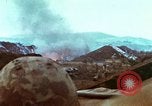
U.S. Air Force Military Airlift Operations in 1968 during the Vietnam War, and during 1976 border tensions in Korea
View from a U.S. Marine bunker as enemy shell explodes nearby, during the siege of Khe Sanh in 1968 during the Vietnam War. The United States Marines in the Battle of Khe Sanh firing mortars and a 105mm howitzer from their bunker. Enemy shells exploding on the tarmac, where American Air Force C-130 aircraft are parked. Marines rushing wounded comrades on stretchers, to C-130s for evacuation. Scene shifts to U.S. Marine Corps Lieutenant Colonel James P. Sheehan, standing at Camp Pendleton, California. (He was a company commander in the siege at Khe Sanh.) As he describes the C-130 aircraft support operations, a contingent of marines marches past, behind him. Scene shifts to a civilian narrator standing in the Military Airlift Command (MAC) Headquarters Command Center at Scott Air Force Base, Illinois. Among other things, he describes MAC support to the Tactical Air Command in Korea. Camera focuses on MAC air routes in the vicinity of the Philippines, Japan, and Korea. Next, is seen view of airfield at Mountain Home Air Force Base, Idaho, briefly at sunset, and then at night, as pilots of the 366th Tactical Fighter Wing and their F-111 aircraft prepare to depart for Korea, in response to border tensions, in August, 1976, after North Korean forces killed two American officers ("Korean Axe Murder Incident" and resulting "Operation Paul Bunyan"). Ground crewman directs a taxiing F-111 using lighted wands. The F-111s takes off. One of them is seen landing after the 7 thousand mile flight to Korea, as Major Paul Malandrino,Jr. (unseen) of the 366th Wing, speaks about MAC's airlift support. A C-141 MAC aircraft is seen landing. View of a C-141 with tail doors open and its cargo of military equipment on the ramp behind it. Glimpse of a marine with rifle and earphones, guarding equipment on the airfield ramp. Closeups of F-111 aircraft taking off.
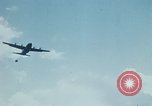
U.S. Air Force Military Airlift operations in Vietnam, 1968 and In Israel, 1973
U.S. Air Force C-130 airdrop operations in 1968, during Vietnam War. C-130 aircraft in flight. View of supplies being airdropped. View from inside cabin of a C-130, as South Vietnamese paratroopers jump from the aircraft. A heavy pallet of supplies being pulled onto a runway by parachutes, from the rear of a low-flying C-130. Scene shifts to October 14, 1973,at Lod International Airport, Tel Aviv, Israel, where a U.S. Air Force Military Airlift Command C-5 aircraft is unloading 186,200 pounds of military assistance cargo, at the start of the U.S. "Nickel Grass" airlift operation during the Yom Kippur war or Arab-Israeli War of 1973. Pallets of ammunition are seen being offloaded, followed by a 175mm self-propelled gun, covered with wooden cargo boxes. Israeli Prime Minister Golda Meir and other observers watch stand on the airport ramp. Golda Meir meets and greets members of the U.S. Air Force crew.
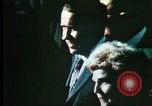
Republican nominee Richard Nixon express his views about the presidential race before U.S. Presidential Election of 1968.
Self-portrait of Richard Nixon aired during his 1968 presidential run against Hubert Humphrey and George Wallace in the United States. An interviewer asks Richard Nixon what did he think when he made a decision to run for the President of the United States in 1968. A picture showing Richard Nixon and his wife Pat Nixon. The interviewer asks if he felt any strain on the family. Nixon says he thought of his family first. A picture showing his wife Pat Nixon and daughters Julie Nixon and Tricia Nixon. Nixon calls this presidency more of a challenge in terms of America being involved in the Vietnam War and in the Cold War with the Soviet Union. A photograph shows Richard Nixon with his wife Pat Nixon, daughters Julie and Tricia and Julie's husband David Eisenhower at a beach. He says that present time is different from World Wars I and II because now America is a great power and there should be a best possible leader to lead the nation. Nixon states that America needs a kind of leadership that would obtain peace and avoid war and surrender. A picture of Mr. and Mrs. Richard Nixon.
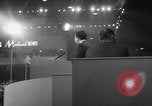
Senator Daniel Inouye talks about demonstrators during keynote address of 1968 Democratic National Convention in Chicago, Illinois
Democratic National Convention of 1968 held at International Amphitheater in Chicago, Illinois United States. Keynote speaker at the meeting, Daniel Ken Inouye, Senator from Hawaii, delivers his address. Democratic representatives from all States at the convention. Placards displayed for seating arrangements of Democrats from different States. Senator Inouye urges delegates to listen to the concerns and protests of youth demonstrators. He points out that it is a worldwide phenomenon, and not just demonstrations affiliated with the Vietnam War. Senator Inouye says, "The marching feet of youth have led us into a new era of politics, and we can never turn back."