


 Francais
 Deutsch
 Italiano
Refine Your Search
+"Washington DC USA" +1954 stock footage and images
- Showing 7 to 12 of 38 results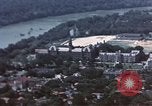
Aerial views of the suburban areas of northwest Washington DC, USA.
Aerial views of northwest Washington DC in United States. Flying by densely populated suburban areas, the Georgetown University, and toward the Washington Monument and U.S. Capitol.
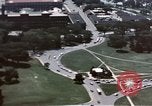
Aerial views of landmark buildings and areas of Washington DC, USA during the 1950s.
Aerial views of the Washington DC area, including the Washington Monument and the Jefferson Memorial. Potomac River seen. Aerial view flying by the National Mall areas leading to the Capitol Building, including Bureau of Supplies and Accounts buildings; Bureau of Ships buildings; National Museum of Natural History; National Gallery of Art; various Constitution Avenue buildings, the Main Navy Building, the Munitions Building, and Union Station. Fly-by of various city and suburban areas of Washington DC metropolitan area, with many construction projects underway, north and east of the U.S. Capitol.
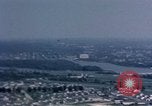
Aerial views of the Pentagon in Arlington, Virginia, near Washington DC, USA.
Aerial views of Arlington, Virginia and Washington DC featruing a 360 degree fly-by of the Pentagon Building. Potomac River in the background. Plane circles the Pentagon more than once with different views seen.
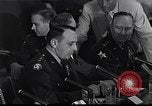
Public Hearing, Senate permanent subcommittee on Investigations. Army-McCarthy hearing April 22, 1954.
April 22, 1954. First open session of Senate permanent subcommittee on investigations in response to charges filed by the U.S. Army on April 13, 1954, concerning improper actions by Senator McCarthy and staff to obtain special treatment for Private G. David Schine, U.S. Army. Seen before start of session are Army Generals Lucius Clay and Alfred Gruenther. Senator Karl Mundt presiding, calls the session to order. Among those seen are Senator Edward Dirksen, second person to the Chairman's right, and Senator Charles E. Potter to Dirksen's right. Senator John L. McClelland sits to Chairman Mundt's left. Senator Joseph McCarthy and his counsel, Roy Cohn, are at the end of the table. At end of clip McCarthy states for the record that "there is no contest between Senator McCarthy and the Department of the Army, and that all that Senator McCarthy has been trying to do is to expose the Communists who have infiltrated the Department of the Army -- a very small percentage."

Timeline summary of the events and achievements of President Eisenhower's administration.
"The Eisenhower Story": A pre-election pro-Eisenhower propaganda film designed to highlight Eisenhower's qualifications for reelection as President in the 1956 election. Factory whistle blows and men entering a factory. Car chassis factory assembly line. Locomotive engineer blows train whistle and railroad locomotive with cultivators on a flat bed car. Cultivators harvesting grain. Woman carries groceries from shop to a 1950's sedan car parked on street. View of 1950's automobile highway traffic and aerial view of highways being built under his plans for highway construction and road expansion. View of Eisenhower at swearing in ceremony during his inauguration as President in 1952. In his speech, Eisenhower emphasizes that, "we stand ready to engage with any and all others in joint efforts to remove the causes of mutual fear and distrust among nations..." Newspaper headline 'Korean Truce Signed' at time of armistice during Korean War. American troops disembark ship and greet family. Secretary of State Dulles talking with German chancellor Konrad Adenauer. Secretary John Dulles seen also with British Prime Minister Winston Churchill. Eisenhower and Churchill at Geneva conference, along with Soviet leader Khrushchev and Marshal Nikolai Bulganin. Eisenhower speaks before United Nations about efforts to form an "atom pool." He notes United States "determination to help solve the fearful atomic dilemma...." Newspaper headlines 'Eisenhower Signs Sea Way Bill'. Construction of Saint Lawrence Seaway. 'Budget' and 'tax cuts' news in newspapers, including headline, "White House ends all wage controls...." Farmer plows field with tractor. Construction of new buildings and highway construction through Eisenhower programs. Views of the newly established Department of Health, Education, and Welfare. Workers filing cards in giant room of file drawers and cabinets. Nurse draws vaccine into syringe. Children are vaccinated (likely polio vaccine). President Eisenhower meets leaders from different countries at White House, including England's Queen Mother and King Paul, Queen Frederica of Greece, and Prime Minister St-Laurent of Canada. Eisenhower at press conference discussing disarmament notes importance of the "elimination of opportunity of surprise attack." View of shore towers and listening platforms and missiles rising on platforms to protect America from attacks. First nuclear submarine, the USS Nautilus (SSN-571 ) launched on January 21, 1954 by Mrs. Mamie Eisenhower in Connecticut. Plane taking off from aircraft carrier USS Forrestal (CV-59) while underway at sea. Formation of Northrop F-89 Scorpion aircraft in flight.
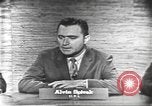
Richard Nixon and John Kennedy answer reporters' questions during a presidential election debate in Washington DC, U.S.
The second Kennedy-Nixon Presidential Debate in Washington DC, United States. Alvin Spivak of United Press International asks Republican candidate U.S. Vice President Richard M. Nixon to comment on his intentions in the field of civil rights. Nixon answers and states that progress is to be made in the field of employment by giving statutory authority to the Committee on Government Contracts. He states that in the field of schools, provisions should be laid whereby the federal government would give assistance to districts who want to integrate their schools. He speaks about presidential leadership. He concludes and says that the civil rights of the Americans should be recognized in order to protect the country from communist rule. Democratic candidate Senator John F Kennedy points that Nixon hasn't discussed what would be his policy on implementing the Supreme Court decision of 1954 and what would he do and what would be his leadership in providing fair employment, housing and education. He concludes by saying that the president must establish a moral leadership. Harold R. Levy of Newsday asks Kennedy to comment on what the President should do in racial discrimination events such as Little Rock Nine or the lunch-counter sit-ins. Kennedy says that he thinks that a president operates in different areas as a legislative leader, an executive leader and a moral leader and his functions differ in each area. He talks about the government contracts. He speaks about the standards set by the Americans which the Communists don't set. He comments on the case of Little Rock and says the U.S. President should go with the Supreme Court's decision. Nixon comments on the matter of the Committee on Government Contracts being mentioned by Kennedy. He talks about the functions of the Democratic Congress. He states that actions are required along with hopes. He concludes and says that in the field of executive leadership, U.S. president must lead and act as he talks.