


 Francais
 Deutsch
 Italiano
Refine Your Search
+"Washington DC USA" +1965 stock footage and images
- Showing 1 to 6 of 33 results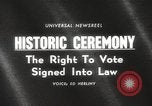
Signing of the National Voting Rights Act of 1965 in the United States.
The National Voting Rights Act of 1965 is enacted into law in the United States. The exterior of the Capitol building. Cars parked along the sides of the street in front of the building. U.S. President Lyndon Baines Johnson addressing audience gathered in the Capitol. People seated on chairs. The President speaks about the voting rights act. People applauding. American civil rights leader Martin Luther King Jr standing with the other officials and civil rights leaders such as Roy Wilkins, James Farmer, and John Lewis, as President Johnson signs the Voting Rights Act in the President's Chamber of the Capitol.
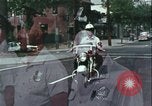
A policeman pulls over driver of 1965 Chevy Nova station wagon
Policeman driving motorcycle along Route 1 South in Washington, D.C. Black 1965 Chevy Nova station wagon running stop sign to merge onto Rt. 1 South. Motorcycle passes Hecht Company truck before siren is turned on to catch stop sign runner. 1965 Chevy Nova station wagon pulling over to side of the road. Annoyed motorist checks his wristwatch. Police on motorcycle approaching as seen in car rear view mirror. A slice of burned toast is tossed at a man who is seated, eating breakfast. He is holding and reading a newspaper while eating. Man makes a disappointed face after drinking bad coffee. Man hurriedly leaving for work after checking his watch and grabbing his newspaper and cigarettes. Black 1965 Chevy Nova station wagon waiting at railroad crossing. Traffic jam in Washington, D.C. street with many cars waiting to move, including a Volkswagen Beetle and other 1960s vehicles. The man huffs in frustration as he looks out car window at bank's outdoor temperature display sign reading 92 degrees fahrenheit. Driver giving license to policeman. Police officer giving license back to driver and explaining the citation, before holding up traffic to allow driver of 1965 Chevy Nova station wagon to re-enter traffic. View of vehicle's 1967 Virginia license plate 235-560.
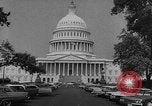
Voting Rights Act signed in U.S. Capitol by President Lyndon B Johnson, with leaders present including Martin Luther King Jr.
The signing of the Voting Rights Act of 1965 in a ceremony in the President's Room near the Senate Chambers in the U.S. Capitol, in Washington DC. President Lyndon B. Johnson talks to other Senators and Congressmen during the signing of the Voting Rights Act. Wider view of other attendees at the signing, including John Lewis in background and other civil rights leaders. A leader whispers in the ear of Martin Luther King Jr., in foreground.
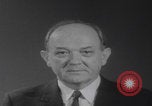
President Johnson addresses the public at a news conference about the Vietnam War
President Lyndon B. Johnson addresses the United States public at a White House news conference about the Vietnam War on July 28, 1965. “We do not seek the destruction of any government, nor do we covet a foot of any territory. But we insist and we will always insist that the people of South Vietnam shall have the right of choice, the right to shape their own destiny in free elections in the South or throughout all Viet-Nam under international supervision, and they shall not have any government imposed upon them by force and terror so long as we can prevent it… We do not want an expanding struggle with consequences that no one can perceive, nor will we bluster or bully or flaunt our power, but we will not surrender and we will not retreat,” says President Johnson,
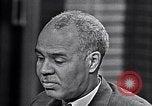
Leroy Collins answers question asked by anchor on Anniversary of Civil Rights Act bill in Washington DC.
Anchor with American civil rights leaders. Anchor seen with Leroy Collins, Former Governor of Florida, and Roy Wilkins, NAACP executive secretary. Anchor asks a question to Leroy Collins and he answers.
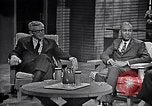
Sterling Tucker answers question during recording of a program on Civil Rights Anniversary in Washington DC.
Anchor asks questions to Sterling Tucker, Washington Director of National Urban League, during recording of a program on Civil Rights Anniversary in Washington DC. Mr. Tucker answers him.