


 Francais
 Deutsch
 Italiano

Refine Your Search
+"Yugoslavia" +1944 stock footage and images
- Showing 7 to 12 of 27 results more
 Hide
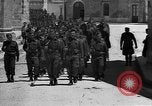
Josip Broz Tito's Partisans at the living quarters in Yugoslavia (WW2)
Josip Broz Tito's Partisans march in Yugoslavia during World War II. Buildings in the background. Partisans in the Partisans' living quarters. Men stand in chow line. Men take their meal. Several men seated in a room. Partisans rest. United States flag, British flag, Russian flag and Yugoslavia flag in view. Pictures of Winston Churchill, Franklin Roosevelt, Joseph Stalin and Josip Broz Tito in the living quarters. A man writes a letter. Two men read war bulletin.

Josip Broz Tito's female Partisans march and Partisans indulge in recreational activities, Yugoslavia (WW2)
Josip Broz Tito's Partisans in Yugoslavia during World War II. Two female Partisans walk down the stairs in Yugoslavia. Partisan women in uniforms hold hands of two children. The Partisans sit with the children on the stairs. Partisan woman smiles with a young boy. A young girl hugging a boy. Yugoslav Partisan women march on the road. Partisan girls assume prone position in front of automatic rifles on lookout. Partisans indulge in recreational activities. Yugoslav Partisans participate in a folk dance. Partisans sing and a man plays accordion.
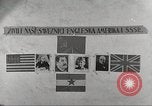
Yugoslav Partisans read and rest in a building in Yugoslavia during World War II.
The Yugoslav Partisans in Yugoslavia during World War 2. Pictures of Allied leaders and Allied flags. The flag of the United States and a picture of U.S. President Franklin D. Roosevelt. The British flag and a picture of British Prime Minister Winston Churchill. The flag of the Soviet Union and a picture of Soviet Premier Joseph Stalin. The flag of Yugoslavia and a picture of Marshal Josip Broz Tito. Partisans read and rest inside a building.
Marshal Josip Broz Tito at his mountain headquarters near Drvar, Bosnia.Yugoslavia. Tito's troops training in Italy during World War II
Note: This film was shown during World War 2 and edited for security reasons. Accordingly, some narrated statements are incorrect or misleading, and should be disregarded. Film opens showing a sentry posted at Yugoslav Partisan Leader Marshal Josip Broz Tito's mountain headquarters in Drvar, Western Bosnia, Yugoslavia. Marshal Tito steps from his headquarters to a lower porch where he stands with American OSS Officer, American Army Major Linn M. Farish, American Liaison to the Partisans, and British Brigadier General Fitzroy Maclean, Winston Churchill's special envoy to the Yugoslav leader. (For security reasons, they are identified as war correspondents.) Scene shifts to the town of Drvar that has experienced several periods of German occupation. Local people go about their daily activities and some pose for the camera. Women are seen salvaging silk from Allied parachutes, that they have spread out on the ground. It will be used as bandages for their Partisan army. View from above of a number of Partisan fighters gathering before the camera. One, a woman with dark hair wearing a black coat, is identified by the narrator, as a 21-year old Montenegrin who left school to join the Partisans. Closeup of that woman conversing with uniformed women soldiers. Next, a loose column of Partisan fighters is seen marching slowly through the town of Drvar. Scene shifts to a large formation of marching Yugoslav Partisan soldiers, who are training in Italy. They are seen standing if formation in a field, under Marshal Tito's command. He orders their officers forward and exchanges salutes with them. Marshal Tito then inspects the ranks. Women soldiers are seen conversing with Tito. He converses with his Chief of Staff, General Koča Popović. Closeup of a smiling woman Partisan fighter. Closeup of a soldier with a notable white moustache. Closeup of two uniformed women with Red Cross armbands. The Partisan soldiers marching across the field with shouldered arms. Film closes with closeup of Marshal Tito in front of his headquarters.
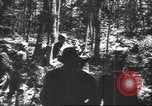
Yugoslav partisans battle against German troops in Nazi occupied areas of Yugoslavia during World War II.
Anti-German Partisan resistance in Nazi occupied areas of Yugoslavia during World War II. Partisans martial their forces in the wooded hills. Partisans fire guns at Italians in a ravine. Dead Italian soldiers. An Axis convoy of trucks under attack by partisans in hills above. Axis troops patrol in a Yugoslav village backyard. A poster offering an award for capture of Partisan leader. Pictures show hanging of Yugoslav Partisans and their execution by Nazi German firing squads. Yugoslav Partisans receive arms on a mountainside. Contingent of uniformed Partisans (including several women) march with arms. Partisans setting up explosives. Detonated explosives. Partisans charge from hilltops. Dead German soldiers. Partisans returning to their villages from the hills. More war dead. Uniformed partisans march into a village. Partisans firing field artillery at German positions. Adolf Hitler shakes hands with Ante Pavelic, head of Croatia. Germans launch an offensive against partisans, whose families flee further into the mountainous and forested regions of the country.

Marshal Tito with allied war correspondents in Yugoslavia; Partisan soldiers training and marching (WW2)
A Yugoslav soldier guarding. Marshal Josip Broz Tito, leader of the Yugoslav Partisans, with first Allied war correspondents to reach his headquarters in an undisclosed hiding location in Yugoslavia during World War II. Civilian people (mostly women and children) on roads in town of Drvar, which changed hands six times during fighting between Axis forces and Partisans. A horse pulled wagon; People with their cattle. Yugoslavian children sitting. Women cutting up silk from Allied supply parachutes, for use in creating bandages for Partisan soldiers. Group of women soldiers and men soldiers of Partisan forces, many of whom were students before the war. Partisan soldiers marching on roads and scenes of large columns of Partisan soldiers drilling and training in Italy for the war effort. Close-up views of faces of Partisan soldiers, both men and women. Marshal Tito standing.