


 Francais
 Deutsch
 Italiano
Refine Your Search
"Bethlehem Pennsylvania USA" 1918 stock footage and images
- Showing 73 to 78 of 1835 results more
more Hide
Hide
Railroad train carrying Marshal Ferdinand Foch to Compiegne, France for signing of Armistice ending World War I.
Views of the Chateau of Franc-port located close to the forest at Rethondes, near the town of Compiègne, where the German delegation was lodged during the World War 1armistice negotiations. On November 8, 1918, a steam locomotive pulls Marshal Foch's train through the railroad station in Compiègne, on the way to the armistice negotiations. Later, on November 11, 1918, after the Armistice is signed, the train is seen as it returns and slows to a stop at the station, in Compiègne. The train bears the name: " Compagnie Internationale Des Wagon-Lits Et Des Grands Express Europeens." Several cars of the train are seen close up, including the voiture-restaurant and dining car number 2419 D, in which the armistice was actually signed. Several French soldiers are seen inside the train, and looking out its windows. A large group of French troops pose and celebrate in front of the train, parked in the station.
American Expeditionary Forces (A.E.F.), 42nd Infantry Division, on maneuvers in France during World War I
American Expeditionary Forces, 42nd Infantry Division (Rainbow Division) in France during World War 1. At Glonville, on May 8, 1918, Captain D. L. Smith talks over a field phone while directing artillery fire. Another soldier stands behind him. Captain D. L. Smith and Major Curtis G. Reddon converse over the field telephone. An officer smokes standing under a tree. Troops walk along a road in the background. On May 9, 1918, In Baccarat, France, U.S. Army Major General Charles T. Menoher, Brigadier General M. J. Lenihan, U.S. Army Colonel Douglas MacArthur and staff officers confer in a field.
American Expeditionary Forces(A.E.F.) 42nd (Rainbow Division) bury their fallen at Baccarat, France, in World War I
A cortege of U.S. Army trucks, covered with American flags and laden with flag-covered coffins of American soldiers,who fell in combat on May 27th, 1918,proceeds through the streets of Baccarat, France, in World War 1. U.S. soldiers of the 42nd Infantry Division march as escorts, beside the trucks. Local citizens observe from the sides of the road. Scene shifts to Memorial Day (May 30, 1918), when U.S. Army Major General Charles T. Menoher and U.S. Army Colonel Douglas MacArthur,of the 42nd Infantry Division, are joined by French Generals Dupont and Penet, in decorating the graves of fallen American soldiers, during a ceremony at a rugged battlefield cemetery containing new graves marked by wooden crosses. A little French girl places a bouquet (reportedly made by Major General Menoher) upon the grave of an American soldier.She is accompanied by other French children who also place bouquets on the graves. An honor guard of American soldiers fires a salute. Scene shifts to a gathering of American soldiers at their base in Baccarat, where they surround a small outdoor stage, to watch a Miss Hart, of the YMCA theatrical Corps dance the Higland Fling. She is dressed in traditional costume of Scotland and accompanied by a violinist. A group of Army musicians, seated close to the stage, watch the performance along with the rest of the troops.
A mix of submarines from World War I to 1925
Sequence 1; The launching of the USS V-1 (later Barracuda SS-163) on July 17, 1924 from the Portsmouth Naval Shipyard in Kittery, Maine. Sequence 2; Two surrendered German U-Boats, most likely the U-117 (L) and the UB-148 (R) circa 1918/19. Sequence 3; The USS S-19 circa 1925 either looking to moor or pulling away to sea. Sequence 4; U.S. "L" class submarines ay Bantry Bay, Queenstown, Ireland circa 1918 World War 1, American submarines had to place an "A" before there name to avoid confusion with the British "L" class submarines. L to R are L-11 (bow), L-1, L-10, L-4 and L-9.

Charles Lindbergh takes off from Roosevelt Field for his famous solo flight from New York to Paris.
People gathered early on a misty morning at Roosevelt Field, Long Island, New York, to watch as Charles Lindbergh attempts to make a solo flight across the Atlantic Ocean in his airplane, The Spirit of St. Louis. The plane starts its takeoff role between groups of spectators, raising dust. The spectators move to get a better view as the plane continues, out of sight in the fog and mist. It is not clear where the plane is, although engine sound has changed. Spectators strain to see it through the mist. Then, some cheers are raised when the crowd realizes that Lindbergh has successfully taken off in his heavily laden airplane. The opening caption refers to Curtiss Field, where the Spirit of St. Louis was test flown and reportedly maintained in Hanger 16. there, from May 12th through the 20th. However, for the Paris flight, the plane was towed a mile to Roosevelt Field where, heavily loaded with fuel, it could take advantage of the longer runway for takeoff. (Note: Both fields were originally part of the old Hempstead Plains Field renamed Hazlehurst Field when taken over by the U.S. Army in 1917. U.S. Geological survey maps of 1918 show three areas named, respectively, Hazelhurst Aviation Field No. 1; Aviation Field No. 2; and Camp Albert L. Mills, abutting it. Field No. 2 was renamed Mitchel Field on July 16, 1918. The eastern part of Field No. 1 was dedicated as Roosevelt Field, on September 24, 1918. After the war, the western part of Field No. 1 became known as Curtiss Field, associated, as it was, with the Curtiss Aeroplane & Motor Company located there.)
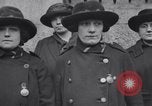
Women join ranks of police reserves in New York City, during World War I.
Closeup of women in the New York City Police reserve, during World War 1. They stand outside the 23rd Police Precinct ("Tenderloin") Station House on West 30th Street, Manhattan, New York City. Their uniforms include round-brimmed hats and overcoats, and they have round badges topped with eagles, pinned to their coats. Next, about 15 are seen, walking two abreast. All wear white gloves and badges, but otherwise, their uniforms are not identical. One supervisor woman walks beside the group, wearing a slightly different badge. Walking casually, a short distance behind the group is a woman (probably Mary Noonan) in the uniform of a captain (with "railroad tracks" insignia on her collar). Scene shifts to a street filled with a traffic mix of horse-drawn and motor vehicles, all staying fairly clear of trolley tracks visible in the center of the road. A police reserve woman stands in the center of the street, directing traffic. Next, a large group of school children is seen standing on a street corner, accompanied by a woman police officer. They begin to cross the street under the watchful eye of another woman reserve police officer, directing traffic in the street. Some adults cross behind the children. (Note: On May 9, 1918, the New York City Police Department announced formation of a new Police Reserve, that would include a women's contingent. This was the idea of Special Deputy Commissioner Rodman Wanamaker, who reasoned, since New York women had received the vote, on November 6th 1917, they should have a role in enforcing the laws. Over 3,000 women were recruited. Their Captain was Mary Noonan. Their duties did not involve direct dealings with criminals. According to the New York Times of May 10, 1918, "If need arose for use of the nightstick or other instrument for curbing crime,the work would be referred to the men members of the force.")