


 Francais
 Deutsch
 Italiano
Refine Your Search
"Bethlehem Pennsylvania USA" 1918 stock footage and images
- Showing 79 to 84 of 1835 results more
more Hide
Hide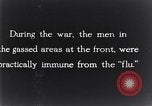
Chemists experiment with chlorine gas for influenza immunizations at Chemical Warfare Service in the United States.
Experiments with chlorine gas for influenza immunizations in United States. A World War I tank sprays gas in a field. View of American soldiers during 1917 to 1918 period of World War I, in a trench, wearing gas masks, and firing rifles at enemy positions. Post war tests on use of Chlorine gas to control the flu (emerging from 1918 Spanish Flu epidemic), inspired by low rate of influenza among United States soldiers exposed to chlorine gas during the war. Man enters a chlorine chamber at the Chemical Warfare Service. A chart on the wall showing results on symptoms after exposure in chlorine chamber. A woman in 1920s hat carrying a tissue is treated with chlorine gas. A testing apparatus on a table. Group of patients sit together in a chlorine chamber being exposed to the chlorine gas. A business man in a suit receives a portable chlorine gas treatment in his office as he is too busy to visit the chlorine chamber.
U.S. soldiers decontaminate combat vehicles and tanks during training; also flashback WW1 mustard gas aftermath scenes
World War 2 training film teaching U.S. soldiers about decontamination of combat vehicles, at Aberdeen Proving Grounds in Maryland. Soldiers during a decontamination procedure with real mustard gas. The soldiers in armored vehicles. A group of soldiers prepares for the decontamination. An aircraft flying at low height. A stationary U.S. Army Pershing tank. Two soldiers in a jeep. Soldiers wearing gas masks decontaminate a vehicle. Flashback scenes to August 1918 in World War I in France, with many mustard gas attack victims being cared for at a field hospital (which narrator says is Field Hospital number 326). Medic washing eyes and face of a World War 1 gas attack victim. Next view is a soldier in 1942 with mustard gas burns on his hand, being treated by a medic. Next scene returns to World War 1 in 1918, showing mustard gas burns on arms, hands, legs, and feet of U.S. Army soldiers.
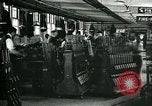
World War I United States arms factory
A U.S. arms manufacturing in World War 1. Hundreds of war production workers seen at shift change, waiting for their respective trolley cars passing on tracks between arms manufacturing plant's buildings. Women at work on metal working machines in an arms factory. Racks of Browning Automatic Rifles (Rifle, Caliber .30, Automatic, Browning, M1918) are being moved about. Assemblers are seen hand fitting parts for the Browning M1917 water cooled machine gun. One man makes final assembly adjustments to one of the machine guns set up on tripod in the factory. He enjoys firing the Browning M1917 machine gun. (Note:The M1917 and M1918 BAR were manufactured by numerous American arms makers. Colt, Remington, Marlin, Royal typewriter, Winchester. Most of the M1917 machine guns were manufactured by New England Westinghouse.)
Free French vehicles moving, damaged buildings, a WW1 Memorial in La Haye Du Puits (WW2)
French troops passing through La Haye Du Puits, Normandy during World War 2. M3 half-tracks pass by ruins of buildings. Army trucks park near a World War 1 memorial used as a motor pool. Two tricolor Free France flags in the World War 1 memorial. An M3 half-track driving, with the Église Saint-Jean showing its damage (Place Patton, 50250 La Haye, France) in the background. French soldiers in trucks pass by a street with shops with signs “CITROEN”, “E. DE SAINT-GERMAIN” and “X GRANDES MARQUES”. Storefronts are damaged from bombing. Tricolor French flags in the street. A close view of a World War 1 Memorial with inscriptions “LA-HAYE-DU-PUITS A SES GLOREAUX MORTS 1914-1918” (“LA-HAYE-DU-PUITS TO ITS GLORIOUS DEAD 1914-1918” in English).
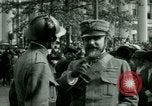
Italian Alpini and Bersaglieri visit the White House.
5 October 1918: Elite Italian Alpini (Alpines) troops and Bersaglieri (Marksmen) on a visit to meet with President Wilson at the White House. Italian General Guglielmotti gives orders to Bersagliere Captain Sani. A crowd outside the White House. Italian Grenatieri (Grenadiers) marching band proceeds into the White House building. Alpini follow them carrying Alpine sticks along with their regular equipment. Bersaglieri marching away from the White House at the end of their visit. (World War i; World War 1; WWI; WW1)

Camouflaged artillery bombard Cantigny, France and U.S. Marines in a trench in Belleau Wood during the Marne Operation.
Chateau Thierry and the Aisne Marne Operation in France. U.S. Army shells Cantigny. The soldiers near the artillery. Camouflaged artillery bombards Cantigny. U.S. troops load shells in the artillery and fire. Smoke comes out of the artillery after firing. Destroyed building. Trucks loaded with U.S. troops. The troops ride forward in trucks. Ruins in Chateau Thierry. U.S. Marines in a trench in Belleau Wood. The soldiers eat food and stand in a group. (May 28-30, 1918 Battle of Cantigny) (World War I. World War 1. WWI. WW1)