


 Francais
 Deutsch
 Italiano
Refine Your Search
"Bethlehem Pennsylvania USA" 1918 stock footage and images
- Showing 181 to 186 of 1835 results more
more Hide
Hide
155mm artillery (Howitzer & Gun) of U.S. Army firing on targets from bushes in Italy.
U.S. Army 155mm artillery guns hidden in bushes and firing in Italy. Camouflaged muzzle of guns seen firing. Smoke rises from the top of the hills and other targets. Seen are both M1917/M1918 155-mm Howitzer (Schneider) and M1/M2 Gun (Long Tom). (World War II period).
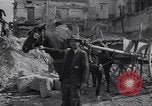
People cleaning up the debris and rubble from the bombed city of Avellino in Italy
Men working in ruins of bombed out city of Avellino, Italy. Men with various equipment cleaning up the remains and debris of wrecked buildings. People working in ruins, people gather at the public square, several people moving on carts, bicycles and signs on the wrecked buildings seen in background, including "Germania 1918" and "Plaza Centrale" on the Red Cross building. Sign of 'Danger Unexploded Bomb' is planted in the rubble. (World War II period).
Governor of Puerto Rico Horace M Towner, Colonel George H. Estes, and other officials welcome Charles Lindbergh in San Juan.
Aviator Charles Lindbergh visits San Juan, Puerto Rico. A huge crowd awaits his arrival at an air field. Lindbergh's plane 'Spirit of Saint Louis' lands and taxis. Men move towards the plane as it comes to a halt. Closeup of the 'Spirit of Saint Louis'. Several officials stand near the airplane as Lindbergh prepares to leave the cockpit. Among them is George H. Estes, Jr., Commander of U.S. Troops in Puerto Rico. ( He held rank of Brigadier General, in 1918, but now wears peacetime rank insignia of Colonel.) Others greeting Lindbergh include Puerto Rican government officials and civilians, who watch as Lindbergh climbs out of the cockpit. Lindbergh poses with Governor of Puerto Rico, Horace M Towner, and other officials.
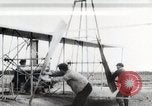
First joint flight by Wright Brothers in 1910 near Dayton Ohio. Also scenes from other "firsts" in early aviation history up until 1919.
Wright brothers' first aircraft flight together near Dayton Ohio in 1910. Wilbur Wright is in the pilot's seat with Orville Wright as passenger to his right. (Until this flight, the Wrights had never flown together so that if one of them was killed, the other could continue their work.) Next, a view of Alberto Santos-Dumont, and the first European flight made by him on 13 September 1909. Following segment shows crowds gathered at Washington DC Polo field as truck arrives carrying mail to be loaded on the first U.S. Air mail flight, May 15, 1918. Army pilot, Lieutenant Webb, in his JN-4H airplane, on Southbound flight from New York, takes off from Philadelphia, where he stopped to pick up more mail. He flies over the Washington Polo Field upon arrival. We see his airplane being unloaded as he jumps down from cockpit and crowds watch. Views of first transatlantic flight begins with takeoff of three out of four existing United States Navy Curtiss flying boat aircraft from Newfoundland, on May 16, 1919. Curtiss flying boats NC-1, NC-3, NC-4 are seen at takeoff from Newfoundland on first leg of the transatlantic journey. Flying Boat NC-4 is also seen at one of its foreign ports, though which is unclear (Azores, Lisbon, or England).
World War 2 film promoting public investment in War Bonds and stamps to aid the war effort and temper inflation
World War 2 era film that also includes some World War 1 scenes. Show girls or chorus girls in follies-like show, costumed as U.S. silver dollars and marching to tune and lyrics alluding to dramatic increase of currency in circulation, over the years. Animation with stacks of coins shows increase in national income from $46 billion,in 1933, to $71 billion, in 1939, and $142 billion in 1943. Back to the "follies dollars," a boy asks why, and then scenes of the Japanese attack on Pearl Harbor,are shown, with U.S. battleships being sunk. Wartime arms plants are shown. An M2A3 Light Tank rolls off a production line. Ships being constructed in a shipyard. B-24 Liberator bombers being built in a factory. Artillery shells being produced. Defense workers receiving their pay. The "follies dollars" group themselves to illustrate the fractions of income devoted to taxes and savings. But other spending is curtailed by wartime shortages. A woman talking with clerk in a drug store. U.S. Army troops crossing a pontoon bridge in open trucks, towing 75mm M1A1 howitzers. Infantry on the march. Animation showing industrial production devoted to war materiel and lots of dollars chasing few civilian goods. A grocery clerk offers to sell a woman customer butter for more than the established price, and she agrees. The "follies" performers then introduce the idea of an "inflationary dollar," and some history of past U.S. inflations. Animated examples of price inflation are shown. Glimpses of World War I scenes are seen, circa 1917 -1918, including: a 12-inch railway gun firing; a huge explosion from shell bursting near the camera; various scenes of United States infantry soldiers and French soldiers in battle action, running to bomb craters for cover and emerging from trenches to go up "over the top" into no-mans land during combat. Meanwhile, singing narration refers to the home front inflation due to competition for limited civilian goods. Map shows Europe and singing narration cites rising prices for food in occupied France and other countries suffering ravages of World War II. Montage of scenes showing needy civilians obtaining food in those countries. Animation shows increases, by 1944, in cost of U.S. civilian goods since the Pearl Harbor attack. "Follies" character called "Double-duty dollar," appears explaining he serves the war and curtails inflation on the home front by being saved through investments in War Bonds and stamps.
Condensed history of Germany from World War I through the rise of Hitler and the 3rd Reich.
A condensed history of Germany from the first World War through the rise of Hitler and the 3rd Reich, prior to World War II. From the Nazi German perspective, 'Sieg Im Westen' depicts German activities during and after World War 1. German troops take an oath of allegiance to Adolf Hitler. The Alpine landscapes, the Rhine and the Cologne Cathedral. An animation of the German frontiers in Bismarck's time. Interior and exterior scenes of the Ruhr industrial area. View of the Hamburg Harbor. Two German soldiers in Prewar uniforms on honor duty as sentries. A German prewar naval vessel or navy ship. An animation of the extent of World War I fighting beyond German borders and ending with the presentation of situation on November 9th , 1918. Scenes of World War I fighting, with many explosions and dirt flying upward on battlefields in World War I, and view of German soldiers in trench carefully looking out towards "no man's land". An animation of World War I fighting. Paul Von Hindenburg, a German General and his deputy, General Erich Friedrich Wilhelm Ludendorff, at a headquarters. Signatures in the Versailles Treaty. An animation depicts the creation of the Polish Corridor. Demilitarization and disarmament activities of German factory areas. World War I German fighter planes are dismantled and wrecked. Labor strike riots and communist rebellion in Berlin with fights in front of the Brandenburg Gate. French occupation of Ruhr area. German postwar hyperinflation. German workers getting books stamped at a payroll office. Hyperinflation demonstrated with various German monetary notes growing in face value, superimposed on a spinning roulette wheel. Types of German inflation money during post-war collapse of economy in Germany. Adolf Hitler addressing a crowd. Storm troopers in regimental parade formations.