


 Francais
 Deutsch
 Italiano
Refine Your Search
-Cebu,-Philippines stock footage and images
- Showing 11521 to 11526 of 58885 results more
more Hide
Hide
Officials speak on the issues of human rights and religious freedom as interest groups protest in the Soviet Union and the U.S.
The US-USSR Moscow Summit on Human rights in Moscow, Soviet Union. U.S. president Ronald Reagan speaks on issues relating to Human rights, and on Soviet shortcomings in adhering to the Helsinki Accords. Other officials seated in front. He speaks about various human rights, including the right to emigrate and travel. View of the Kremlin in Moscow and of Soviet pedestrians walking in city. U.S. Secretory of State George Pratt Shultz speaks about strategic arms reductions in light of the weapons race. The White house press secretary Marlin Fitzwater at a press conference. The board reads 'Department of State'. Exteriors of the building. View of protesters permitted to demonstrate in the Soviet Union indicating some improvement in conditions. In Washington DC, citizens march on streets demonstrating for the freedom of Soviet Jews. The soviet scholar Peter Reddaway speaks about the reforms and highlights reforms and changing Soviet policy on open-ended internment of mental health patients. People pray inside a church in the Soviet Union. George Weigel, the president of the James Madison Foundation, speaks of importance of religious freedom in the Soviet union on a news panel. Weigel states that religious freedom is a key test of Glasnost and Perestroika. Exterior view of the Ukrainian Catholic National Shrine of the Holy Family under construction in Washington DC, built by Ukrainian American Catholics. People in the Soviet Union protest, marching on a street and holding signs and pickets. A large military parade in the Soviet Union in Red Square.
U.S. President Ronald Reagan delivers a New Year's greeting to the people of the Soviet Union
American President Ronald Reagan is seen in the the Roosevelt Room of the White House in Washington, DC, from where He delivers a New Year's greeting to the people of the Soviet Union. He is seated in front of a fireplace mantle decorated with holly. A large poinsettia plant sits in front of the fireplace. The American flag is displayed to his right. The President describes the ways typical American families celebrate Christmas, Hanukkah, and the New Year. He mentions the U.S.Presidential election scheduled for next year (1988). Reagan notes that he and General Secretary Gorbachev signed the Intermediate Nuclear Forces Treaty, last month and hope to meet again, in a few months, in Moscow. He alludes to Soviet and American representatives in Geneva discussing a 50 percent reduction in strategic nuclear weapons suggests they may have a treaty ready to sign in Spring. President Reagan notes that America and the Soviet Union have the opportunity to develop a defensive shield against ballistic missiles (also called SDI or Star Wars), and that the U.S. intends to pursue the possibility that technology offers. In other matters, the President speaks of expanding contacts and communications between our two countries. He mentions Human rights and human dignity. He expresses concern about senseless conflicts in a number of regions. He closes by wishing the Soviet people a Happy New Year. (Note: President Reagan's message was recorded on December 23, 1987, in the White House and broadcast on January 1, 1988.)
General Secretary Gorbachev of the Soviet Union extends New Year greetings to people of the United States.
Opening scene shows closeup of a large illuminated Red Star displayed during New Year holidays atop Nikolskaya Tower in the Kremlin. It is seen again, from Red Square, along with Kremlin wall. A light snow covers evergreen trees in foreground. The General Secretary of the communist party of Soviet Union Mikhail Sergeyevich Gorbachev speaks on world net telecast in Moscow, Soviet Union. He begins his remarks by saying: "Ladies and gentleman, friends, as we celebrate the New Year, I am glad to address the citizens of the United States of America and to convey to you season's greetings and best wishes from all Soviet people." He speaks of the improving interactions and relations between "our two peoples." Among other things, he states: "Human life is equally priceless, whether in the Soviet Union, the United States, or in any other country. So, let us spare no effort to affirm peace on Earth. He finishes by saying: "In concluding this New Year address to the people of the United States of America, I wish peace, happiness, and joy to every American family. A happy New Year to all of you."
The damaged aircraft carrier, a destroyer and a sinking ships at Bikini Atoll during Operation Crossroads in Marshall islands.
The damage caused due to an atom bomb test during Operation Crossroads on Bikini Atoll in Micronesian islands, Marshall Islands. An aircraft carrier sinks. Damaged aircraft carrier. Damage caused to Bikini atoll. A damaged destroyer. Some of the damage of the destroyer. Aircraft on the carrier and water being sprayed on it. A destroyer and the fire fighting equipment in operation. Aircraft carrier tilting on one side. Aircraft carrier sinks.
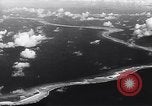
Atomic bomb explosion as seen from distances during Operation Crossroads at Bikini Atoll in Marshall islands.
The damage caused due to an atomic bomb test during Operation Crossroads at Bikini Atoll in Marshall islands. The Bikini Atoll at zero hour. The atom bomb burst seen from twelve mile distance. A U.S. Air Force B-29 Superfortress in flight in between the atomic cloud carrying a bomb. Several views of the atomic cloud. Atomic bomb explosion views. Another shot of the atomic bomb burst from the distance of seven miles distance.
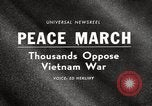
The anti war protests against the United States involvement in the Vietnam War.
Anti-war protests in the United States during the Vietnam War. Protesters march and demonstrate against the United States involvement in the Vietnam War from Central Park to the UN headquarters in New York City. Demonstrators in crowd holding protest signs. A number of African American marchers hold signs that read, "Black men should fight white racism, not Vietnamese freedom fighters." Another sign reads, "They are our brothers whom we kill." Masses of people including doctors, teachers, and businessmen on streets. People dressed in different costumes and 1960s hippie fashion as they protest. Young men participate in burning their draft cards while a crowd gathers around to watch the draft card burning. Pro-war counter protestors (sometimes called "Hawks") also demonstrating and arguing with anti-war activists. Pro-war banner reads, "End Hanoi Sanctuary. Let's bomb Hanoi to win the war and destroy the Communist conspiracy." Another Hawk sign reads, "Anarchy Cannot be Permitted in the USA. Fight Communism and Red Termites." African American civil rights activist Martin Luther King Jr. walks toward the United Nations building with other officials advocating peace. Policemen drag a protester. Scene changes to San Francisco: 50000 people carry banners as they protest the war in Vietnam and march to the Kezar Stadium (670 Kezar Dr, San Francisco, CA 94118, United States) for a mass assembly. People push each other during the protest as pro-war demonstrators clash with anti-war demonstrators and pacifists. A huge crowd gathered at a stadium.
CRITICALPAST.COM: About Us | Contact Us | FAQs - How to Order | License Agreement | My Account | My Lightboxes | Shopping Cart | Advanced Search | Featured Collections | Website Terms & Conditions | Privacy Policy ©2026 CriticalPast LLC.
License Agreement |
Terms & Conditions |
Privacy Policy
©2026 CriticalPast LLC.