


 Francais
 Deutsch
 Italiano
Refine Your Search
-Cebu,-Philippines stock footage and images
- Showing 1267 to 1272 of 58885 results more
more Hide
Hide
U.S. soldiers direct landing helicopters to extract ARVN from Laos, after Operation Lan Son 719
U.S. soldier lights a green smoke signal as U.S. Army Bell UH-1 Iroquois (Huey) helicopters approach the landing zone. U.S. soldiers direct landing UH-1 Iroquois (Huey) helicopters as they arrive to extract ARVN (Army of the Republic of Vietnam) soldiers from area of Route 9, in Laos, after Operation Lam Son 719 during the Vietnam War. Soldiers signal as the choppers land. Soldiers direct South Vietnamese troops into the choppers. Several more UH-1s approach for landing. ARVN soldiers seated in the helicopters as they take off. Soldiers signal the helicopters as they land. ARVN soldiers board numerous helicopters as they land and take off in rapid succession.
ARVN soldiers being evacuated by helicopters after Operation Lam Son 719.
ARVN (Army of the Republic of Vietnam) soldiers assembled for evacuation after Operation Lam Son 719 in Laos during the Vietnam War. South Vietnamese soldiers on a hill top near Route 9. U.S. soldiers signal U.S. Army Bell UH-1 Iroquois (Huey) helicopters for landing. South Vietnamese soldiers hold onto their helmets and board waiting choppers under direction of ARVN officers. U.S. Army crew members assist them in boarding. A Vietnamese officer supervises as a line of soldiers moves along to board the helicopters. Military vehicles at the camp. U.S. soldiers talk to Vietnamese soldiers. ARVN soldiers seated in the UH-1s. U.S. soldiers in protective goggles around the helicopters with rotor blades spinning. Soldiers seated in helicopters as they take off. A military ambulance in the background. A U.S. Army CH-47 Chinook helicopter in flight. A UH-1 on ground. Military jeeps approach the helicopter. The ambulance driven away. An air ambulance helicopter lands on the field. A soldier checks the rotor blades atop the helicopter. U.S. soldiers stand around. Aerial view of the area around Route 9. A convoy moves along Route 9. Tents and military vehicles at the camp. U.S. and ARVN soldiers around stationary choppers. Construction material and dug up patches.
FFTI women leaders Marquis de Chabannes La Palice and Madame AC Staehling interviewed by several men in France.
Women leaders of the French Forces of the Interior (FFI). French women patriots Marquis de Chabannes La Palice and Madame AC Staehling. Both women being interviewed by several men. The women seated at tables. They smoke cigarettes while giving the interview. The interviewers seated around the two women.

Montage of scenes involving military equipment and operations emphasizing signal corps communications
'The Signal Corps Fights' depicts the role and contribution of the U.S. Army Signal Corps in combat and war. Montage of military equipment and combat scenes (some staged). Opens with glimpses of: massed formation of U.S. Army soldiers; similar formation of bombs in a munitions factory; row of P-47 fighter planes parked on an airfield; a huge radar antenna; battery of U.S. 120 mm M1 anti-aircraft guns; troops marching toward the camera; Martin B-26 Marauder aircraft dropping bombs, that explode on the ground; formation of German He 111 bombers in flight; U.S. battery of 120mm anti-aircraft guns firing; gun camera views of U.S. fighter strafing German aircraft on the ground, and attacking a German Messerschmitt bf 109 head-on (The tail is blown off and the pilot bails out at the last instant); fire engulfing some soldiers. Next, a soldier is seen at a large signal corps field telephone switchboard, and other communications switchboards are shown with operators. Momentary glimpse of troops, ostensibly engaged in combat. A soldier communicating from under a camouflage netting, and one holding a rifle and talking in a phone as he strings wire from a spool in his backback. A german soldier ostensibly cutting a U.S. communications cable that he discovers in the field. A U.S. soldier crawling along the line to find and repair the damage, followed by a staged "attack" by the German soldier. They engage in a knife fight. Soviet infantry advancing on the Eastern Front. Soviet T-34 tanks advancing. Soviet soldiers engaged in combat. An unusual U.S. tank with two guns, and side protection over track wheels. M3 Stuart light tanks going down hill with infantry in france during World war 2. Hand of signal corps soldier using a key to send morse code message. Soldier in bunker using field telephone. Signal corps soldiers communicating with field switchboards during combat. Momentary glimpse of German Messerschmitt bf 109 and another aircraft speeding past. Bomb exploding. Huge clouds of black smoke billowing, behind camouflaged German military vehicles parked. Twisted frames of German wrecked vehicles and rail cars. Huge number of German soldiers marshaling to retreat from advancing Allies. German officers conferring.
U.S. Army Signal Corps officers train at Fort Monmouth and production of signal communication items in the United States.
The role and contribution of the U.S. Army Signal Corps in combat and war. U.S. Army Signal Corps officers train at the Signal Corps Officer Candidate School (OCS) Fort Monmouth, New Jersey. Officers train at telegraph machines under the supervision of an instructor. Officers seated at desks in a classroom. Instructors take classes with the help of charts, diagrams and black boards. Officers seated atop electric poles for training. Two officers train in hand-to-hand combat at the OCS. Officers learn to use Radio Relay. Students listen to an instructor as he demonstrates the process. A U.S. soldier lays field wire across a hilly terrain to establish wire communications in the European Theater during World War II. Soldiers on the hill. Soldiers set up a sending station at the point where the wire can't go forward. A receiver is set up at the point from where the wire can go forward again. A soldier receives a photograph of a map through facsimile. Items of signal communication including radio relays, receivers, walkie-talkies, radio boxes and fuses to be produced and distributed by the USA Signal Corps to all other ground forces, navy and the Allies. New, modern, improved efficient signal communication equipment. A soldier displays two old type fuses and their counterparts.
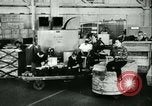
U.S. Army Signal Corps communication material and equipment is produced and distributed in World War II.
The role and contribution of the U.S. Army Signal Corps in combat and war, especially during World War 2. Workers organize and prepare signal communication material and equipment for transportation. Men transfer the items including wooden cartons, cables, signaling units in trolleys. Workers load the material into trucks. Shuttle ships in docks. Signal communication supplies for U.S. and Allied troops in the European Theater loaded onto the ships. The shuttle ships make their way under security in heavy seas. A Nazi U-boat wolf pack in the water during the early stages of World War II. torpedoes launched and U.S. ships are attacked bu the German submarines, smoke due to the explosions. U.S. sailors on board and jumping from burning ships into water.German wolfpack submarine fleet in a harbor. German Kriegsmarine sailors lower German Neger torpedo-carrying craft (sometimes called Human Torpedo) into the water. A U.S. B-25 bomber aircraft in flight locates a German submarine. The radio operator gives the exact location and the submarine is attacked. View from within cockpit as bomb sight is fixed on German submarine target. View of bomb doors open and bombs away from B-25 aircraft. Explosion in water is seen and the submarine is hit. Dramatized scene from inside of submarine as it is rocked by explosion and fills with water.
CRITICALPAST.COM: About Us | Contact Us | FAQs - How to Order | License Agreement | My Account | My Lightboxes | Shopping Cart | Advanced Search | Featured Collections | Website Terms & Conditions | Privacy Policy ©2026 CriticalPast LLC.
License Agreement |
Terms & Conditions |
Privacy Policy
©2026 CriticalPast LLC.