


 Francais
 Deutsch
 Italiano
Refine Your Search
-Cebu,-Philippines stock footage and images
- Showing 1279 to 1284 of 58885 results more
more Hide
Hide
Signal Corps weekly film reports sent to Photographic Center and used in training films for U.S. troops during World War II.
The role and contribution of the U.S. Army Signal Corps in combat and war. Amphibious landings of the first wave of Allied troops including Signal Corps Units in Normandy, France on D Day during World War 2. The Joint Assault Signal Companies (a Signal Corps Unit that accompanies the soldiers on every beach landing) go ashore in Normandy. Soldiers in landing crafts approach the beach. Landing crafts anchored along the shore line. A U.S. flag on the beach. Crafts approach the beach. U.S. Army Signal Corps combat photographers using motion picture cameras to film the battle that ensues on the beach and in the fields. Gun fire and explosions in the battlefield, filmed by combat cameraman. Allied aircraft in flight. Airmen load weekly film reports of the war in all Theaters made by Signal Corps officers from a van into an aircraft. The films are sent to the Photographic Center in New York. A soldier assembles the films. Technicians organize and arrange the films. They place the film reels onto racks. The film content is used to make training and orientation films for the U.S. troops. Troops watch the films in order to cut down the training period, and stay informed about the order of event in other Theaters of Operation. The films include 'Why We Fight' and 'The Fighting Men' series. Clips and recordings from these films.
U.S. soldiers watch a film at a foxhole theater and films made for workers by the Signal Corps during World War II.
The role and contribution of the U.S. Army Signal Corps in combat and war. Army Pictorial Service films including screen magazines and GI movies are delivered to war fronts in all Theaters during World War 2. An officer arrives in a jeep with the films. Officers and soldiers around tents at the base. Soldiers in camouflage rain coats and hats seated at a foxhole theater. The soldiers watch the latest Joan McCraken Broadway hit Bloomer Girl. Scenes from the film. US: Pictures shown to workers depict the use of products manufactured by them at the war fronts. A poster reads 'B-52 Super Bombers, Bell Aircraft'. Men working inside the Bell Aircraft Corporation plant in NY. Huge machinery, equipment and aircraft parts being manufactured. Workers near stands piled with equipment and parts. A foreign version of the films made for Chinese allies. A U.S. officer talks to soldiers. The film dubbed in Chineese.
The U.S. Army Signal Corps Signal Intelligence work during World War II.
The role and contribution of the U.S. Army Signal Corps in combat during World War 2. Soldiers on guard duty in a field. A soldiers talks over a radio receiver at the door of a cabin. An antenna on the cabin roof. Signal Officers intercept enemy transmission by the mean of radio and other electric equipment. Electrical equipment, radios, deciphering equipment, laboratory equipment and parts seen at work in Signal Corps facilities where intercepted enemy communications are analyzed and codes and ciphers are deciphered. Officers skilled in encryption and decryption work to decode enemy codes and messages. They use a microscope to read and write messages in microscopic writing on grains of rice. Signal Intelligence work in North Africa during World War 2. U.S. soldiers on tanks advance over rough terrain. A formation of U.S. B-17 bomber aircraft in flight. Tanks advance with the ground forces. The radio intercept picked up messages from a certain German Division headquarters. A soldier sets radio direction finders on the particular location. Officers receive the information and locate the headquarters on a map. The Allied troops attack the enemy. They hit them with tracers. Artillery and guns are fired. Smoke from fire due to explosions. Soldiers advance in prone positions. They lie low during the night assaults. German soldiers load and fire a mortar. Explosions in a field due to mortar attack. Dead U.S. soldiers and injured U.S. soldiers in foxholes and on the battlefield following mortar attacks. U.S. soldiers help a fellow wounded soldier in a jungle setting.
Army Signal Corps receive and send messages via various methods in World War II; Pentagon signal center operations.
The role and contribution of the U.S. Army Signal Corps in combat during World War 2. Submarine cables laid down by the Signal Corps. Soldiers operate field army communication equipment for communication within and between units. Soldiers talk over the radio in a military jeep. American soldiers employ communication equipment seated at a table in a camp. A U.S. Army Signal Officer goes through documents. An officer receives a message in Washington DC. The message is relayed from the State Department to the Signal Center in the Pentagon building. Exterior views of the Pentagon building circa 1943 or 1944. Inside the Army Communications Signal Center in the Pentagon, technicians work using various communication equipment. They receive messages punched on tape as the tapes emerge from machines. Workers encoding and decoding secret and confidential messages that run the war. Workers at the 'Traffic Control, Army Command and Administrative System'. Paper messages seen gliding across a track near the ceiling above a signboard. A man inserts and removes cables from switchboard slots. The plans are then passed on in code through a maze of antennas all over the world. An animated map depicts the sending of these messages by radio multi-channels, radio teletypes, and manual radios to the front lines. A vast network of Army communication system from Washington DC to the rest of the world to carry a message around the world in three and a half minutes.
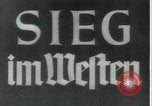
Germany under Paul Von Hindenburg during World War I and Adolf Hitler during World War II.
'Sieg im Westen' (Victory in the West) depicts Germany in World War I, and the first phase of German assault on France and the Low Countries during World War II. German troops swear loyalty to Nazi German Fuhrer Adolf Hitler. Panoramic views of the German countryside. Mountains, farmers harvesting crops, German cities, a cathedral, steel mills and coal mines. German troops reviewed at a colonial post. German troops advance during World War I. German President Paul Von Hindenburg and Generalquartiermeister (Quartermaster general) Erich Ludendorff. Animated maps depict powers allied with and arrayed against Germany in WW I, the extent of German advances, and the effect of the Versailles Treaty on Germany's borders. Forts are demolished, cannon and hangars destroyed, ships scuttled, and planes junked. German communists arouse crowds. Communist literature, montage demonstrates hyperinflation during the Weimar Republic. Inflated price posted on food. German Fuhrer Adolf Hitler reviews storm troops. Paul Von Hindenburg reviews German troops. German troops train with wooden tanks. French Prime Minister Andre Leon Blum and other officers review a military parade at Champ-Elysees in Paris. Troops march before the Arc de Triomphe. Paul Von Hindenburg appoints Adolf Hitler Reich chancellor. Hitler spades some earth, men build factories, war material production begins during rearmament of Germany, and concrete is laid for an autobahn (freeway).
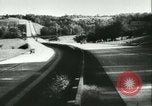
British Expeditionary Force troops mobilize in England while Adolf Hitler is greeted by thousands as he rides through Vienna.
The first phase of German assault on France and the Low Countries during World War II. Vehicles move on an autobahn (freeway). In England: British troops parade and drill. British recruits in civilian clothing are seen with baggage as they join military during recruitment for war effort. German Fuhrer Adolf Hitler reviews German troops. War materiel rolls from German factories, including views of artillery, tanks, and aircraft for German war effort rolling off of production lines. Hitler rides through Vienna Austria and across the Czechoslovakian border. Large group of people gathered on the streets greet him and give the Nazi salute. Hitler in his car as it makes its way across the border. Soldiers give the Nazi salute.
CRITICALPAST.COM: About Us | Contact Us | FAQs - How to Order | License Agreement | My Account | My Lightboxes | Shopping Cart | Advanced Search | Featured Collections | Website Terms & Conditions | Privacy Policy ©2026 CriticalPast LLC.
License Agreement |
Terms & Conditions |
Privacy Policy
©2026 CriticalPast LLC.